Smart Ring vs Fitness Watch for Workout and Recovery Tracking: Which Is Better?
Compare a smart ring vs fitness watch for workout and recovery tracking. Learn the differences in heart rate monitoring, sleep tracking, exercise features, comfort, battery life, and everyday use to choose the right wearable for your fitness goals.
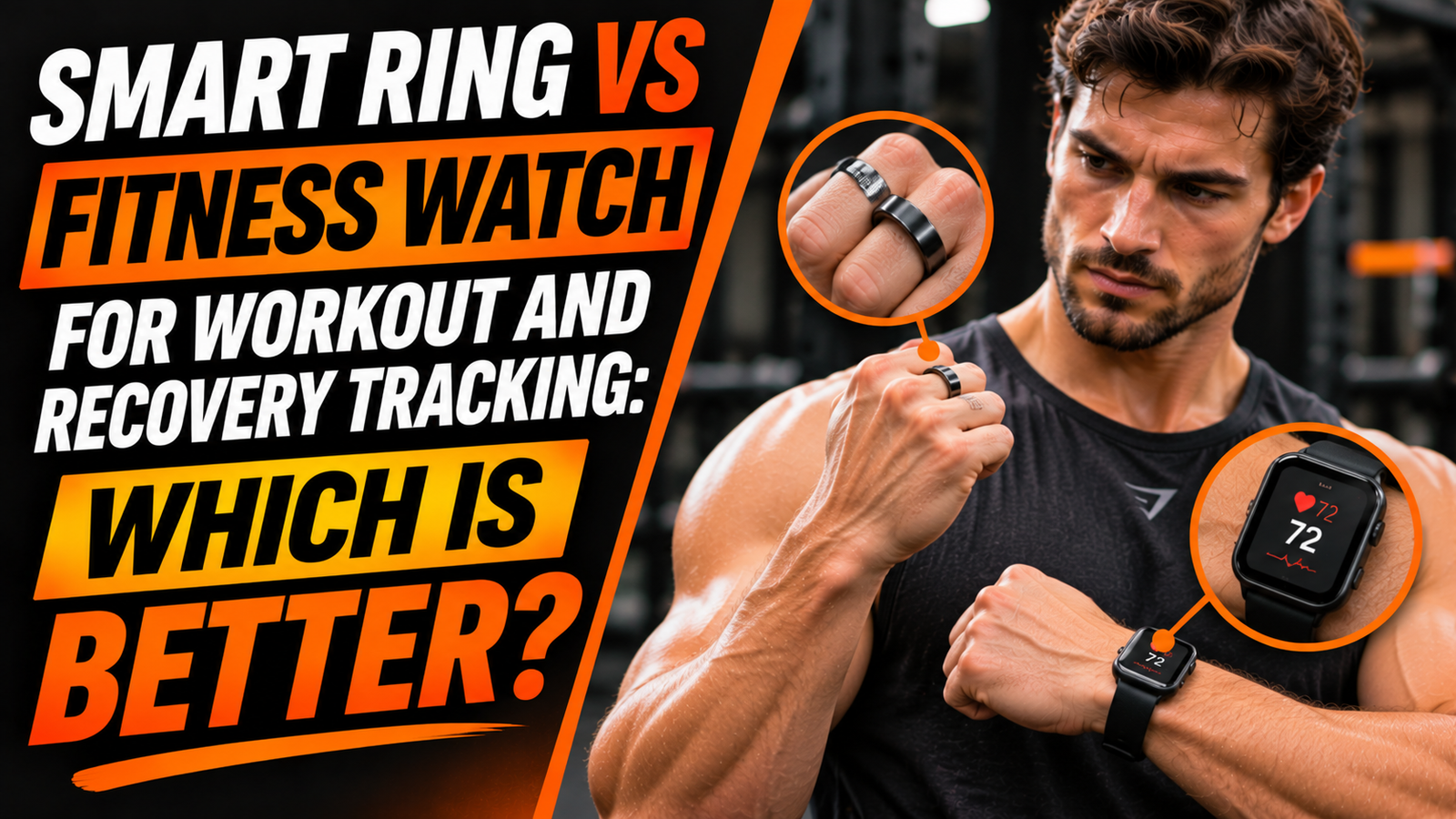
Smart Ring vs Fitness Watch for Workout and Recovery Tracking: Which Is Better?
Choosing between a smart ring and a fitness watch can be confusing, especially when both promise to help you understand your health, workouts, sleep, and recovery. At first glance, they may seem to do the same thing. Both can collect health-related data, track certain daily activities, and show patterns that help you understand your habits.
However, there is an important difference between a smart ring and a fitness watch. A smart ring generally focuses on discreet, continuous tracking, sleep, and recovery insights. A fitness watch typically offers more visible workout data, exercise controls, GPS features on supported models, and real-time feedback during training.
So, in the smart ring vs fitness watch debate, which device is better for workout and recovery tracking?
The answer depends on how you exercise, how closely you want to monitor your training, whether you care more about sleep insights or live workout statistics, and how comfortable you feel wearing a device throughout the day.
This guide compares both options in practical terms so you can make a decision based on your routine rather than marketing claims.
What Is a Smart Ring?
A smart ring is a compact wearable device that fits around one of your fingers. It contains small sensors that can measure selected signals, such as changes in heart rate, skin temperature, movement, and other physiological patterns, depending on the model.
The companion app uses these measurements to estimate information about your sleep, daily activity, resting heart rate, and recovery-related trends.
Unlike a traditional smartwatch, most smart rings do not have a large screen. You usually check your information through a smartphone app rather than looking at your finger throughout the day.
All Tools
How Does a Smart Ring Track Fitness?
A smart ring uses sensors to collect measurements while you sleep, rest, move, and perform everyday activities. The app then processes those measurements to provide summaries and estimates.
Depending on the product, features may include:
- Sleep duration and sleep-stage estimates
- Resting heart rate
- Heart rate variability (HRV)
- Overnight skin-temperature trends
- Daily movement and activity estimates
- Recovery or readiness scores
- Estimated activity levels and energy expenditure
- Selected workout tracking features
- Body fat calculator
- One rep max calculator
- 28 Day Abs Starter
- Leg Raises
- Mountain Climbers
Not every ring offers the same capabilities. Some models include automatic activity detection or workout heart rate tracking, while others focus more heavily on sleep and general wellness.
It is also important to understand that a recovery score is an estimate, not a direct measurement of how recovered your muscles are. The score is generated using a company's chosen metrics and algorithm.
Who Should Consider a Smart Ring?
A smart ring may suit people who:
- Want to monitor sleep without wearing a watch to bed.
- Prefer a small, discreet wearable.
- Are interested in resting heart rate and HRV trends.
- Want a simple overview of their daily activity and recovery patterns.
- Do not need a screen full of workout statistics.
- Prefer to check their health summaries after a workout rather than during it.
For example, someone who goes for daily walks, performs a few strength sessions each week, and wants to understand their sleep habits may appreciate a smart ring.
However, a ring may be less convenient for someone who needs detailed live statistics while running, cycling, swimming, or following a structured training session.
What Is a Fitness Watch?
A fitness watch is a wrist-worn device designed to track exercise, physical activity, and selected health metrics. Depending on the model, it may also offer smartphone notifications, navigation, music controls, contactless payments, and other smartwatch functions.
Fitness watches range from basic activity trackers to advanced multisport devices used by runners, cyclists, swimmers, and endurance athletes.
Their biggest advantage is that they can display workout information while you are exercising.
How Does a Fitness Watch Track Workouts?
Most fitness watches combine movement sensors with optical heart rate sensors. More advanced models may include GPS, barometric altimeters, and additional sensors for specific activities.
Common features include:
- Live heart rate monitoring
- Workout duration and pace
- Step counting and distance estimates
- GPS tracking on supported models
- Running and cycling statistics
- Strength-training modes
- Training-load or recovery estimates on selected devices
- Sleep tracking
- Heart rate variability trends on supported models
- Notifications and other smartwatch features
The available functions vary significantly between devices. A basic fitness band may not provide the same training analysis or navigation features as a premium multisport watch.
A watch can be particularly useful when you need to check your pace, distance, heart rate, or interval timing without stopping your workout.
Who Should Consider a Fitness Watch?
A fitness watch may be a better choice for people who:
- Run outdoors and want pace or GPS distance.
- Cycle and need ride statistics.
- Follow structured workouts or interval sessions.
- Want to monitor heart rate during exercise.
- Prefer seeing their statistics on their wrist.
- Track several sports or training activities.
- Want workout features alongside everyday smartwatch functions.
For example, a runner training for a 10K event may benefit from live pace information, lap timing, GPS distance, and workout summaries.
Someone who follows a strength-training programme may also prefer a watch that lets them start and stop sessions, track intervals, or record exercises, although the quality of these features differs between models.
Smart Ring vs Fitness Watch: Key Differences at a Glance
The easiest way to compare the two devices is to look at how they fit into a normal day.
| Feature | Smart Ring | Fitness Watch |
|---|---|---|
| Main strength | Discreet daily tracking and sleep insights | Workout tracking and real-time feedback |
| Sleep tracking | Often a major focus | Available on many models |
| Resting heart rate | Available on many models | Available on many models |
| HRV tracking | Available on many models, often overnight | Available on selected models and during supported measurement periods |
| Live workout data | Limited or model-dependent | Usually more comprehensive |
| GPS | Usually relies on a connected phone or lacks built-in GPS | Built-in GPS on many sports-focused models |
| Workout controls | Usually managed through an app | Often available directly on the watch |
| Exercise selection | Varies by product | Often includes multiple workout modes |
| Comfort during sleep | Small form factor may appeal to some users | Depends on watch size, strap, and personal preference |
| Comfort during strength training | Rings may interfere with gripping weights | Watches may feel bulky during some exercises |
| Screen | Usually no display | Display available |
| Notifications | Usually limited or unavailable | Common on smartwatch-style models |
| Battery life | Often several days, depending on model and use | Varies from short daily charging cycles to multiple weeks |
| Recovery insights | Available on selected products | Available on selected products |
| Phone dependence | Often relies heavily on a companion app | Varies; many functions work directly on the watch |
| Best fit | People prioritising discreet tracking and sleep trends | People prioritising workouts and training data |
Important: These are general differences, not guarantees. A premium smart ring may offer more workout features than a basic ring, while an entry-level fitness watch may lack the advanced training analysis available on higher-end sports watches.
Always compare the specifications of the exact models you are considering.
Which Is Better for Workout Tracking?
If your main goal is to monitor workouts as they happen, a fitness watch is generally the more practical choice.
Its display makes it easier to check exercise duration, heart rate, pace, distance, and interval timing. On supported devices, you can also use GPS to map outdoor activities and review your route afterward.
A smart ring can still contribute useful activity data. However, its small form factor means that it generally offers fewer ways to interact with workout information during exercise.
1. Running and Walking
For walking, both devices may provide useful information about daily movement and activity.
A smart ring can help you observe how active you have been throughout the day. Depending on the model, it may also record certain workouts and estimate their duration or intensity.
A fitness watch is usually more convenient if you want to monitor pace, distance, heart rate, and elapsed time while walking or running.
For outdoor runners, built-in GPS is particularly valuable when you want to record routes without carrying your phone.
Better choice for structured running: Fitness watch.
Better choice for discreet daily activity tracking: Smart ring.
2. Strength Training and Weightlifting
Strength training presents a different challenge because neither device can perfectly measure every part of a workout.
A fitness watch may let you record a strength session, time rest periods, and monitor heart rate. Some models offer exercise recognition or manual set logging.
However, wrist-based heart rate measurements can become less reliable during activities involving repeated wrist movement, gripping, or changes in muscle tension.
Smart rings also have limitations. A ring can feel uncomfortable or become a safety concern when gripping heavy dumbbells, barbells, or other equipment.
For this reason, remove a ring during heavy lifting when appropriate, and follow the ring manufacturer's safety guidance. Do not assume a fitness wearable can accurately measure strength, repetitions, or muscle fatigue without additional input.
Better choice for recording and managing a workout: Fitness watch.
Important comfort consideration: Some people prefer removing both devices during particular lifts. Comfort and safe handling of equipment should take priority over continuous data collection.
3. Cycling
Cyclists often need more than a basic activity summary.
Depending on the model, a fitness watch can record GPS routes, speed, distance, heart rate, elevation, and workout duration. Some devices can also connect to compatible cycling sensors.
A smart ring may provide general activity or heart rate information, but it is usually less suited to cyclists who want detailed ride data on a screen.
Better choice for cycling: Fitness watch, especially one with suitable GPS and cycling features.
4. HIIT and Interval Training
High-intensity interval training involves repeated changes in effort. You might alternate between 30 seconds of hard exercise and 60 seconds of recovery.
A fitness watch can make these sessions easier to manage because you can see timers, heart rate, and workout intervals directly on your wrist.
A smart ring may capture useful information about the session, depending on its capabilities, but it is not generally the most convenient tool for following detailed intervals in real time.
Remember that optical heart rate sensors may lag behind rapid changes in intensity. This can affect both ring-based and wrist-based readings.
Better choice for interval-based training: Fitness watch.
Smart Ring vs Fitness Watch for Recovery Tracking
Workout tracking tells you what happened during exercise. Recovery tracking attempts to help you understand how your body is responding to training, sleep, stress, and everyday demands.
This is where the comparison becomes more interesting.
Both smart rings and fitness watches may provide recovery-related information, but their approaches differ by product.
Some smart rings focus heavily on overnight measurements and morning readiness summaries. Some sports watches combine sleep and HRV information with recent exercise, training load, and recovery estimates.
Neither type of device can tell you exactly how recovered you are simply by producing a score.
What Does Recovery Tracking Actually Mean?
Recovery tracking refers to monitoring signals and patterns that may help you decide whether to maintain, increase, or reduce your training intensity.
Depending on the wearable, these signals may include:
- Resting heart rate
- Heart rate variability
- Sleep duration
- Sleep consistency
- Recent exercise and activity levels
- Changes in temperature-related measurements
- Training load
- Subjective reports of tiredness or soreness
Different products use different combinations of these measurements. Their scores are not directly interchangeable.
For instance, a readiness score of 80 on one device does not necessarily mean the same thing as a recovery score of 80 on another.
It is more useful to understand your personal baseline and watch how measurements change over time.
1. Sleep Tracking
Sleep is an important part of recovery because it supports normal physical and mental functioning.
A smart ring can be appealing for overnight tracking because it does not have a watch face and may feel less bulky on the wrist. Whether it feels comfortable depends on the ring's size, fit, design, and your sleeping habits.
A fitness watch can also track sleep, although some people find wearing a watch overnight uncomfortable.
Both devices estimate sleep information using sensor data and algorithms. Sleep stages shown in an app should not be treated as exact measurements of brain activity, as they are not equivalent to a clinical sleep study.
Which is better?
A smart ring may be preferable if you want a discreet device for overnight tracking. A fitness watch may be the better all-round option if you also want detailed training data in one device.
2. Heart Rate Variability (HRV)
Heart rate variability, or HRV, refers to variation in the time between consecutive heartbeats.
HRV can change with sleep, stress, exercise, illness, alcohol consumption, and other factors. For some people, long-term trends can provide useful context about how their body is responding to daily demands.
Both smart rings and some fitness watches track HRV, although the timing and methods of measurement differ.
For example, a device might collect HRV primarily during sleep, while another may offer measurements through a separate health or recovery feature.
Do not compare individual HRV values from different devices as if they were perfectly equivalent. Measurement conditions and algorithms can differ.
A single low HRV reading does not automatically mean you need to skip training. Likewise, one high reading does not guarantee that you are ready for a difficult workout.
Look for trends, consider how you feel, and pay attention to changes that persist.
3. Resting Heart Rate
Resting heart rate is another useful metric for observing personal trends.
Some people notice changes in resting heart rate after demanding workouts, poor sleep, travel, illness, or periods of increased stress.
Both smart rings and fitness watches can measure resting heart rate on supported models.
Rather than focusing on one reading, look at changes relative to your usual pattern. A persistent change, especially alongside symptoms such as unusual fatigue or feeling unwell, deserves more attention than a single isolated number.
Wearable readings are not a substitute for medical assessment.
4. Daily Readiness and Recovery Scores
Many wearables turn multiple measurements into a single score or recommendation.
Depending on the product, this may be labelled readiness, recovery, body battery, training readiness, or something similar.
Smart rings often emphasise how overnight measurements relate to the day ahead. Sports watches may incorporate exercise history, training load, sleep, HRV, and other available signals.
However, there is no universal formula for a recovery score.
One brand may place greater emphasis on sleep, while another may give more weight to recent training. The same person's score can therefore differ between devices.
A practical approach: Use the score as one source of information, not as a command. If your wearable suggests you are ready for a hard session but you feel unusually exhausted or sore, adjust your training accordingly.
Which One Should You Choose So Far?
For people who mainly want detailed workout information, a fitness watch is generally the stronger starting point.
For people who care more about discreet sleep monitoring, resting heart rate, and overnight recovery trends, a smart ring may be a better fit.
If you want both, consider whether one device already covers your main needs before paying for two. Two wearables may produce different estimates, add subscription costs, and create more data than you actually use.
The best wearable is not the one that collects the most measurements. It is the one that provides useful information you can understand and apply consistently.
Smart Ring vs Fitness Watch: Accuracy, Comfort, Cost, and Everyday Use
Choosing a wearable is not just about the number of features it offers. You also need to consider how consistently you will wear it, how useful its measurements are, and whether the information helps you make better decisions.
A device with advanced features may not be worth the expense if you rarely use them. On the other hand, a simple wearable may feel limiting if you want detailed workout statistics.
Let's compare the practical differences between smart rings and fitness watches.
1. Smart Ring vs Fitness Watch: Which Is More Accurate?
There is no single winner for every measurement. Accuracy depends on the sensor, device design, activity, fit, software, and the metric being measured.
A smart ring may perform well for certain overnight measurements, while a fitness watch may be more practical for tracking an outdoor run or managing an interval workout.
It is better to compare accuracy by feature rather than assume one device is more accurate overall.
Heart Rate Accuracy
Both smart rings and fitness watches commonly use optical sensors to estimate heart rate by detecting changes in blood flow near the skin.
The quality of these readings can vary during exercise.
Factors that may affect measurements include:
- Rapid changes in exercise intensity
- Repeated wrist or hand movement
- Gripping weights or equipment
- Poor device fit
- Cold conditions or reduced blood flow near the skin
- Sensor placement and individual differences
All Tools
During steady walking or other relatively consistent activities, a wearable may provide useful heart rate trends. During intense intervals or strength training, readings can lag behind changes in effort or become less reliable.
A fitness watch is generally more convenient when you want to view heart rate during exercise. However, a visible display does not automatically make its sensor more accurate.
If heart rate accuracy is especially important for your training, check independent testing of the specific model. A compatible chest strap may be worth considering for activities where more responsive heart rate data is useful.
Sleep Tracking Accuracy
Both device types estimate sleep using combinations of movement, heart rate, and other sensor data.
They can help you observe patterns such as:
- Approximate sleep duration
- Bedtime and wake-up consistency
- Changes in overnight heart rate
- Estimated sleep stages
- Differences between workdays and weekends
However, consumer wearables do not measure sleep in exactly the same way as a clinical sleep study. Sleep-stage estimates can be wrong, even when the overall sleep-duration estimate appears reasonable.
A smart ring may be more comfortable for someone who dislikes sleeping with a watch. But comfort alone does not prove that its sleep data is more accurate.
When evaluating sleep, focus on repeated patterns and how you feel during the day rather than treating every app result as a precise measurement.
GPS and Distance Accuracy
This is one area where a sports-focused fitness watch can have a clear practical advantage.
Models with built-in GPS can record outdoor routes and estimate distance without relying entirely on a phone. Some watches also support additional satellite systems or specialised navigation features.
Most smart rings do not offer the same independent GPS functionality. Some can use location data from a connected smartphone or combine movement data with other information.
If you regularly run outdoors, cycle, or train for distance-based events, check whether the watch has built-in GPS and whether its route-tracking performance has been independently reviewed.
Accuracy verdict: Neither device wins every category. Compare heart rate, sleep, GPS, and recovery features separately, based on the activities you actually perform.
2. Comfort: Which Device Is Easier to Wear All Day?
Comfort matters more than many buyers expect. A wearable can collect useful information only when you wear it correctly and consistently.
Smart rings and fitness watches have different comfort considerations.
Smart Ring Comfort
A smart ring is small and does not have a screen or wrist strap. Some people find this design convenient for sleeping, working at a desk, or wearing throughout the day.
However, ring comfort depends heavily on fit.
A ring that is too tight may become uncomfortable when your fingers swell. A loose ring may move around and affect sensor contact. Finger size can also change with temperature, exercise, and time of day.
Before purchasing, check the manufacturer's sizing process and wear-test recommendations.
There is another important consideration: rings can interfere with gripping weights, barbells, kettlebells, and other equipment. A ring may become uncomfortable or create an injury risk if it catches or compresses during lifting.
For heavy lifting, follow the manufacturer's safety guidance and consider removing the ring before handling equipment.
Fitness Watch Comfort
A fitness watch sits on the wrist and is secured with a strap.
Some people barely notice it after a few days, while others dislike wearing a watch during sleep or long workouts.
Comfort can depend on:
- Watch size and weight
- Strap material
- Strap adjustment
- Skin sensitivity
- Sweat and moisture
- Whether the watch moves during exercise
A watch that is too loose may produce inconsistent optical heart rate readings. Wearing it excessively tight can cause discomfort or skin irritation.
Follow the manufacturer's fit instructions, particularly for exercise and overnight monitoring.
Which Is More Comfortable?
There is no universal answer.
A smart ring may appeal to someone who dislikes wrist-worn devices. A lightweight fitness watch may be more comfortable for someone who does not like wearing jewellery.
If possible, try the device before committing to it. For rings, sizing is especially important because an incorrect fit can affect both comfort and measurements.
3. Battery Life and Charging
Battery life affects how consistently you can collect data.
If a device needs frequent charging, you may miss overnight measurements or forget to put it back on after charging. However, battery performance varies substantially between models.
Smart Ring Battery Life
Many smart rings are designed to operate for several days per charge, although actual battery life depends on the model, sensor use, fit, firmware, and other settings.
Some rings come with a charging case or portable charging accessory. This can make it easier to top up the battery without always connecting the ring to a wall charger.
Before buying, check:
- The manufacturer's stated battery life
- Whether the figure assumes specific settings
- Charging time
- Whether a charging case is included
- Battery replacement or repair options
- Whether all features remain available at lower battery levels
Fitness Watch Battery Life
Fitness watch battery life varies widely.
A basic activity tracker may last for several days or longer. A feature-rich smartwatch may need more frequent charging, especially when its screen, notifications, and continuous health measurements are active.
Sports watches with efficient displays and power-saving modes may last considerably longer, although GPS use can reduce battery life.
If you record long runs, hikes, or cycling sessions, check the manufacturer's battery estimate for GPS mode rather than relying only on its general smartwatch battery figure.
Battery Life Comparison
| Consideration | Smart Ring | Fitness Watch |
|---|---|---|
| Typical design goal | Continuous, discreet tracking | Daily use and exercise tracking |
| Battery life | Often several days, depending on model | Ranges from frequent charging to multiple weeks |
| GPS impact | Usually less relevant because built-in GPS is uncommon | Can significantly reduce battery life |
| Charging accessories | Some models include a charging case | Usually uses a dedicated charging cable or dock |
| Main concern | Remembering to charge and maintain sensor contact | Balancing display, GPS, and sensor use |
Buying tip: Look for independent battery tests where possible. Manufacturer estimates may not reflect how long the device lasts with your preferred settings.
4. Smart Ring vs Fitness Watch: Price and Subscription Costs
The initial purchase price is only one part of the cost.
Some smart rings offer their full experience after purchase, while others require a paid membership for certain insights or historical data features. Fitness watches may provide extensive information without a recurring fee, although some companion apps or optional services may have paid features.
These arrangements differ by brand and model, so check the current terms before buying.
What Should You Include in the Total Cost?
Consider the following:
- Upfront device price
- Required or optional subscription fees
- Replacement straps or accessories
- Charging accessories
- Warranty and repair coverage
- Replacement costs if the battery cannot be serviced
- Compatibility with your phone
- Any paid app features you expect to use
A device with a lower purchase price may cost more over time if it requires a subscription for features you consider essential.
Similarly, an expensive fitness watch may not be good value if you only want basic sleep and activity summaries.
A Simple Cost Comparison
| Your Priority | What to Check Before Buying |
|---|---|
| Lowest long-term cost | Total cost over two or three years, including subscriptions |
| Detailed training statistics | Whether core workout features are included |
| Sleep and recovery insights | Which reports are free and which require membership |
| Long battery life | Independent battery tests for your intended use |
| Phone-free workouts | GPS, storage, and connectivity capabilities |
| Easy replacement | Warranty, repair, and battery-service policies |
Prices change, particularly across Indian retailers and during seasonal sales. Compare the current price of the exact model rather than relying on an old review or a general price range.
5. Smart Ring vs Fitness Watch for Different Fitness Goals
The right wearable depends on what you want to improve.
Here are practical examples to help you match the device to your routine.
If Your Goal Is Weight Loss
You do not need an expensive wearable to lose weight.
A smart ring may help you notice changes in daily movement and sleep habits. A fitness watch may make it easier to track walking duration, exercise frequency, distance, and heart rate.
Neither device directly measures body fat loss with enough precision to replace a sensible nutrition plan and consistent activity.
For most people, useful habits include:
- Walking regularly
- Performing strength training suited to their ability
- Following a sustainable eating pattern
- Getting adequate sleep
- Tracking body-weight trends, if appropriate
- Maintaining a routine they can follow over time
Recommendation: Choose a smart ring if discreet sleep and daily-activity tracking are your priorities. Choose a fitness watch if you want to monitor workouts and activity targets directly.
If Your Goal Is Muscle Gain
For muscle gain, a wearable should support your training rather than become the centre of it.
A fitness watch may help you record workout duration, manage rest periods, and monitor general activity. Some models also provide strength-training modes.
However, the most important information for building muscle is often not a wearable metric. You need a suitable training programme, progressive resistance, sufficient food, adequate protein, and recovery time.
A ring may help you observe sleep and resting heart rate trends, but it cannot reliably tell you how much muscle you have gained or whether a particular muscle group is fully recovered.
Recommendation: A fitness watch is generally more useful for managing sessions. A smart ring may be a helpful addition if sleep tracking is your main concern.
If Your Goal Is Better Sleep
If you mainly want to understand your sleeping patterns, a smart ring may be appealing because it is small and has no watch face.
A fitness watch can also provide useful overnight measurements, particularly if you already wear it comfortably.
Whichever you choose, use the data to look for patterns rather than obsess over every sleep score.
For example, you might compare how you feel after a consistent bedtime with how you feel after several late nights. Your wearable can provide additional context, but your daytime energy and overall sleep habits matter too.
Recommendation: A smart ring may suit people who prefer a discreet overnight device. A comfortable fitness watch can work just as well for someone who likes having one wearable for everything.
If Your Goal Is Better Cardio Fitness
People who run, cycle, row, or perform structured cardio sessions often benefit from live exercise data.
A fitness watch can provide workout timers, heart rate, pace, distance, and GPS information, depending on the model.
A smart ring may offer a broader view of activity and recovery, but it is generally less practical for managing structured workouts.
Recommendation: A fitness watch is usually the better primary device for cardio training.
If You Are a Beginner
Beginners do not need to monitor every available metric.
It is often more useful to build a consistent routine than to spend too much time interpreting recovery scores.
If you mainly walk, do a few home workouts, and want to monitor sleep, either device may be sufficient. If you want to follow running plans, measure outdoor distance, or track workout intervals, a fitness watch offers more practical tools.
Recommendation: Start with the simplest device that supports your current routine and likely next steps.
6. Should You Wear Both a Smart Ring and a Fitness Watch?
Some people choose to use both devices.
For example, they might wear a fitness watch during training and use a smart ring for overnight tracking. This arrangement can be useful when the ring feels more comfortable during sleep or when someone wants the different features offered by each product.
However, buying two wearables is not necessary for most people.
Possible Benefits of Using Both
- More options for recording workouts and overnight measurements
- Access to different app features
- A wrist display during exercise and a discreet device at night
- A way to compare personal trends across products
Potential Drawbacks
- Higher upfront and ongoing costs
- More charging and device maintenance
- Different measurements that may be difficult to compare
- Duplicate notifications or activity records
- More time spent checking data
- Confusion when the two apps provide different scores
If you use both, avoid treating one device's score as the final authority. Each manufacturer may calculate recovery differently.
It is also worth checking whether both devices can write activity data to the same health platform. Duplicate workout records can distort activity summaries in some apps.
Practical advice: Start with one device. Consider a second only if you can identify a specific feature that the first device does not provide.
7. Privacy: What Happens to Your Health Data?
Smart rings and fitness watches can collect information that many people consider personal, including activity patterns, sleep estimates, heart rate, and other health-related measurements.
Before buying, understand how the company stores and processes this information.
Questions to Ask Before Purchasing
- Does the device require a cloud account?
- Which measurements are uploaded to the company's servers?
- Can you delete your data or close your account?
- Does the app share information with third parties?
- Are some features unavailable without a subscription?
- Can you export your data?
- Does the company explain its privacy and retention policies clearly?
Read the privacy policy and app permissions before connecting a wearable to your phone.
If you are uncomfortable sharing certain information, check whether the relevant features can be disabled. Keep in mind that turning off permissions may affect functionality.
A reputable product should explain what data it collects and how the information is used. Do not assume that a device stores all health data locally simply because it has no screen.
8. Common Mistakes to Avoid When Buying a Smart Ring or Fitness Watch
A wearable can be useful, but a poor buying decision may leave you with an expensive device you rarely use.
Avoid these common mistakes.
Mistake 1: Buying Based Only on the Recovery Score
A higher recovery score does not automatically mean a device is better.
Different brands use different formulas, measurements, and reference ranges. One device may emphasise sleep, while another considers recent exercise and training load.
Compare the underlying features rather than the score alone.
Mistake 2: Assuming Every Wearable Measures Everything
Not every ring records workouts automatically. Not every watch has built-in GPS. Some devices provide HRV trends, while others offer only limited recovery information.
Before purchasing, make a list of your must-have features and confirm that the exact model supports them.
Mistake 3: Ignoring Fit and Comfort
An uncomfortable device is less likely to be worn consistently.
For a ring, pay attention to sizing and changes in finger swelling. For a watch, consider its weight, strap, and how it feels during sleep and exercise.
Fit can also affect sensor performance.
Mistake 4: Expecting Medical-Grade Results
Consumer wearables are designed for general tracking and wellness insights, not to diagnose every health problem.
Sleep-stage estimates, recovery scores, calorie estimates, and heart rate measurements can have limitations.
If you have symptoms or concerns about your health, do not rely on a wearable score instead of professional advice.
Mistake 5: Paying for Features You Will Never Use
A high-end sports watch may be unnecessary if you mainly want step counts and basic sleep information.
Likewise, a premium smart ring may not make sense if your main goal is to track GPS runs and monitor intervals.
Choose according to your actual routine, not the longest feature list.
Mistake 6: Checking Every Metric Too Often
Constantly checking heart rate, HRV, sleep scores, and readiness can make fitness feel more complicated than it needs to be.
Use a wearable to identify patterns and support healthy habits. If the data makes you anxious or encourages you to ignore how you feel, reduce how often you check it.
Mistake 7: Ignoring Phone Compatibility and Membership Requirements
Some features depend on your phone's operating system, app version, or an active membership.
Confirm compatibility before ordering. Also check whether you will retain access to important measurements and historical reports if you stop paying for a subscription.
9. A Simple Decision Guide
If you are still undecided, use this quick guide.
| Your Main Need | Better Starting Choice | Why |
|---|---|---|
| Live running pace and distance | Fitness watch | Easier access to workout statistics and GPS on supported models |
| Structured interval training | Fitness watch | Workout timers and controls are more convenient |
| Discreet overnight tracking | Smart ring | Small design may be more comfortable for some sleepers |
| General daily activity trends | Either | Both may track activity and selected health metrics |
| Recovery insights | Either | Features and algorithms differ by model |
| Cycling statistics | Fitness watch | Better support for GPS and cycling-related data on suitable models |
| Strength-training session management | Fitness watch | More convenient workout controls on supported devices |
| Minimal wrist accessories | Smart ring | Avoids wearing a watch on the wrist |
| One device for workouts and notifications | Fitness watch | Combines exercise tracking with smartwatch functions |
| A simple way to review sleep and resting heart rate | Smart ring or fitness watch | Choose based on comfort, app quality, and measurement features |
Use this table as a starting point, not a strict rule. The right choice depends on the exact models, your comfort, and the features you will actually use.
10. Best Practices for Getting Useful Data From Your Wearable
Regardless of which device you choose, a few habits can make your data more useful.
Wear It Consistently
Follow the manufacturer's guidance for sensor placement and fit. Large gaps in use can make it harder to interpret trends.
Consistency does not mean ignoring comfort or safety. Remove the device when needed.
Establish Your Personal Baseline
Give yourself time to learn what your usual sleep duration, resting heart rate, and other tracked measurements look like.
A single reading is rarely as informative as a pattern over several days or weeks.
Combine Data With How You Feel
Consider your energy, mood, soreness, sleep quality, and workout performance alongside the app's recommendations.
If the device suggests that you are ready for an intense workout but you feel unwell or unusually fatigued, take that information seriously.
Use Metrics That Support Your Goals
You do not need to check every available measurement.
For a beginner runner, workout consistency and gradual progression may matter more than advanced recovery metrics. For someone focused on sleep, bedtime consistency and overall sleep duration may be more useful than daily activity scores.
Review Trends Instead of Chasing Perfect Scores
Daily variation is normal. Your goal should not be to produce a perfect number every morning.
Look for meaningful patterns and use them to make sensible changes to your routine.
11. Final Buying Advice: Which Device Offers Better Value?
The best value depends on what you expect the device to do.
A fitness watch is often the stronger all-round choice for someone who wants to actively manage workouts, track outdoor exercise, and review training statistics. A smart ring may offer better personal value to someone who wants a discreet wearable focused on sleep, daily activity, and recovery-related trends.
Neither device replaces a well-designed exercise plan, good sleep habits, sensible nutrition, or medical care when needed.
Before you buy, ask yourself three questions:
- What do I want to track most? Choose your two or three most important features.
- When will I wear it? Consider workouts, sleep, work, and everyday activities.
- What will I do with the data? Make sure the information will help you make decisions rather than simply add more numbers to your day.
If you answer these questions honestly, the choice between a smart ring and a fitness watch becomes much easier.
Call to Action
Still deciding between a smart ring and a fitness watch? Start by identifying your top fitness priorities: workout performance, sleep quality, recovery trends, or everyday activity.
Compare devices based on the features you will genuinely use, their comfort, battery life, phone compatibility, and any subscription costs. You do not need the most expensive wearable to build better habits.
Choose the device that fits your lifestyle, use its measurements consistently, and combine the data with how you feel and perform. That is a more practical way to get value from your fitness tracker.
FAQ 1: Is a smart ring better than a fitness watch?
A smart ring may be better for discreet sleep and everyday recovery tracking, while a fitness watch is generally better for live workout statistics, GPS-based exercise tracking, and training controls. The better option depends on your fitness goals and the features of the specific models.
FAQ 2: Is a smart ring accurate for workout tracking?
A smart ring can track selected activities and physiological measurements, depending on its capabilities. However, performance varies by model and activity. For structured workouts that require live heart rate, pace, GPS, or interval timing, a fitness watch is often more convenient.
FAQ 3: Which is better for sleep tracking, a smart ring or a fitness watch?
Both can estimate sleep duration, sleep stages, and overnight physiological trends on supported models. A smart ring may feel less bulky during sleep, but comfort does not automatically mean greater accuracy. Consider independent testing and focus on long-term patterns rather than individual sleep-stage estimates.
FAQ 4: Can a smart ring track heart rate during exercise?
Some smart rings offer workout heart rate tracking, but availability and performance vary. Movement, sensor fit, and rapid changes in exercise intensity can affect readings. Check the manufacturer's specifications if exercise heart rate is a priority.
FAQ 5: Is a fitness watch better for gym workouts?
A fitness watch is often more convenient for recording gym sessions, checking workout duration, monitoring heart rate, and managing rest intervals. However, wrist-based readings may be less reliable during certain strength exercises, and wearing a watch or ring may be uncomfortable during heavy lifting.
FAQ 6: Do smart rings track HRV and recovery?
Many smart rings track heart rate variability (HRV) and use it alongside other measurements to provide recovery or readiness insights. The exact features depend on the model. HRV is influenced by several factors, so it is more useful to review personal trends than interpret a single reading in isolation.
FAQ 7: Can a fitness watch tell me when I am fully recovered?
No fitness watch can determine recovery with complete certainty. Some models estimate recovery using measurements such as sleep, HRV, recent exercise, and training load. These estimates can provide useful context, but they should be considered alongside fatigue, soreness, sleep quality, and overall well-being.
FAQ 8: Do smart rings require a monthly subscription?
Some smart rings offer optional or required memberships for certain features, while others provide their main functions without a recurring fee. Subscription policies vary by brand and model. Check which measurements, reports, and historical data remain available if you do not subscribe.
FAQ 9: Can I wear a smart ring and a fitness watch together?
Yes, you can use both if their fit, compatibility, and intended use allow it. For example, you might use a watch during workouts and a ring for overnight tracking. However, the additional cost and differences between their measurements may not justify using two devices for everyone.
FAQ 10: Which is better for beginners: a smart ring or a fitness watch?
A fitness watch is a good starting point for beginners who want to track walking, running, workout duration, and exercise intensity. A smart ring may suit beginners who mainly want to understand sleep and daily activity patterns. Choose the simpler, more comfortable option that supports your current routine.
Stop reading, start moving
Reading about training is the easy part. Fifteen minutes today beats a fortnight of research - and all of it is free.
Start Free