Functional Fitness Exercises for Everyday Strength and Mobility
Discover functional fitness exercises that help improve everyday strength, balance, flexibility, and mobility. Learn beginner-friendly movements, proper techniques, and how to build a practical workout routine at home.
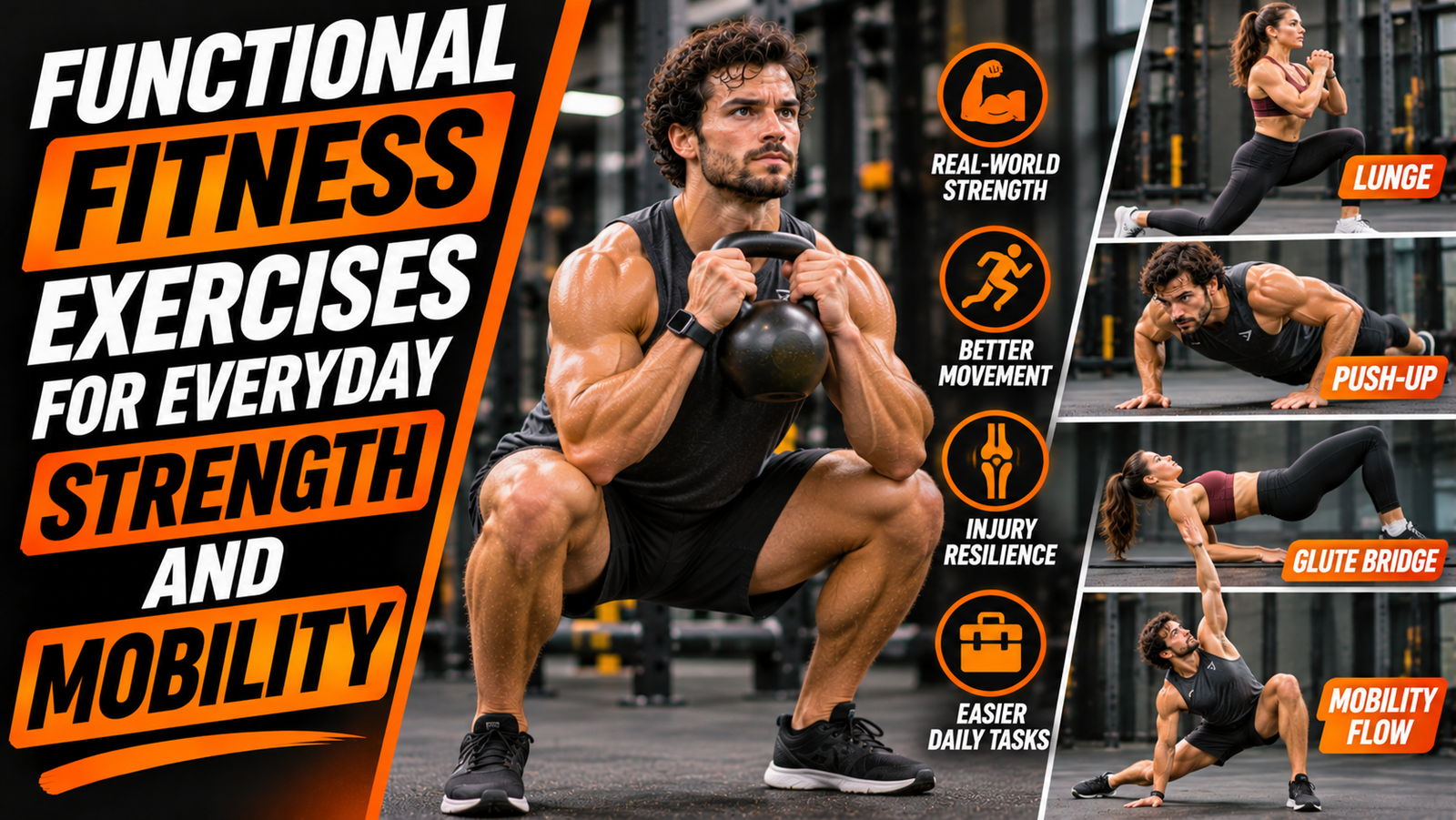
Functional Fitness Exercises for Everyday Strength and Mobility
Everyday activities can require more strength and mobility than we realise. Carrying grocery bags, climbing stairs, getting up from a chair, reaching for something on a high shelf, or lifting a suitcase all involve different movements working together.
This is where functional fitness exercises can be useful. Instead of focusing only on how much weight you can lift or how many repetitions you can complete, functional training develops strength, balance, coordination, and mobility through movements that resemble real-life activities.
You do not necessarily need a gym membership or expensive equipment to get started. Many functional exercises can be performed at home using your body weight, a sturdy chair, resistance bands, or a pair of light dumbbells.
In this guide, you will learn what functional fitness means, why it matters, which exercises beginners can try, and how to start building a practical routine for everyday strength and mobility.
All Tools
- All Tools
- 14 Day Kickstart
- Protein calculator
- BMI calculator
- Protein calculator
- HIIT Fat Burn
- Calorie burn calculator
- Legs And Glutes
- Squats
What Is Functional Fitness?
Functional fitness is an approach to exercise that develops physical abilities used in everyday activities and other tasks that matter to you.
These abilities include:
- Strength: Producing enough force to lift, carry, push, or pull objects.
- Mobility: Moving your joints through a comfortable and useful range of motion.
- Balance: Maintaining control while standing, walking, reaching, or changing direction.
- Coordination: Getting different parts of your body to work together smoothly.
- Stability: Controlling your body position while moving or holding a position.
- Endurance: Sustaining physical activity without becoming tired too quickly.
Functional fitness exercises often combine several of these qualities in a single movement.
For example, a squat can help develop the leg and hip strength used when sitting down and standing up. A farmer's carry challenges your grip, posture, and ability to walk while holding a load. A step-up works your legs and challenges balance in a way that resembles climbing stairs.
These exercises do not perfectly reproduce every real-world task, but they can help you practise relevant movement patterns in a controlled setting.
Functional Fitness vs Traditional Strength Training
Functional fitness and traditional strength training are not opposites. In fact, they can complement each other.
Traditional strength training often focuses on developing strength in particular muscles or movement patterns. Functional training places greater emphasis on how physical abilities work together to support specific activities.
| Feature | Functional Fitness | Traditional Strength Training |
|---|---|---|
| Main focus | Practical movement and physical abilities | Strength development and muscle performance |
| Common exercises | Squats, carries, step-ups, lunges, and pushing movements | Squats, presses, rows, curls, and deadlifts |
| Equipment | Body weight, bands, dumbbells, or household-friendly alternatives | Free weights, resistance machines, bands, or body weight |
| Balance and coordination | Often included in exercise selection | Can be included, depending on the programme |
| Everyday relevance | Exercises are selected around practical movement goals | Exercises can also improve everyday strength |
| Best approach | Adapt movements to your needs and abilities | Combine exercises to suit your goals |
The important distinction is the purpose of the programme, not the name of the exercise. A conventional squat can be part of a functional fitness routine, just as a functional programme can include traditional resistance exercises.
Why Are Functional Fitness Exercises Important?
Everyday movement rarely involves only one muscle or joint. Carrying a bag while walking, for instance, requires grip strength, upper-body control, balance, and coordination.
Functional fitness can help you develop these abilities together.
1. Build Strength for Everyday Tasks
Getting out of a low chair, lifting a box, carrying shopping, and moving household objects all require strength.
Exercises such as squats, hip hinges, rows, and carries can help develop the muscles involved in these tasks.
You can begin with simple bodyweight variations and gradually introduce resistance as your technique and confidence improve.
The goal is not necessarily to lift the heaviest weight possible. It is to build strength that supports your personal needs and activities.
2. Improve Mobility and Range of Motion
Mobility refers to your ability to move a joint through a range of motion with appropriate control.
For everyday activities, useful mobility can help you reach overhead, turn your body, bend toward the floor, and move comfortably through different positions.
Functional fitness routines may include:
- Controlled shoulder circles.
- Gentle hip rotations.
- Ankle mobility movements.
- Supported squats within a comfortable range.
- Thoracic rotations.
- Controlled overhead reaches.
Mobility varies from person to person. You do not need to force your joints into extreme positions to benefit from regular movement practice.
3. Practise Balance and Coordination
Balance becomes important when walking on uneven ground, stepping onto a curb, changing direction, or reaching while standing.
Functional exercises can provide opportunities to practise balance under manageable conditions.
Examples include supported single-leg stands, controlled step-ups, and slow marching in place.
Start near a stable support if you are unfamiliar with balance exercises. If you have a history of falls, significant dizziness, or a condition that affects balance, seek appropriate professional guidance before trying challenging variations.
4. Support Better Movement Control
Good movement control means being able to perform an action smoothly and deliberately rather than rushing through it.
For example, lowering yourself into a chair under control requires you to coordinate your hips, knees, ankles, and trunk.
Exercises that emphasise controlled movement can help you practise this skill.
However, no single exercise automatically guarantees perfect posture or prevents injuries. Technique, exercise selection, training load, and individual circumstances all matter.
5. Make Home Workouts More Practical
Functional training does not require a complicated setup.
A beginner-friendly routine might use:
- A sturdy chair.
- A clear area of floor space.
- A resistance band.
- A pair of light dumbbells, if available.
- A stable step or low platform designed for exercise.
You can begin with bodyweight movements and add equipment later if it suits your goals.
This flexibility makes functional fitness a practical option for people who prefer home workouts or have limited time to exercise.
The Main Movement Patterns in Functional Fitness
Before choosing exercises, it helps to understand the movement patterns they train.
A balanced functional fitness routine can include several of the following patterns.
1. Squatting
Squatting involves bending at the hips and knees while controlling your body position.
Everyday examples include sitting down, standing up, and picking up objects from lower surfaces.
Useful exercises:
- Chair squats.
- Bodyweight squats.
- Goblet squats with a dumbbell.
Beginners can start by sitting down on a sturdy chair and standing up again with control.
2. Hip Hinging
A hip hinge involves moving your hips backward while maintaining a controlled trunk position.
This pattern is useful when bending to pick up an object from the floor or lifting something from a low surface.
Useful exercises:
- Wall hip hinges.
- Bodyweight hip hinges.
- Dumbbell Romanian deadlifts.
The aim is to practise moving through the hips rather than repeatedly rounding your back to reach downward.
3. Pushing
Pushing movements develop the muscles used when moving an object away from your body.
Examples include pushing a door, moving a lightweight object across a surface, or pushing yourself up from certain positions.
Useful exercises:
- Wall push-ups.
- Incline push-ups.
- Dumbbell chest presses.
Choose a variation that allows you to maintain control throughout the movement.
4. Pulling
Pulling exercises develop the muscles used when drawing an object toward your body.
They can be relevant when opening a heavy door, pulling an object closer, or moving equipment.
Useful exercises:
- Resistance-band rows.
- Supported dumbbell rows.
- Cable rows.
For home training, a resistance band can be useful, provided it is secured to an appropriate anchor and checked for damage before use.
5. Carrying
Carrying involves holding a load while walking or maintaining a stable standing position.
It can be useful for practising the strength and control needed when carrying shopping bags, luggage, or other everyday items.
Useful exercises:
- Farmer's carries.
- Suitcase carries.
- Light static carries.
Start with a manageable load. Walk slowly, breathe normally, and avoid leaning excessively to one side.
6. Stepping and Lunging
Stepping and lunging involve moving your body between different positions while controlling your balance.
These patterns can help you practise actions associated with stairs, walking, and changing direction.
Useful exercises:
- Low step-ups.
- Supported reverse lunges.
- Split squats.
- Marching in place.
Use a low step and a stable support when needed. You can begin with simple marching before progressing to more demanding movements.
7. Rotating and Resisting Rotation
Everyday tasks can involve turning to reach an object or moving while carrying something.
Functional fitness may include controlled rotation and exercises that challenge your ability to resist unwanted trunk movement.
Useful exercises:
- Gentle standing trunk rotations.
- Seated thoracic rotations.
- Resistance-band Pallof presses.
Keep rotations comfortable and controlled. Avoid forcing the lower back into an extreme position.
10 Functional Fitness Exercises for Everyday Strength and Mobility
The following exercises offer a starting point for a beginner-friendly routine. Choose variations that match your current ability rather than trying to complete every movement immediately.
1. Chair Squats
Main focus: Leg strength, hip control, and standing up from a seated position.
How to perform them:
- Place a sturdy chair against a wall to prevent it from moving.
- Stand in front of the chair with your feet approximately hip- to shoulder-width apart.
- Move your hips backward and bend your knees as you lower yourself.
- Lightly touch the chair or sit down under control.
- Press through your feet and stand up.
- Repeat at a comfortable pace.
Beginner recommendation: Start with 6–10 controlled repetitions.
Make it easier: Use a higher chair or place your hands on the armrests for support if the chair is designed for that purpose.
Common mistake: Dropping onto the chair instead of controlling the lowering phase.
2. Wall Push-Ups
Main focus: Chest, shoulders, triceps, and upper-body pushing strength.
How to perform them:
- Stand facing a wall.
- Place your palms against the wall around chest height.
- Position your feet far enough back to create a comfortable angle.
- Bend your elbows and bring your chest toward the wall.
- Push through your hands to return to the starting position.
Keep your body controlled rather than allowing your hips to sag or your lower back to arch excessively.
Beginner recommendation: Try 6–12 repetitions.
Make it easier: Stand closer to the wall.
Make it harder: Progress to incline push-ups against a sturdy counter or bench when you can maintain good control.
3. Hip Hinge
Main focus: Hip movement and the muscles of the hips and back of the thighs.
How to perform it:
- Stand with your feet about hip-width apart.
- Keep your knees slightly bent.
- Place your hands on your hips.
- Push your hips backward while keeping your trunk controlled.
- Lean forward only as far as you comfortably can.
- Push through your feet and bring your hips forward to stand upright.
Imagine closing a drawer with your hips rather than bending forward entirely through your lower back.
Beginner recommendation: Perform 8–10 slow repetitions.
Common mistake: Turning the movement into a deep squat by bending the knees excessively.
4. Supported Step-Ups
Main focus: Leg strength, coordination, and balance.
How to perform them:
- Stand in front of a low, stable step designed for exercise.
- Hold a secure support if necessary.
- Place one foot fully on the step.
- Press through that foot to step up.
- Bring the other foot up if the movement feels comfortable.
- Step down slowly and repeat on the other side.
Beginner recommendation: Start with 5–8 repetitions per side.
Choose a step height that allows you to move without twisting, wobbling, or pushing excessively through your hands.
Safety tip: Avoid unstable stools, chairs, or improvised platforms.
5. Standing Calf Raises
Main focus: Calf strength and control around the ankles.
How to perform them:
- Stand near a wall or sturdy support.
- Position your feet approximately hip-width apart.
- Slowly lift your heels and rise onto the balls of your feet.
- Pause briefly at the top.
- Lower your heels with control.
Beginner recommendation: Complete 8–15 repetitions.
Make it easier: Use both hands for support and lift your heels only as high as comfortable.
6. Resistance-Band Rows
Main focus: Upper-back strength and pulling control.
How to perform them:
- Secure a suitable resistance band to an appropriate anchor according to its instructions.
- Hold the handles with your arms extended in front of you.
- Stand or sit in a stable position.
- Pull the handles toward your torso while keeping your shoulders relaxed.
- Pause briefly, then return to the starting position slowly.
Beginner recommendation: Try 8–12 repetitions.
Avoid shrugging your shoulders toward your ears or using momentum to pull the band.
If you do not have a suitable anchor, choose another pulling exercise rather than attaching the band to an unsafe object.
7. Farmer's Carry
Main focus: Grip strength, trunk control, and carrying ability.
How to perform it:
- Select two light weights that you can hold comfortably.
- Stand tall with one weight in each hand.
- Keep your shoulders relaxed and your arms by your sides.
- Walk slowly across a clear, level space.
- Turn carefully and return to the starting point.
- Put the weights down with control.
Beginner recommendation: Start with 15–30 seconds of walking.
You can also practise standing still while holding light weights before adding movement.
Common mistake: Choosing weights that cause you to lean, shrug, or hold your breath.
8. Standing March
Main focus: Balance, coordination, and controlled leg movement.
How to perform it:
- Stand near a stable support.
- Keep your torso upright and your feet comfortably apart.
- Lift one knee a short distance.
- Lower that foot with control.
- Repeat with the other leg.
- Continue alternating sides at a comfortable pace.
Beginner recommendation: March for 20–40 seconds.
Hold the support if necessary. You do not need to lift your knees high to practise the movement.
9. Bird Dog
Main focus: Trunk stability, coordination, and controlled movement.
How to perform it:
- Begin on your hands and knees on a comfortable surface.
- Position your hands under your shoulders and knees under your hips.
- Gently engage your trunk muscles.
- Extend one arm forward, or extend the opposite arm and leg if you can maintain control.
- Keep your trunk as steady as possible.
- Return to the starting position and change sides.
Beginner recommendation: Try 5–8 controlled repetitions per side.
Make it easier: Lift only one arm or one leg at a time.
Avoid arching your back or rotating your hips to reach farther. If kneeling is uncomfortable, choose a standing trunk-stability exercise instead.
10. Wall Slides
Main focus: Shoulder movement and controlled overhead reaching.
How to perform them:
- Stand facing a wall or with your back near the wall, depending on the variation you choose.
- Place your arms in a comfortable starting position.
- Slowly slide your arms upward within a pain-free range.
- Pause briefly.
- Lower your arms with control.
Beginner recommendation: Perform 6–10 repetitions.
Do not force your arms overhead or try to keep every part of your back pressed against the wall if doing so feels uncomfortable.
If you have shoulder pain or restricted movement, consider guidance from a qualified physiotherapist.
How to Choose the Right Functional Exercises
You do not need to include all 10 exercises in every workout.
A more manageable approach is to select movements that cover several important patterns.
| Training Goal | Exercise Options | Beginner Starting Point |
|---|---|---|
| Standing up and sitting down | Chair squats | 6–10 repetitions |
| Pushing strength | Wall push-ups | 6–12 repetitions |
| Bending and lifting practice | Hip hinges | 8–10 repetitions |
| Stair-climbing practice | Supported step-ups | 5–8 per side |
| Ankle and calf strength | Calf raises | 8–15 repetitions |
| Pulling strength | Resistance-band rows | 8–12 repetitions |
| Carrying ability | Farmer's carries | 15–30 seconds |
| Balance and coordination | Standing marches | 20–40 seconds |
| Trunk control | Bird dogs | 5–8 per side |
| Comfortable shoulder movement | Wall slides | 6–10 repetitions |
These are starting suggestions, not mandatory targets. You may need fewer repetitions, additional support, or a different exercise depending on your experience, mobility, and health.
Basic Safety Tips Before You Start
Functional training should challenge you without forcing you to ignore discomfort or poor technique.
Follow these practical guidelines:
- Warm up first: Spend a few minutes walking gently, marching in place, or moving your joints comfortably.
- Start with easier variations: Build confidence before increasing the range of motion, repetitions, or resistance.
- Move with control: Avoid rushing through unfamiliar exercises.
- Use stable equipment: Chairs, steps, and supports should not slide, tip, or collapse.
- Breathe normally: Avoid unnecessarily holding your breath during repetitions.
- Allow recovery: Rest between sets and sessions as needed.
- Stop for concerning symptoms: Sharp pain, chest pain, faintness, or unusual shortness of breath should not be treated as normal workout discomfort.
If you have a chronic health condition, a recent injury, significant joint pain, or concerns about your balance, consult an appropriate healthcare professional before starting or changing your exercise routine.
The best functional fitness programme is one you can perform safely, adapt as your ability improves, and maintain consistently.
A Beginner-Friendly Functional Fitness Workout Plan
Knowing individual exercises is useful, but combining them into a balanced routine makes it easier to train consistently.
A good beginner functional fitness workout should cover several movement patterns without making the session unnecessarily complicated. You can start with bodyweight exercises and introduce resistance as your technique and confidence improve.
For most beginners, two or three sessions per week can be a practical starting point, provided the sessions suit their current fitness level and allow enough recovery.
A 20-Minute Functional Fitness Workout at Home
This routine combines lower-body strength, upper-body pushing and pulling, balance, and trunk control. You can complete it at home with minimal equipment.
| Workout Component | Exercise | Suggested Amount |
|---|---|---|
| Warm-up | Gentle marching and shoulder circles | 3–4 minutes |
| Lower-body strength | Chair squats | 8–10 repetitions |
| Upper-body pushing | Wall push-ups | 8–12 repetitions |
| Hip movement | Bodyweight hip hinges | 8–10 repetitions |
| Upper-body pulling | Resistance-band rows | 8–12 repetitions |
| Balance | Standing march | 30 seconds |
| Trunk stability | Bird dog | 5–8 repetitions per side |
| Cool-down | Gentle walking and comfortable mobility | 2–3 minutes |
How to perform the workout:
- Begin with the warm-up to prepare for movement.
- Perform each exercise at a comfortable pace.
- Rest for approximately 30–60 seconds between exercises, or longer if needed.
- Complete one round when starting out.
- Add a second round only when you can maintain good technique without excessive fatigue.
- Finish with gentle movement and notice how you feel.
The actual session may take longer than 20 minutes if you need additional rest. That is perfectly reasonable.
If you do not have a resistance band, replace band rows with another suitable pulling exercise or omit them until you have access to appropriate equipment. Avoid improvising with unstable furniture or unsecured bands.
Should You Train for Repetitions or Time?
Both approaches can work.
Repetition-based training is useful for movements such as squats, push-ups, rows, and calf raises. It helps you track how many controlled repetitions you complete.
Time-based training can be useful for exercises such as marching in place or carrying light weights. It allows you to focus on maintaining a steady pace for a set period.
Beginners should prioritise movement quality rather than trying to complete as many repetitions as possible.
For example, eight controlled chair squats may be more useful than fifteen rushed repetitions that become difficult to perform safely.
A Weekly Functional Fitness Schedule
Your weekly schedule should reflect your experience, daily activity, available time, and recovery needs. You do not need to perform every exercise every day.
The following example provides a simple structure for someone who wants to develop everyday strength and mobility.
Example Weekly Plan for Beginners
| Day | Activity | Main Focus |
|---|---|---|
| Monday | Functional fitness workout | Full-body strength and movement control |
| Tuesday | Easy walk and gentle mobility | Comfortable movement |
| Wednesday | Functional fitness workout | Strength, balance, and coordination |
| Thursday | Rest or relaxed walking | Recovery |
| Friday | Functional fitness workout, if recovered | Full-body strength |
| Saturday | Walking, cycling, or another enjoyable activity | General fitness |
| Sunday | Rest or gentle movement | Recovery and preparation for the next week |
This schedule is an example, not a requirement. If three workouts feel too demanding, start with two sessions per week. You can add another session when the current routine feels manageable.
If you are already active through sports, cycling, running, or physically demanding work, account for those activities when deciding how much additional training to do.
How to Adjust the Schedule to Your Lifestyle
If you have a desk-based job: Short movement breaks throughout the day can complement your formal workouts. Try walking briefly, standing up from your chair, or performing comfortable shoulder and ankle movements.
If you spend much of the day standing: Your legs may already be working hard. Begin with manageable training volume and avoid adding demanding lower-body sessions when you feel unusually fatigued.
If you have limited time: Two short, well-planned sessions may be easier to maintain than a complicated daily routine.
If you are returning after a long break: Begin with one set of a few basic exercises. Increase the workload gradually rather than immediately returning to your previous training level.
If you are already strength training: Functional exercises can complement your existing programme. You may not need a separate functional fitness day if your regular workouts already include squatting, hinging, pushing, pulling, carrying, and balance work.
How to Combine Strength and Mobility Training
Strength and mobility support different aspects of movement, but they can work together in the same workout.
Strength training develops your ability to produce force. Mobility exercises help you practise moving your joints through a comfortable range of motion with control.
You do not have to choose between them.
Start With a Short Warm-Up
Before strength exercises, spend a few minutes moving gently.
A simple warm-up might include:
- Walking or marching in place.
- Shoulder circles.
- Gentle hip movements.
- Ankle movements.
- Several easy chair squats.
The purpose is to prepare for the session, not to tire yourself out before the main workout.
Train Strength Through Comfortable Ranges of Motion
For example, a chair squat develops leg strength while practising the movement involved in sitting down and standing up.
A wall push-up develops pushing strength while allowing you to control the difficulty by adjusting your distance from the wall.
A step-up combines leg strength with balance and coordination.
Choose ranges of motion that feel comfortable and allow you to maintain control. Do not force a joint into a position simply because an exercise demonstration shows a deeper movement.
Finish With Gentle Mobility Work
After your strength exercises, you can include a few comfortable mobility movements.
Options include:
- Gentle shoulder circles.
- Controlled thoracic rotations.
- Ankle movements.
- Easy hip rotations.
- Comfortable overhead reaches.
Move slowly and stay within a range that feels manageable.
Mobility work should not create sharp pain. If a movement repeatedly causes discomfort, stop and consider a suitable alternative or seek guidance from a qualified professional.
Does Mobility Work Need to Be Done Every Day?
Not everyone needs a long daily mobility routine.
Some people find short, regular sessions useful, especially when they want to practise a particular movement or maintain a consistent exercise habit. Others may prefer to include mobility exercises during warm-ups and on selected recovery days.
Your approach should depend on your goals, current mobility, daily activities, and how your body responds.
How to Progress Your Functional Fitness Routine
Your first workout should feel manageable. Over time, you can gradually increase the challenge as exercises become easier.
Progression does not always mean lifting heavier weights. You can also improve control, increase repetitions, use a slightly larger comfortable range of motion, or reduce unnecessary assistance.
1. Improve Your Technique First
Before increasing the difficulty, make sure you understand the movement.
For chair squats, focus on lowering yourself under control and standing up without using momentum.
For wall push-ups, keep your body aligned and avoid allowing your hips to sag.
For farmer's carries, choose weights that allow you to walk steadily without leaning excessively.
Good technique should come before more repetitions or heavier resistance.
2. Increase Repetitions Gradually
Suppose you begin with eight chair squats per set.
After several sessions, eight repetitions may feel manageable, and you may be able to complete ten with the same level of control.
You can gradually increase the repetitions within a reasonable range rather than making a large jump in workload.
You do not need to increase the repetitions every session. Staying at the same level while you build confidence is also progress.
3. Add Resistance When Appropriate
Once bodyweight exercises become comfortable, external resistance may help you continue developing strength.
Possible options include:
- Light dumbbells.
- Resistance bands.
- A suitable weighted vest.
- Other purpose-designed exercise equipment.
For example, you might progress from chair squats to bodyweight squats and later try a goblet squat with a light dumbbell.
Only add resistance if you can perform the movement with appropriate control. Choose equipment that is secure, undamaged, and suitable for the exercise.
4. Increase the Difficulty of the Movement
Some exercises can be made more challenging by changing their setup.
| Easier Variation | Possible Progression |
|---|---|
| Wall push-up | Incline push-up against a stable counter |
| Chair squat | Bodyweight squat to a comfortable depth |
| Supported standing march | Marching without hand support, if safe |
| Light farmer's carry | Slightly heavier carry |
| Low step-up | A modestly higher exercise step, if appropriate |
| Bird dog with one limb | Opposite arm-and-leg bird dog |
| Basic hip hinge | Hip hinge with light resistance |
You do not need to progress every exercise at the same time.
A useful rule is to change one factor at a time, such as repetitions, resistance, or exercise difficulty. This makes it easier to notice how your body responds.
5. Track More Than Weight or Repetitions
Functional fitness is not only about the numbers recorded in a workout log.
You can also track whether you are becoming more comfortable with particular movements.
For example:
- Can you stand up from a chair with greater control?
- Can you complete your usual set without rushing?
- Can you carry a manageable load without leaning to one side?
- Can you perform step-ups with steadier movement?
- Does your workout feel more manageable than it did several weeks ago?
These observations can help you understand your progress without relying entirely on body weight or appearance.
Keep expectations realistic. Changes in strength, mobility, balance, and everyday comfort vary between individuals.
Functional Fitness for Different Age Groups and Fitness Levels
Functional fitness can be adapted to different needs, but the most suitable exercises depend on the individual rather than age alone.
Functional Fitness for Beginners
If you are new to exercise, start with a small selection of familiar movements.
A simple starting combination could include:
- Chair squats.
- Wall push-ups.
- Standing marches.
- Supported calf raises.
- Gentle shoulder movements.
Begin with one set of each exercise and rest as needed.
Focus on learning the movements before adding more exercises. If you feel comfortable after several sessions, you can gradually increase the repetitions or add another set.
Functional Fitness for Older Adults
For older adults, exercises may be selected to support leg strength, balance, coordination, and the ability to perform everyday activities.
Possible options include:
- Sit-to-stand exercises from a suitable chair.
- Supported calf raises.
- Controlled marching.
- Low step-ups with appropriate support.
- Resistance-band rows.
- Gentle mobility movements.
Choose a stable environment and adjust the exercise to your ability.
If you have a history of falls, osteoporosis, significant joint problems, dizziness, or a condition that affects movement, consult a healthcare professional or qualified exercise specialist for personalised advice.
People who are new to balance training should begin with appropriate support rather than attempting challenging single-leg exercises immediately.
Functional Fitness for People Who Sit for Long Periods
Long periods of sitting can make it easy to neglect regular movement. A combination of planned workouts and short movement breaks may help you become more active throughout the day.
Useful options include:
- Standing up from your chair periodically.
- Gentle marching in place.
- Comfortable shoulder circles.
- Short walks.
- Chair squats, if appropriate.
- Hip-hinge practice.
You do not have to complete a full workout every time you take a movement break. The purpose is to create more opportunities to move while keeping your activity manageable.
Functional Fitness for People Who Already Exercise
If you already run, cycle, lift weights, or participate in sports, functional training can help address movement patterns that receive less attention in your current routine.
For example, a runner might include calf raises, step-ups, and single-leg balance practice. Someone who mainly performs upper-body resistance exercises might add squats, hip hinges, and loaded carries.
Select exercises based on your actual needs rather than adding movements simply because they are labelled functional.
Common Functional Fitness Mistakes to Avoid
Functional training can be straightforward, but a few common mistakes may make it less effective or unnecessarily difficult.
Mistake 1: Trying to Train Every Movement in One Session
A long list of exercises can make a beginner workout confusing and time-consuming.
Instead, select a handful of movements that cover different patterns. You can change the exercises over time as your needs develop.
Mistake 2: Prioritising Speed Over Control
Fast repetitions can be useful in some training programmes, but beginners should first learn to control each movement.
If your technique deteriorates, reduce the repetitions, slow down, or choose an easier variation.
Mistake 3: Making Every Exercise Unstable
Standing on an unstable surface or performing difficult single-leg movements is not automatically better than using a stable position.
In many cases, beginners benefit more from learning the movement on a stable surface before introducing additional balance challenges.
Use instability only when it serves a clear purpose and is appropriate for your ability.
Mistake 4: Ignoring Pulling Exercises
People training at home may perform plenty of squats and push-ups but very little pulling work.
Where possible, include suitable pulling exercises, such as resistance-band rows or supported dumbbell rows, to develop a more balanced routine.
Make sure any equipment or anchor is appropriate for the exercise.
Mistake 5: Confusing Mobility With Stretching Alone
Stretching can be useful, but mobility training can also involve controlled movements through a comfortable range of motion.
For example, a controlled step-up challenges movement control, strength, and balance. A gentle thoracic rotation practises movement through the upper back.
A well-rounded routine can include both strength and mobility exercises.
Mistake 6: Increasing Resistance Too Quickly
Adding heavier weights before you can control the exercise may lead to poor technique and excessive fatigue.
Increase resistance gradually and only when the current variation feels manageable.
Mistake 7: Expecting Immediate Changes in Everyday Performance
A few workouts can help you become familiar with the movements, but noticeable changes in strength and coordination generally require consistent practice over time.
Set realistic goals and review your progress over several weeks rather than judging the entire programme after one session.
Mistake 8: Treating Pain as a Sign of Progress
Muscle effort and mild fatigue can occur during exercise, but sharp or worsening pain should not be ignored.
Stop an exercise that causes concerning symptoms and consider professional guidance if the problem persists.
How to Make Functional Fitness Part of Everyday Life
You do not need to reserve every movement for a formal workout. Everyday routines can provide opportunities to practise healthy movement habits, although ordinary activities are not always a substitute for structured strength training.
Add Movement Breaks to Your Day
If you spend a lot of time working at a desk, take occasional breaks to stand, walk, or move your joints comfortably.
Set a reminder if you often lose track of time while working.
Practise Controlled Everyday Movements
When sitting down, stand up or lower yourself at a comfortable pace rather than rushing unnecessarily.
When picking up a manageable object, consider how you position your feet and hips. Keep the load close to your body when practical and avoid twisting awkwardly under a heavy load.
These habits can encourage more deliberate movement, but they do not eliminate all injury risks.
Use Short Workouts to Build Consistency
If you struggle to find time for exercise, begin with a short session that fits your schedule.
For example, you might perform chair squats, wall push-ups, hip hinges, and standing marches in a 10- to 15-minute workout.
As your routine becomes more familiar, you can add exercises or increase the session length if needed.
Choose Activities You Enjoy
Walking, cycling, swimming, dancing, gardening, and recreational sports can all contribute to overall physical activity.
The best combination depends on your preferences, abilities, and goals. You are more likely to maintain a routine that fits your lifestyle than one that feels unnecessarily complicated.
How to Know Whether Your Functional Fitness Routine Is Working
Progress may appear in different ways, depending on what you want to achieve.
If your main goal is strength, you might gradually perform more controlled repetitions or use slightly more resistance.
If your goal is mobility, you may notice that certain movements feel more comfortable or easier to control.
If you want to improve balance, you might become more confident performing appropriate standing exercises.
If your goal is general fitness, you may find it easier to complete your usual routine without becoming as tired.
Consider reviewing your progress every three to four weeks. Record the exercises, repetitions, resistance, and any observations about technique or comfort.
Avoid using a single measure as proof that the entire programme is working. Fitness progress is influenced by sleep, nutrition, recovery, health, and consistency, as well as the exercises themselves.
If a movement repeatedly causes pain, your balance worsens, or your everyday function declines unexpectedly, reassess the programme and seek professional advice where appropriate.
Final Tips for Building a Sustainable Functional Fitness Routine
Functional fitness does not need to be complicated to be useful.
Start with exercises that reflect your goals, practise them with control, and build up gradually. A routine that includes squatting, hinging, pushing, pulling, carrying, stepping, and comfortable mobility work can provide a practical foundation for everyday strength.
Remember these principles:
- Start with exercises that match your current ability.
- Use stable supports when needed.
- Include both upper-body and lower-body movements.
- Practise balance in a safe environment.
- Progress gradually rather than changing everything at once.
- Allow time for recovery.
- Choose movements that help you work toward meaningful everyday goals.
- Adjust the routine when your needs, schedule, or physical condition changes.
The aim is not to make ordinary movements look like a complicated workout. It is to develop the strength, control, and mobility that help you participate more comfortably in the activities that matter to you.
Conclusion: Build Strength for the Movements That Matter
Functional fitness exercises can help you develop strength, mobility, balance, and coordination for everyday activities. Whether you want to climb stairs more comfortably, carry shopping bags, get up from a chair, or move with greater control, a well-planned routine can help you work toward those goals.
You do not need an expensive gym membership or complicated equipment to get started. Simple movements such as chair squats, wall push-ups, hip hinges, calf raises, and standing marches can provide a practical foundation for beginners.
The key is to choose exercises that suit your current fitness level and practise them consistently.
Start with a manageable routine two or three times per week if that suits your needs. Focus on controlled movements, use support when necessary, and gradually increase repetitions or resistance as the exercises become easier.
Remember that functional fitness is not about making every movement difficult. It is about developing the physical abilities that support your everyday life.
For the best results, combine strength training with regular physical activity, comfortable mobility work, adequate sleep, and enough recovery between demanding sessions. Adapt your routine as your needs change, and do not ignore persistent pain or other concerning symptoms.
Start small, stay consistent, and build your fitness around the activities that matter most to you. Over time, a practical functional fitness routine can become a sustainable part of your lifestyle.
Call to Action (CTA)
Ready to build strength for everyday life? Start with a few beginner-friendly functional fitness exercises, such as chair squats, wall push-ups, hip hinges, and standing marches.
Choose movements that match your current ability, practise them with control, and gradually increase the challenge as you become more comfortable.
Looking for more practical fitness guidance? Explore our other workout guides for beginner-friendly strength training, home exercises, walking routines, and mobility tips to help you build a routine that fits your lifestyle.
1. What are functional fitness exercises?
Functional fitness exercises are movements designed to develop physical abilities that can support everyday activities and other practical tasks. Common examples include squats, step-ups, hip hinges, rows, carries, and balance exercises.
2. What are the best functional fitness exercises for beginners?
Useful beginner options include chair squats, wall push-ups, standing marches, supported calf raises, hip hinges, and resistance-band rows. Start with variations you can perform comfortably and with control.
3. Can I do functional fitness exercises at home?
Yes. Many functional fitness exercises require little or no equipment. You can begin with bodyweight movements and use suitable equipment, such as resistance bands or light dumbbells, as your experience increases.
4. How often should I do functional fitness workouts?
For some beginners, two or three sessions per week can be a practical starting point. The ideal frequency depends on your fitness level, exercise intensity, other physical activities, health, and recovery needs.
5. Can functional fitness improve mobility?
Functional fitness routines can include exercises that practise controlled movement through comfortable joint ranges. Combining mobility work with appropriate strength exercises may help you develop movement control, but results vary depending on the individual and programme.
6. Is functional fitness better than traditional strength training?
Neither is universally better. Functional fitness emphasises abilities relevant to practical movements, while traditional strength training often focuses on developing strength through specific exercises. The two approaches can complement each other.
7. Do I need equipment for functional fitness?
No. You can begin with bodyweight exercises such as chair squats, wall push-ups, standing marches, and hip hinges. Resistance bands, dumbbells, and suitable exercise steps can provide additional options as you progress.
8. Can older adults do functional fitness exercises?
Many older adults can benefit from appropriately selected strength, balance, and mobility exercises. Movements such as supported sit-to-stands, calf raises, and controlled marching may be suitable starting points. Exercise selection should reflect individual abilities and health needs.
9. How long should a functional fitness workout last?
A beginner session may take approximately 15–30 minutes, including a warm-up, exercises, rest periods, and a cool-down. The appropriate duration depends on your goals, exercise selection, and fitness level. A shorter, manageable session can be a useful starting point.
10. How long does it take to see results from functional fitness?
Progress varies according to training consistency, exercise difficulty, recovery, nutrition, and starting fitness level. You may notice improvements in exercise familiarity or control before larger changes in strength or physical capacity. Track your progress over several weeks rather than expecting immediate results.
Stop reading, start moving
Reading about training is the easy part. Fifteen minutes today beats a fortnight of research - and all of it is free.
Start Free