Best Home Workouts for People Who Sit All Day
Discover the best home workouts for people who sit all day, including simple mobility, strength, stretching, and cardio exercises you can do with little equipment.
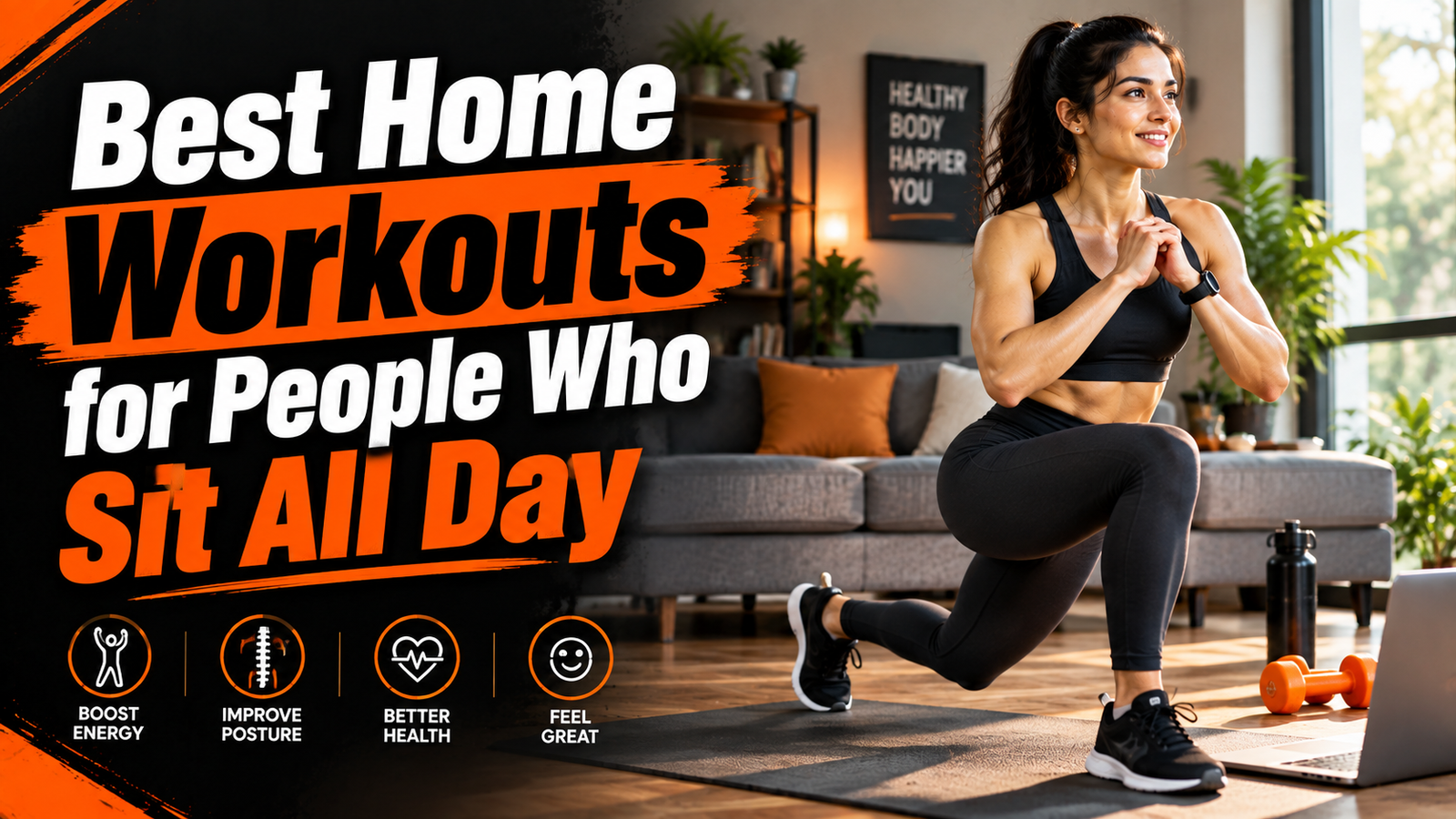
Best Home Workouts for People Who Sit All Day
If you spend most of your day sitting at a desk, working from home, studying, driving, or using a computer, finding time to exercise can be challenging.
The good news is that you do not need a gym or a complicated workout program to become more active.
The best home workouts for people who sit all day combine simple movements that improve general fitness, strengthen major muscle groups, and break up long periods of inactivity.
A good routine can include exercises such as squats, glute bridges, wall push-ups, bird dogs, mobility drills, stretching, and short periods of cardio.
The goal is not to undo every hour of sitting with one exhausting workout.
Instead, think about movement throughout the entire day.
Why Sitting All Day Can Be a Problem
Sitting is a normal part of many people's work and daily routines. The concern is often not sitting itself, but spending long periods with very little movement.
A typical desk-based day might involve:
- Free Tools
- BMI calculator
- Macro calculator
- Sitting during breakfast
- Commuting while seated
- Working at a desk for several hours
- Sitting during meetings
- Driving home
- Watching television or using a phone in the evening
This can result in a very low level of overall daily movement.
Regular physical activity can help you maintain general fitness and support cardiovascular health, muscle strength, mobility, and overall well-being.
This is why a home workout should be viewed as one part of an active lifestyle rather than a complete solution by itself.
What Makes a Good Workout for Desk Workers?
A useful home workout for someone who sits for long periods should be practical.
You do not need dozens of exercises.
Instead, focus on movements that cover several important areas.
1. Lower-Body Strength
Exercises such as squats and lunges train the muscles of your legs and hips.
2. Upper-Body Strength
Push-ups and their easier variations can train the chest, shoulders, and arms.
3. Core Stability
Exercises such as bird dogs and dead bugs can train the muscles responsible for trunk stability.
4. Hip and Thoracic Mobility
Gentle mobility exercises can help you move through comfortable ranges of motion after spending a long time in one position.
5. Cardiovascular Movement
Walking, marching, dancing, cycling, or other forms of cardio can help increase your overall activity.
6. Frequent Movement Breaks
A workout is useful, but so are short movement breaks throughout your workday.
Best Home Exercises for People Who Sit All Day
You can perform many useful exercises without equipment.
Here are some beginner-friendly options.
| Exercise | Main Focus | Equipment |
|---|---|---|
| Bodyweight squat | Legs and hips | None |
| Glute bridge | Glutes and hips | None |
| Wall push-up | Upper body | Wall |
| Bird dog | Core stability | None |
| Reverse lunge | Legs and balance | None |
| Dead bug | Core stability | None |
| Calf raise | Lower legs | None |
| Marching in place | Cardio | None |
| Hip mobility drill | Hip movement | None |
| Thoracic rotation | Upper-body mobility | None |
You can choose a small number of these exercises and build a short routine around them.
10 Best Home Workouts for People Who Sit All Day
1. Bodyweight Squats
The bodyweight squat is one of the simplest ways to train your lower body without equipment.
It primarily works the muscles around your thighs and hips.
How to Perform a Bodyweight Squat
- Stand with your feet approximately hip-width apart.
- Keep your chest comfortably upright.
- Bend your knees and hips to lower your body.
- Descend only as far as you can comfortably control.
- Push through your feet to return to standing.
- Repeat.
Start with 8–12 controlled repetitions.
You do not need to squat as deeply as possible. Comfortable range of motion and good control are more important than forcing depth.
Beginner Modification
If regular squats are difficult, perform sit-to-stand repetitions from a sturdy chair.
This gives you a stable reference point and can make the movement easier to learn.
2. Glute Bridges
Glute bridges are a simple floor exercise that trains the muscles around your hips and buttocks.
They can be useful in a home strength routine because they require no equipment.
How to Perform a Glute Bridge
- Lie on your back.
- Bend your knees and place your feet on the floor.
- Keep your arms comfortably beside you.
- Press through your feet.
- Raise your hips in a controlled manner.
- Pause briefly at the top.
- Lower your hips slowly.
Try 8–15 repetitions to begin.
Focus on controlled movement rather than trying to lift your hips as high as possible.
3. Wall Push-Ups
If traditional push-ups are too difficult, wall push-ups are an excellent starting variation.
They train pushing muscles in the upper body while allowing you to control the difficulty.
How to Perform a Wall Push-Up
- Stand facing a wall.
- Place your hands on the wall around chest height.
- Step back slightly.
- Bend your elbows and bring your chest toward the wall.
- Push yourself back to the starting position.
Perform 8–15 repetitions depending on your fitness level.
As you become stronger, you can progress from wall push-ups to an incline push-up using a stable elevated surface, and eventually toward floor push-ups if appropriate.
4. Bird Dog
The bird dog is a controlled exercise that challenges core stability while involving the shoulders and hips.
How to Perform It
- Start on your hands and knees.
- Keep your back in a comfortable neutral position.
- Slowly extend one arm and the opposite leg.
- Pause briefly.
- Return to the starting position.
- Repeat on the opposite side.
Try 6–10 repetitions per side.
Move slowly rather than trying to complete the exercise quickly.
5. Reverse Lunges
Reverse lunges can strengthen the legs while also challenging balance and coordination.
How to Perform a Reverse Lunge
- Stand comfortably upright.
- Step one foot backward.
- Bend your knees while lowering under control.
- Push through the front foot.
- Return to standing.
- Switch sides.
Start with 6–10 repetitions per side.
If balance is difficult, hold onto a sturdy support.
You can also use a smaller range of motion until you become more comfortable.
6. Dead Bugs
The dead bug is another core exercise that can be performed on the floor.
It emphasizes controlled movement rather than speed.
Basic Method
- Lie on your back.
- Position your arms and legs comfortably.
- Slowly move one arm and the opposite leg away from the starting position.
- Return to the starting position.
- Repeat on the opposite side.
Start with 5–8 controlled repetitions per side.
If you find it difficult to maintain control, reduce the range of movement.
7. Calf Raises
Calf raises are simple and can be performed almost anywhere.
How to Perform Them
- Stand near a wall or sturdy surface if needed.
- Rise onto the balls of your feet.
- Pause briefly.
- Lower your heels slowly.
- Repeat.
Try 10–20 repetitions.
Because the movement is simple, it can also be incorporated into short movement breaks.
8. Marching in Place
Marching in place is an easy way to add movement without needing much space.
It can be useful during a short break from your desk.
Try This
March comfortably for 2–5 minutes.
Swing your arms naturally and maintain a pace that feels appropriate for your fitness level.
You can gradually make the movement more challenging by increasing the pace or adding controlled knee lifts.
9. Hip Mobility Exercise
Long periods of sitting can mean that your hips remain in a relatively fixed position for extended periods.
A simple mobility routine can help you regularly move your hips through comfortable ranges of motion.
One option is a controlled hip circle or gentle standing hip movement.
Perform slow repetitions without forcing the joint into uncomfortable positions.
Mobility exercises should feel controlled and comfortable rather than painful.
10. Thoracic Rotation
The thoracic spine is the middle portion of the spine.
A gentle rotation exercise can add movement to the upper body after long periods of desk work.
Simple Seated Rotation
- Sit upright on a stable chair.
- Keep your feet supported.
- Place your hands comfortably across your chest.
- Slowly rotate your upper body to one side.
- Return to the center.
- Repeat on the other side.
Perform 5–10 controlled repetitions per side.
Avoid forcing the rotation.
A Simple 15-Minute Home Workout
You do not need an hour to begin.
A short full-body routine can be enough to establish the habit.
Beginner 15-Minute Routine
Warm-up — 3 minutes
- 28 Day Abs Starter
- Mountain Climbers
- One rep max calculator
- March in place
- Shoulder movements
- Gentle hip movements
Main workout — 10 minutes
Complete 2 rounds:
- 10 bodyweight squats
- 10 wall push-ups
- 10 glute bridges
- 6 bird dogs per side
- 10 calf raises
Cool-down — 2 minutes
- Easy walking around the room
- Gentle comfortable stretches
Adjust the repetitions to match your fitness level.
The goal is to finish feeling like you have exercised, not completely exhausted.
Why Strength Training Matters for Desk Workers
People who sit all day often focus only on stretching.
Stretching can be useful, but a well-rounded routine should also include strengthening exercises.
Strength training can help you develop and maintain muscle strength and functional capacity.
You do not necessarily need heavy weights.
Bodyweight exercises can provide an accessible starting point.
A balanced home workout might include:
- Squatting
- Pushing
- Lunging
- Hip extension
- Core stability
- Carrying or resistance work when equipment is available
Over time, you can increase the challenge through additional repetitions, more difficult variations, resistance bands, or weights.
Stretching vs Strength Training for People Who Sit All Day
Stretching and strength training serve different purposes.
| Activity | Main Purpose |
|---|---|
| Stretching | Flexibility and comfortable range of motion |
| Mobility exercises | Controlled movement through a range of motion |
| Strength training | Muscle strength and physical capacity |
| Cardio | Cardiovascular fitness and endurance |
| Walking | General movement and aerobic activity |
You do not have to choose only one.
A practical routine can combine all of them.
For example, you might perform a short strength workout three days per week and take regular walking or mobility breaks during your workday.
The Most Important Habit: Break Up Long Sitting Periods
One common mistake is thinking that a 30-minute workout completely solves the problem of sitting for the rest of the day.
It is better to think beyond the workout.
If you spend eight or more hours working at a desk, consider building movement into your schedule.
Examples include:
- Standing during some phone calls
- Walking during short breaks
- Taking the stairs when practical
- Walking to get water
- Doing a few mobility movements between meetings
- Taking a short walk after meals
- Moving around during television breaks
These small actions can make your day less sedentary.
A Simple Desk-Break Routine
When you have been sitting for a long period, take a brief movement break if your schedule allows.
Try:
1 minute: Walk around the room
30 seconds: Shoulder rolls or arm movements
30 seconds: Bodyweight squats or sit-to-stands
30 seconds: Gentle hip movement
30 seconds: Easy marching
You can repeat this sequence whenever practical.
It does not need to become another stressful task on your calendar.
The goal is simply to introduce more movement into a predominantly sedentary day.
How Often Should You Work Out at Home?
There is no single perfect schedule.
For beginners, consistency is more important than creating an extremely demanding program.
A practical starting point could be:
- 2–3 full-body strength sessions per week
- Regular walking throughout the week
- Short movement breaks during prolonged sitting
- Gentle mobility work when it feels useful
As your fitness improves, you can gradually increase workout duration, resistance, or exercise difficulty.
If you have been inactive for a long time, start conservatively and progress gradually.
A Beginner-Friendly Weekly Structure
Here is an example:
| Day | Activity |
|---|---|
| Monday | 15–20 min full-body home workout |
| Tuesday | Walking + movement breaks |
| Wednesday | 15–20 min full-body home workout |
| Thursday | Walking + mobility |
| Friday | 15–20 min full-body home workout |
| Saturday | Longer walk or enjoyable activity |
| Sunday | Rest or easy movement |
This is only a template.
You can adjust it around your work schedule, fitness level, and recovery.
Final Tip for Desk Workers
Do not wait for the perfect workout setup.
You can start with a small space, comfortable clothing, and a few minutes.
The most effective routine is often the one that is simple enough to repeat.
Start with basic strength exercises, add walking and mobility, and look for opportunities to interrupt long periods of sitting throughout the day.
Over time, those habits can become a sustainable part of your lifestyle.
A 20-Minute Home Workout for People Who Sit All Day
If you have a busy work schedule, a 20-minute workout can be a practical middle ground between doing nothing and trying to fit in a long gym session.
This workout combines strength, mobility, and light cardio.
20-Minute Routine
Warm-up — 3 minutes
- March in place
- Arm circles
- Gentle hip movements
- Easy bodyweight squats
Strength circuit — 12 minutes
Complete 2–3 rounds:
- 10–12 bodyweight squats
- 8–12 incline or wall push-ups
- 10–15 glute bridges
- 6–10 bird dogs per side
- 10–15 calf raises
Cardio finisher — 3 minutes
Choose one:
- Marching in place
- Step-ups on a stable low step
- Dancing
- Fast walking around your home
Cool-down — 2 minutes
Walk slowly and perform a few comfortable mobility movements.
The intensity should match your fitness level. If you are new to exercise, start with fewer repetitions and more rest.
A 30-Minute Full-Body Home Workout
If you have more time, you can build a more complete session.
Warm-Up — 5 Minutes
- 1 minute easy marching
- 10 shoulder rolls
- 10 controlled squats
- Gentle hip movements
- Easy walking
Strength Block — 15 Minutes
Complete 2–3 rounds:
| Exercise | Repetitions |
|---|---|
| Squat | 10–15 |
| Incline push-up | 8–12 |
| Reverse lunge | 6–10 each side |
| Glute bridge | 12–15 |
| Bird dog | 6–10 each side |
Rest as needed.
Cardio Block — 5 Minutes
Choose one activity:
- Brisk marching
- Step-ups
- Dancing
- Fast walking
- Low-impact cardio movements
Cool-Down — 5 Minutes
Use gentle, comfortable movements rather than aggressive stretching.
This workout can be adjusted based on your fitness level.
A Low-Impact Workout for Beginners
Not everyone needs jumping exercises.
If you are new to exercise, prefer lower-impact movement, or simply dislike jumping, you can still create an effective home routine.
Try:
- March in place — 60 seconds
- Sit-to-stand — 10 repetitions
- Wall push-ups — 10 repetitions
- Glute bridges — 12 repetitions
- Standing knee lifts — 10 per side
- Bird dogs — 6 per side
- Calf raises — 15 repetitions
Rest for 30–60 seconds and repeat for another round if comfortable.
This type of routine can be especially useful for someone transitioning from a mostly sedentary lifestyle.
Strength + Cardio: A Better Combination for Desk Workers
A common home-workout mistake is choosing only one type of exercise.
For example, someone may spend 20 minutes stretching every day but never perform strengthening exercises.
Another person may perform only high-intensity cardio and ignore mobility and recovery.
A more balanced approach is to combine:
Strength + cardio + mobility + everyday movement
Each component serves a different purpose.
Strength Training
Helps develop and maintain muscle strength.
Cardio
Helps improve cardiovascular fitness and endurance.
Mobility
Encourages controlled movement through comfortable ranges of motion.
Everyday Movement
Helps reduce the amount of time spent completely inactive.
This combination is often more practical than trying to make one workout do everything.
A 10-Minute Desk Worker Movement Break
Sometimes you simply do not have time for a complete workout.
A 10-minute movement break can still be useful.
Try This Sequence
Minute 1–2: Walk around your home
Minute 3: Sit-to-stands
Minute 4: Wall push-ups
Minute 5: March in place
Minute 6: Glute bridges
Minute 7: Gentle thoracic rotations
Minute 8: Calf raises
Minute 9: Easy walking
Minute 10: Comfortable mobility movements
This should not be treated as a replacement for a complete exercise program.
Think of it as another opportunity to move during a sedentary day.
How to Progress Your Home Workout
The body adapts when it repeatedly encounters a manageable challenge.
If you perform exactly the same workout forever, it may eventually become easier.
You can gradually progress by changing one variable at a time.
1. Increase Repetitions
For example:
10 squats → 12 squats → 15 squats
2. Increase Sets
You might move from two rounds to three.
3. Increase Resistance
When bodyweight exercises become easy, consider resistance bands, dumbbells, or another appropriate form of resistance.
4. Use a More Challenging Variation
For example:
Wall push-up → incline push-up → floor push-up
5. Improve Control
Slowing down the movement can make an exercise more challenging without immediately adding weight.
6. Reduce Excessive Rest
Only if your goal and fitness level make this appropriate.
You do not need to use every progression method at once.
Home Workout Progression Examples
| Beginner | Intermediate Progression |
|---|---|
| Wall push-up | Incline push-up |
| Sit-to-stand | Bodyweight squat |
| Supported reverse lunge | Reverse lunge |
| Glute bridge | Single-leg bridge |
| Easy marching | Brisk marching or step-ups |
| Basic bird dog | Longer controlled holds |
| Bodyweight squat | Squat with resistance |
Progress only when you can perform the current movement comfortably and with control.
How to Add Resistance at Home
You do not necessarily need a full home gym.
If you want to make strength training more challenging, options can include:
- Resistance bands
- Adjustable dumbbells
- Light dumbbells
- A sturdy backpack loaded appropriately
- Other purpose-designed resistance equipment
However, household objects should only be used if they are stable and safe.
Avoid using unstable furniture or objects that could unexpectedly break, slide, or tip.
For beginners, bodyweight exercises can provide plenty of practice before adding external resistance.
Mobility Routine for People Who Sit at a Desk
If you spend much of the day at a computer, you may appreciate a short mobility routine.
Try the following:
Shoulder Rolls
Perform slow circles with your shoulders.
Thoracic Rotations
Rotate your upper body gently from side to side.
Hip Movements
Use controlled standing hip circles or another comfortable hip mobility drill.
Ankle Movements
Move your ankles through a comfortable range of motion.
Gentle Standing Extension
Stand tall and move comfortably rather than forcing your lower back into an extreme position.
Spend roughly 30–60 seconds on each movement.
Mobility work should feel controlled and comfortable.
If a movement causes pain, stop and consider getting professional advice.
Home Workout for Office Workers With Tight Hips
People often describe feeling "tight" after sitting for long periods.
Rather than assuming one specific muscle is responsible, use a combination of movement and strengthening.
A simple sequence could include:
- Easy walking — 2 minutes
- Glute bridges — 10–15 repetitions
- Controlled hip mobility — 5–10 repetitions per side
- Bodyweight squats — 8–12 repetitions
- Reverse lunges — 6–8 per side
- Gentle stretching — 20–30 seconds where comfortable
The objective is not to force flexibility.
Regular movement and gradually building strength can be more useful than aggressively stretching an area that feels uncomfortable.
What About Posture?
"Posture" is often discussed as though there is one perfect position that everyone should maintain all day.
In reality, staying in one position for a long time can be uncomfortable even if that position looks good.
Instead of trying to hold a rigid posture for hours, focus on changing positions and moving regularly.
You can:
- Adjust your chair
- Change your sitting position
- Stand periodically
- Walk during suitable breaks
- Move your shoulders and upper body
- Avoid staying in one fixed position for excessively long periods
Movement variety is often more practical than trying to maintain one "perfect" posture throughout the workday.
Common Home Workout Mistakes for Desk Workers
Mistake 1: Only Stretching
Stretching can feel good after sitting, but it should not necessarily be the only form of exercise.
Include strengthening and aerobic movement as well.
Mistake 2: Exercising Too Hard on Day One
If you have spent months or years being relatively inactive, jumping into a demanding workout can leave you excessively sore and make it harder to continue.
Start with manageable sessions.
Mistake 3: Ignoring Daily Movement
A 30-minute workout does not mean you should spend the other 10 hours completely inactive.
Look for opportunities to walk and change positions during the day.
Mistake 4: Increasing Everything at Once
Adding more repetitions, more sets, more resistance, and more workout days simultaneously can make a program unnecessarily difficult.
Progress gradually.
Mistake 5: Using Poor-Quality Equipment
If you use resistance bands, dumbbells, steps, or other equipment, make sure they are appropriate and stable.
Mistake 6: Exercising Through Significant Pain
Normal muscular effort and mild exercise discomfort are different from sharp, severe, or persistent pain.
Stop an exercise that causes significant pain and seek appropriate professional guidance when needed.
How to Stay Active While Working From Home
Working from home can make it easy to remain seated for long stretches.
One useful strategy is to attach movement to existing habits.
For example:
After finishing a meeting → walk for a few minutes.
After sending a major work task → stand and move around.
Before lunch → take a short walk.
After lunch → walk for a few minutes.
After several hours of computer work → perform a short mobility routine.
This approach removes some of the pressure to "find time" for exercise.
Instead, movement becomes part of your normal workday.
Use the Environment to Encourage Movement
Your environment can influence how much you move.
Simple changes may include:
- Keep water slightly away from your desk.
- Walk to another room for suitable calls.
- Use stairs when practical.
- Avoid keeping every frequently used item within arm's reach.
- Take short walking breaks between tasks.
- Put exercise equipment somewhere visible and accessible.
The idea is not to make your workday inconvenient.
It is to create more natural opportunities for movement.
How to Build a Home Workout Habit
Motivation can change from day to day.
A better strategy is to make your workout easy to start.
Choose a Consistent Time
For example:
- Before work
- During lunch
- Immediately after work
- Before your evening shower
Keep Equipment Ready
If you use a mat or resistance band, keep it somewhere accessible.
Start Small
A 10-minute workout is better than repeatedly waiting for a perfect 60-minute window.
Track Your Sessions
A simple calendar checkmark can be enough.
Increase Gradually
Build the habit first, then increase the challenge.
A 4-Week Home Workout Progression
| Week | Strength | Cardio/Movement | Main Goal |
|---|---|---|---|
| Week 1 | 2 sessions | Daily movement breaks | Build the habit |
| Week 2 | 3 sessions | Regular walking | Improve consistency |
| Week 3 | 3 sessions | Add short cardio blocks | Increase activity |
| Week 4 | 3 sessions | Longer or brisker activity | Build capacity |
This is a general example rather than a personalized prescription.
If you are very inactive, you may need to spend longer at each stage.
How to Know When to Progress
You may be ready to increase the challenge when:
- Exercises feel easier than they did initially.
- You can complete your repetitions with good control.
- You recover comfortably between sessions.
- Your current routine no longer feels challenging.
- You consistently complete your planned workouts.
Progress does not always mean doing more.
Sometimes improving technique, control, balance, or consistency is meaningful progress.
What If You Have Only 5 Minutes?
Do not assume a short amount of time is pointless.
Try:
- 1 minute marching
- 1 minute squats or sit-to-stands
- 1 minute wall push-ups
- 1 minute walking
- 1 minute mobility
Then return to your work.
If you have another five minutes later, repeat.
Several short movement periods can be easier to fit into a busy day than one long workout.
What If You Sit for 8–10 Hours Every Day?
The answer is not to punish yourself with an extremely long workout.
Instead, use multiple strategies:
During work: Take regular movement breaks when practical.
Before or after work: Perform a structured workout.
Throughout the day: Walk whenever opportunities arise.
Outside work: Choose active hobbies when possible.
On weekends: Include longer walks, recreational activities, sports, or other enjoyable movement.
This creates a more active lifestyle rather than relying on one exercise session.
Home Workouts vs Gym Workouts for Desk Workers
You do not need a gym to improve your fitness.
| Home Workout | Gym Workout |
|---|---|
| Convenient | Wider equipment selection |
| Minimal travel | More resistance options |
| Low setup time | Can support structured programs |
| Easy to fit around work | Useful for progressive strength training |
| Often inexpensive | May provide coaching or classes |
For someone with a busy desk job, convenience can be a major advantage of home workouts.
However, a gym can be useful if you enjoy it and want access to heavier resistance or specialized equipment.
The best environment is the one that helps you exercise consistently.
The Most Practical Strategy for Desk Workers
If you sit all day, think beyond a single workout.
A strong overall approach could look like this:
Morning: 5–10 minutes of movement
Workday: Short movement breaks
Lunch: Brief walk when practical
Evening: 20–30 minute workout several days per week
Weekend: Longer walk or enjoyable physical activity
This does not have to be followed exactly.
The principle is simply to spread movement across the day instead of trying to compensate for an entire sedentary day with one intense session.
Safety Considerations
Most healthy adults can begin with relatively simple movement, but exercise should still be appropriate for the individual.
If you have a significant medical condition, recent injury, persistent pain, dizziness, chest discomfort, unusual shortness of breath, or another concerning symptom, seek appropriate medical guidance before continuing or increasing exercise.
During workouts, prioritize:
- Controlled movements
- Appropriate exercise difficulty
- Adequate recovery
- Safe surroundings
- Gradual progression
You do not need to train to exhaustion to make exercise worthwhile.
The Bottom Line
For people who sit all day, the best home workout is not necessarily the hardest one.
A practical routine combines strength training, mobility, cardiovascular movement, and frequent breaks from sitting.
Start with basic exercises such as squats, glute bridges, wall push-ups, bird dogs, and marching. As you become fitter, gradually increase repetitions, resistance, workout duration, or exercise difficulty.
Most importantly, do not rely on your workout alone.
A 20-minute home workout becomes even more valuable when combined with regular walking and frequent opportunities to move throughout the workday.
The goal is to make movement a normal part of your day—not another task that feels impossible to maintain.
Conclusion: Best Home Workouts for People Who Sit All Day
The best home workouts for people who sit all day do not need to be complicated, expensive, or extremely intense.
If your work keeps you at a desk for several hours, focus on building a routine that combines strength training, mobility, cardiovascular activity, and regular movement breaks.
Simple exercises such as squats, glute bridges, wall push-ups, bird dogs, lunges, calf raises, and marching can provide a useful foundation for a home workout.
But there is an important point to remember:
One workout does not completely cancel out an entire day of sitting.
Instead of relying only on a 20- or 30-minute workout, look for opportunities to move throughout the day.
Take short walking breaks. Stand during suitable calls. Walk after meals. Change positions regularly. Use stairs when practical. Add a few mobility exercises between long periods of computer work.
These small habits can complement your structured workouts.
Key Takeaways
- You do not need a gym to stay active if you sit all day.
- A balanced home routine should include strength, cardio, and mobility.
- Squats, glute bridges, wall push-ups, bird dogs, and lunges are useful beginner exercises.
- Start with short workouts if you have limited time.
- Gradually increase repetitions, resistance, duration, or exercise difficulty.
- Stretching alone should not be the entire exercise program.
- Regular movement breaks are important during long periods of desk work.
- Walking can be an easy way to increase daily activity.
- Avoid trying to compensate for a sedentary day with an excessively hard workout.
- Consistency is more important than having a perfect workout routine.
- If you experience significant or persistent pain, seek appropriate professional guidance.
Ready to Move More?
You do not need to completely change your lifestyle tomorrow.
Start with 10–15 minutes of movement and build from there.
Try a short home workout before work, during a suitable break, or after finishing your workday. Then look for small opportunities to walk and change positions throughout the day.
If your goal is to improve fitness, lose weight, build strength, or create a healthier daily routine, a qualified fitness professional can help you develop a program suited to your individual needs.
Start small, stay consistent, and make movement part of your everyday routine.
Frequently Asked Questions
1. What are the best home workouts for people who sit all day?
The best home workouts for people who sit all day typically combine strength exercises, cardiovascular movement, mobility, and regular movement breaks. Useful exercises include squats, glute bridges, wall push-ups, lunges, bird dogs, marching, and gentle mobility exercises.
2. How long should a home workout be if I sit all day?
There is no single ideal duration. A 15–30 minute workout can be a practical starting point for many people. If you have less time, even a short movement session can be useful. The important thing is to combine structured exercise with regular movement throughout the day.
3. Can I exercise at home without equipment?
Yes. Many effective beginner exercises can be performed using only your body weight. Squats, glute bridges, lunges, wall push-ups, bird dogs, and marching require little or no equipment.
4. What exercises are good after sitting for several hours?
Walking, gentle mobility exercises, bodyweight squats, sit-to-stands, calf raises, and controlled upper-body movements can be practical choices after prolonged sitting. Avoid forcing stretches or movements into painful ranges.
5. Is stretching enough if I sit all day?
Stretching can be useful, but it does not need to be your only form of exercise. A balanced routine should also include strengthening and cardiovascular activity, along with regular movement breaks during the workday.
6. How often should desk workers exercise at home?
A practical starting point for many beginners is two or three full-body strength sessions per week, combined with regular walking and movement breaks. Your ideal frequency depends on your fitness level, schedule, recovery, and individual circumstances.
7. Can home workouts help with weight loss if I sit all day?
Home workouts can contribute to weight management by increasing physical activity and energy expenditure. However, weight loss depends on your overall energy balance and lifestyle, including nutrition, daily movement, sleep, and consistency.
8. What is the best exercise for a sedentary lifestyle?
There is no single best exercise for everyone. Walking, strength training, mobility exercises, cycling, swimming, and other forms of physical activity can all be useful. A combination of activities is often more practical than relying on one exercise.
9. How can I exercise if I have only 10 minutes?
Use a short full-body circuit. For example, alternate marching in place, squats or sit-to-stands, wall push-ups, glute bridges, and gentle mobility exercises. Work at a comfortable intensity and adjust the repetitions to your fitness level.
10. How can I stop sitting so much while working from home?
Build movement into your existing routine. Take short walking breaks, stand during suitable calls, walk to another room between tasks, move after meals, change positions regularly, and perform brief mobility or exercise sessions throughout the day.
Stop reading, start moving
Reading about training is the easy part. Fifteen minutes today beats a fortnight of research - and all of it is free.
Start Free