Push Pull Legs Workout for Beginners: Complete Guide
Learn how to start a push pull legs workout for beginners with simple exercises, weekly schedules, progression tips, recovery advice, and common mistakes to avoid.
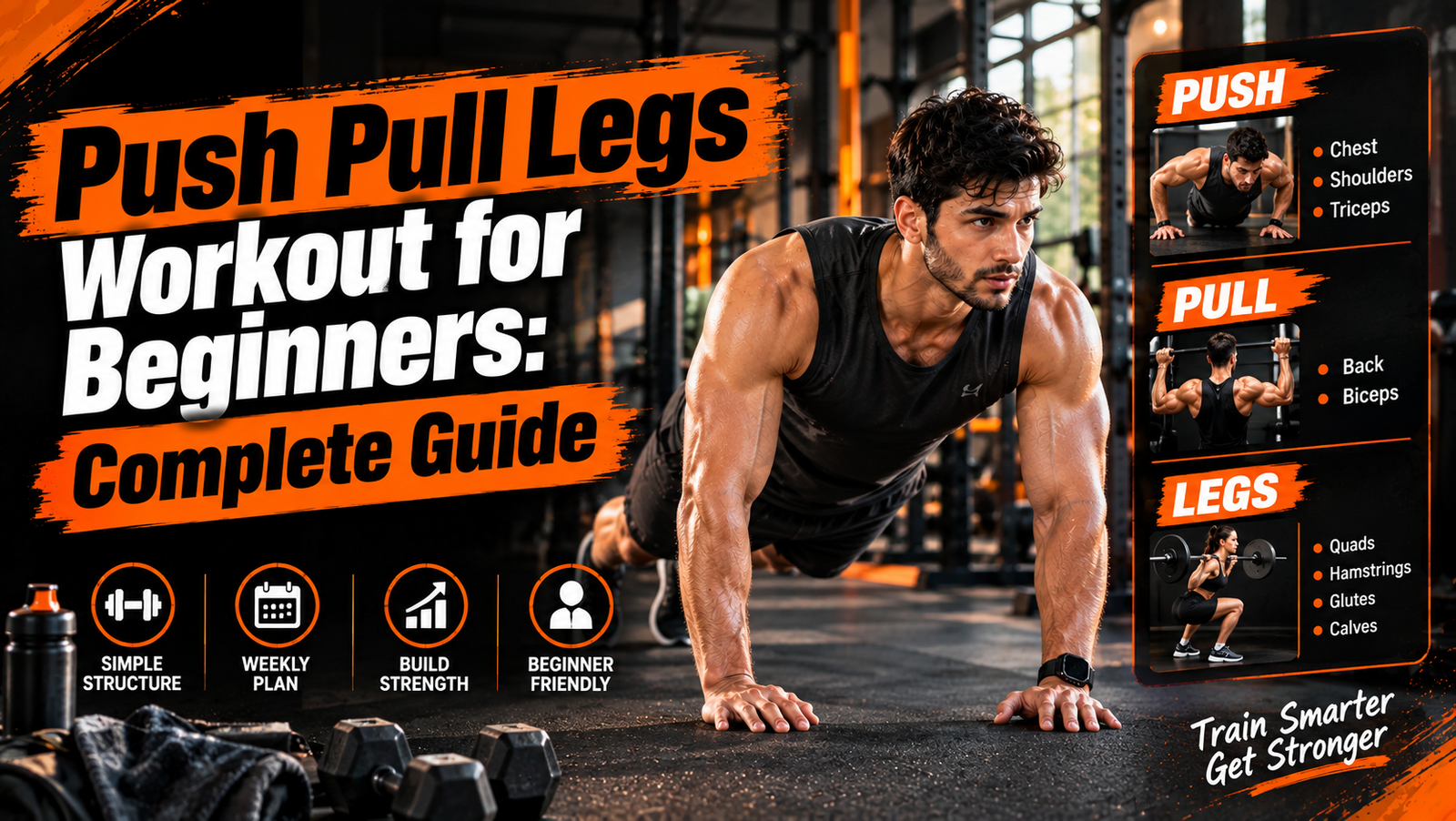
Push Pull Legs Workout for Beginners: Complete Guide
Starting a gym routine can be confusing when every person seems to recommend a different training split.
One person tells you to train one muscle group every day. Someone else recommends full-body workouts. Then you hear about the push pull legs workout for beginners and wonder whether it is actually suitable for someone who is still learning the basics.
The good news is that you do not need an advanced training history to understand a push-pull-legs routine.
The idea is quite simple: exercises are organized according to the main actions your muscles perform.
- Push: exercises where you press a resistance away from your body
- Pull: exercises where you bring resistance toward your body
- Legs: exercises focused primarily on the lower body
This structure can make your workouts easier to organize and gives different muscle groups time to recover between sessions.
However, a beginner does not necessarily need to train six days a week.
A well-planned PPL routine can be adjusted around your schedule, experience, recovery, and goals.
This guide explains how the split works, what to do on each training day, how many days to train, which exercises beginners can start with, and how to progress without turning every workout into a test of exhaustion.
All Tools
- BMI calculator
- Calorie calculator
- One rep max calculator
- Protein calculator
- Macro calculator
- Water calculator
- Ideal weight calculator
- Calorie burn calculator
- Body fat calculator
What Is a Push Pull Legs Workout?
Push Pull Legs, commonly shortened to PPL, is a workout split that divides resistance training into three broad categories.
Push Day
You train muscles that contribute mainly to pushing movements.
Typical exercises target:
- Chest
- Front and side shoulders
- Triceps
Examples include:
- Bench press
- Dumbbell press
- Machine chest press
- Overhead press
- Lateral raises
- Triceps extensions
Pull Day
Pull training focuses on muscles involved in pulling movements.
This usually includes:
- Back
- Rear shoulders
- Biceps
Examples include:
- Lat pulldowns
- Seated rows
- One-arm dumbbell rows
- Face pulls
- Biceps curls
Leg Day
The lower body gets its own session.
Commonly trained areas include:
- Quadriceps
- Hamstrings
- Glutes
- Calves
Examples include:
- Squats
- Leg presses
- Romanian deadlifts
- Leg curls
- Lunges
- Calf raises
The exact exercise selection can vary considerably.
The important concept is the organization of training, not following one specific list of exercises forever.
Why Do Beginners Consider Push Pull Legs?
One reason the PPL split is popular is that it gives a workout a clear purpose.
Instead of walking into the gym and wondering what to train, you already know the general focus of the day.
For example:
Monday → Push
Wednesday → Pull
Friday → Legs
That simple structure can remove some of the uncertainty that comes with starting resistance training.
Another advantage is that exercises involving similar movement patterns can be grouped together.
A beginner can learn a smaller number of movements, practice them repeatedly, and gradually improve rather than constantly switching between unrelated exercises.
That said, PPL is not the only good option for beginners.
A full-body routine performed two or three times per week can also work very well.
The best split is the one that fits your schedule and allows you to train consistently.
How Does a Push Pull Legs Split Work?
A basic PPL routine might look like this:
| Day | Workout |
|---|---|
| Monday | Push |
| Tuesday | Rest |
| Wednesday | Pull |
| Thursday | Rest |
| Friday | Legs |
| Saturday | Rest or light activity |
| Sunday | Rest |
This is a three-day PPL schedule.
It is a particularly simple way to introduce the concept to someone who is new to structured strength training.
A more experienced person might repeat the cycle twice:
| Day | Workout |
|---|---|
| Monday | Push |
| Tuesday | Pull |
| Wednesday | Legs |
| Thursday | Rest |
| Friday | Push |
| Saturday | Pull |
| Sunday | Legs |
But beginners should not assume that six training days are automatically better.
More sessions mean more training volume and also require more time and recovery.
Push Day Workout for Beginners
A beginner push workout should not contain ten different chest exercises.
You need a few movements that cover the major pushing muscles without creating unnecessary fatigue.
1. Chest Press
You can use:
- Barbell bench press
- Dumbbell bench press
- Machine chest press
Choose the version you can perform with good control.
For someone completely new to resistance training, a machine can sometimes make the setup easier to understand.
What to focus on
Keep your movements controlled and avoid treating the weight as the main goal.
The first few weeks are about learning how to position yourself, move through a comfortable range, and understand how the exercise feels.
2. Shoulder Press
A shoulder press trains the muscles involved in pressing overhead.
You can perform it with:
- Dumbbells
- A machine
- A barbell
A seated version may feel more stable for some beginners.
Do not force your shoulders into an uncomfortable position simply to copy someone else's range of motion.
3. Lateral Raise
Lateral raises are commonly used to train the side portion of the shoulders.
This exercise does not require very heavy weight.
In fact, beginners often benefit from using a light load and focusing on controlled movement.
Avoid swinging the weights aggressively just to complete more repetitions.
4. Triceps Exercise
You can finish a beginner push session with one direct triceps movement.
Options include:
- Cable pushdowns
- Overhead cable extensions
- Dumbbell triceps extensions
- Assisted triceps machine
One exercise is generally enough when you are starting.
Your triceps are already involved in pressing movements, so there is no need to fill the workout with several similar isolation exercises.
Example Beginner Push Day
A simple starting workout could look like this:
| Exercise | Sets | Repetitions |
|---|---|---|
| Chest press | 2–3 | 8–12 |
| Shoulder press | 2–3 | 8–12 |
| Lateral raise | 2 | 10–15 |
| Triceps pushdown | 2 | 10–15 |
The numbers are a starting framework rather than a rule.
If you are completely new, even two sets per exercise can be enough while you learn the movements.
Pull Day Workout for Beginners
Pull day focuses primarily on the back and the muscles that help you pull resistance toward your body.
A beginner routine can be surprisingly straightforward.
1. Lat Pulldown
The lat pulldown is a common beginner-friendly way to train the upper back and lat muscles.
Sit securely, grip the bar, and pull it toward your upper chest while keeping your torso controlled.
Avoid turning the exercise into a swinging movement.
The objective is not to move the heaviest possible weight.
2. Seated Cable Row
Rows train the muscles responsible for pulling the resistance toward your torso.
Sit tall, hold the handle, and pull it toward your body.
Return the weight under control rather than allowing the cable to snap forward.
A controlled return is part of the exercise.
3. Rear-Delt Exercise
You can add a movement such as:
- Reverse fly
- Face pull
- Rear-delt machine
These exercises can complement your larger back movements.
Again, keep the weight manageable.
Small shoulder movements rarely benefit from excessive loading.
4. Biceps Curl
Finish with one direct biceps exercise.
Options include:
- Dumbbell curls
- Cable curls
- Machine curls
- Hammer curls
Choose one and learn to perform it properly.
There is little reason for a beginner to perform several types of curls during the same workout.
Example Beginner Pull Day
| Exercise | Sets | Repetitions |
|---|---|---|
| Lat pulldown | 2–3 | 8–12 |
| Seated cable row | 2–3 | 8–12 |
| Face pull or reverse fly | 2 | 10–15 |
| Dumbbell or cable curl | 2 | 10–15 |
This gives you a basic combination of vertical pulling, horizontal pulling, rear-shoulder work, and direct arm training.
Leg Day Workout for Beginners
Leg day is where many beginners make the mistake of trying to copy advanced lifters.
You do not need five different squat variations and hundreds of repetitions.
Start by covering the major lower-body movement patterns.
1. Squat or Leg Press
A squat can be an excellent foundational exercise.
However, if you are still learning the movement, a leg press may provide a simpler introduction to lower-body resistance training.
Both can have a place in a beginner program.
The right choice depends on your comfort, access to equipment, mobility, and ability to perform the movement safely.
2. Romanian Deadlift
The Romanian deadlift is a hip-focused exercise that trains the posterior chain, including the hamstrings and glutes.
The movement should come primarily from bending at the hips rather than repeatedly bending the knees.
Start with a light load while learning the pattern.
If the movement feels unfamiliar, getting instruction from a qualified fitness professional can be useful.
3. Leg Curl
A leg curl provides direct work for the hamstrings.
Because the movement is relatively simple to understand, it can be a convenient accessory exercise after larger lower-body movements.
4. Calf Raise
Calf raises can be performed on a machine or with other forms of resistance.
Use a controlled movement instead of bouncing rapidly through repetitions.
Example Beginner Leg Day
| Exercise | Sets | Repetitions |
|---|---|---|
| Squat or leg press | 2–3 | 8–12 |
| Romanian deadlift | 2–3 | 8–12 |
| Leg curl | 2 | 10–15 |
| Calf raise | 2–3 | 10–15 |
You can add a lunge or split squat later if you want more single-leg training.
There is no need to turn the first leg workout into an endurance challenge.
How Many Days Should a Beginner Follow PPL?
This is one of the most important questions.
A beginner does not need to train six days per week just because the program is called Push Pull Legs.
Option 1: Three Days Per Week
This is often the easiest version to manage.
Monday: Push
Wednesday: Pull
Friday: Legs
This schedule leaves rest days between workouts.
It can work particularly well for people who are balancing training with work, college, family responsibilities, or other activities.
Option 2: PPL With a Flexible Schedule
You can also rotate through the workouts without assigning them to fixed weekdays.
For example:
Workout 1: Push
Rest
Workout 2: Pull
Rest
Workout 3: Legs
Rest
Then repeat when your schedule allows.
This approach can be useful when your working hours change from week to week.
Option 3: Six-Day PPL
A six-day routine might look like:
Monday: Push
Tuesday: Pull
Wednesday: Legs
Thursday: Push
Friday: Pull
Saturday: Legs
Sunday: Rest
This setup can provide more frequent training, but it is not automatically appropriate for beginners.
If you are still developing exercise technique, recovering from workouts, and learning how your body responds to training, starting with three sessions may be more sensible.
You can always increase training frequency later.
PPL vs Full Body for Beginners
Both approaches can work.
The important difference is how training is distributed.
| Feature | Push Pull Legs | Full Body |
|---|---|---|
| Workout focus | Specific movement groups | Multiple body areas |
| Typical session | More focused | More varied |
| Three-day schedule | Push/Pull/Legs | Full body each session |
| Missed workout impact | One category may be missed | Major areas may still be trained |
| Exercise learning | Repeated movement focus | More movement variety |
| Suitable for beginners | Yes, when simplified | Yes |
| Frequency flexibility | High | High |
If you can only train three times per week, either format can be reasonable.
Your choice can come down to preference.
Some beginners enjoy concentrating on a smaller group of movements during each session. Others prefer training their whole body each time they enter the gym.
How Much Rest Should You Take Between Sets?
There is no single rest period that works for every exercise.
A practical beginner approach is to rest long enough that you can perform the next set with reasonable technique.
For larger movements such as squats, presses, rows, and deadlift variations, you may need more recovery.
For smaller exercises such as lateral raises or curls, shorter rest periods may be sufficient.
If you are breathing heavily and your next set becomes sloppy, take more time.
Resting is not wasted time.
It helps you prepare for the next set.
How Heavy Should Beginners Lift?
Choose a resistance that allows you to perform the planned repetitions with controlled technique.
You should not need to sacrifice form simply to use a heavier weight.
For example, if your target is 8–12 repetitions and you can perform 12 controlled repetitions with room to spare, the weight may eventually be ready for a small increase.
If you can only perform a few repetitions before your technique breaks down, the load may be too high.
Your first objective is to learn the movement.
The numbers can improve afterward.
What Does "Progressive Overload" Mean?
Progressive overload simply means gradually asking your body to handle more training demand over time.
That does not always mean adding more weight.
You could progress by:
- Adding a repetition
- Adding a small amount of weight
- Performing another set
- Improving exercise technique
- Increasing your comfortable range of motion
- Using a slightly harder variation
- Reducing unnecessary rest when appropriate
For beginners, even small improvements can represent meaningful progress.
Imagine you start with a chest press at a certain weight and can perform 8 controlled repetitions.
Several weeks later, you can perform 12 repetitions with the same load.
That is progress.
You do not need to increase the weight every single workout.
The Beginner Mistake of Chasing Failure
Training to complete muscular failure means continuing until you cannot perform another repetition with acceptable technique.
Beginners do not need to take every set to that point.
Leaving some capacity in reserve can make it easier to maintain technique and recover between sessions.
For most exercises, especially when you are still learning the movement, controlled repetitions should take priority over squeezing out one additional difficult repetition.
A workout can be productive without leaving you completely exhausted.
Warm-Up Before a PPL Workout
A warm-up does not need to be a 20-minute event.
For many beginners, a short general warm-up followed by lighter sets of the first exercise is enough to prepare for the session.
You might begin with:
- 3–5 minutes of easy cardio
- Shoulder circles on push day
- Light rows or pulldowns on pull day
- Bodyweight squats on leg day
- A few easy mobility movements
Then perform one or more lighter practice sets before your working sets.
The goal is to prepare, not to tire yourself out before the actual workout.
Beginner PPL Workout: The Bigger Picture
A good PPL routine is not simply a list of exercises.
It is a system.
You need:
A clear training split
So you know what to do when you arrive.
Manageable exercise selection
So you can learn the movements properly.
Reasonable training volume
So you can recover.
Gradual progression
So the workouts continue to challenge you.
Rest and recovery
So your body has time to adapt.
Consistency
So the plan actually has time to work.
This is why a beginner should resist the temptation to copy an advanced lifter's program exactly.
Your starting point should match your current experience.
Key Takeaway From Part 1
The push pull legs workout for beginners is a straightforward way to organize resistance training into push, pull, and lower-body sessions.
A beginner-friendly version does not need a huge number of exercises or six gym visits every week.
A simple three-day structure—Push, Pull, Legs—can be enough to learn the basics, build consistency, and establish a foundation for future training.
Start with manageable weights, learn each movement carefully, allow enough recovery, and progress gradually.
The goal of your first PPL program is not to train like an advanced bodybuilder.
It is to become stronger, more confident, and more consistent with resistance training.
More Options
Push Pull Legs Workout for Beginners: Complete Guide — Part 2
A beginner does not need a complicated PPL program to make progress.
In fact, one of the easiest ways to make a new routine difficult is to add too many exercises, too many sets, and too many training days before you have learned the basics.
A better approach is to start with a manageable structure, repeat it long enough to become comfortable, and then make small changes as your strength improves.
The routine below is designed around that idea.
A Complete 3-Day PPL Workout for Beginners
If you are new to structured resistance training, this is a practical place to begin.
You can train on:
Monday → Push
Wednesday → Pull
Friday → Legs
The remaining days can be used for rest, walking, mobility work, or other light activities.
Day 1: Push Workout
1. Machine Chest Press or Dumbbell Bench Press
Sets: 3
Repetitions: 8–12
Start with a weight that allows you to control both the pressing and lowering portions of the movement.
If you are unfamiliar with free weights, a chest-press machine can make the first few sessions easier to understand.
2. Seated Shoulder Press
Sets: 2
Repetitions: 8–12
Keep the movement controlled and avoid forcing your shoulders into an uncomfortable position.
3. Cable or Dumbbell Lateral Raise
Sets: 2
Repetitions: 10–15
Use a light resistance.
The goal is to train the shoulders, not to see how much weight you can swing.
4. Triceps Pushdown
Sets: 2
Repetitions: 10–15
Keep your upper arms relatively stable while extending your elbows.
Push-Day Summary
| Exercise | Sets | Reps |
|---|---|---|
| Chest press | 3 | 8–12 |
| Shoulder press | 2 | 8–12 |
| Lateral raise | 2 | 10–15 |
| Triceps pushdown | 2 | 10–15 |
That gives you 9 working sets for the session.
You do not need to add another five chest exercises.
Day 2: Pull Workout
After a rest day, move to your pulling muscles.
1. Lat Pulldown
Sets: 3
Repetitions: 8–12
Think about bringing your elbows downward rather than simply pulling the bar with your hands.
Do not lean dramatically backward to move a heavier load.
2. Seated Cable Row
Sets: 3
Repetitions: 8–12
Keep the torso reasonably stable.
Pull the handle toward your body and return it under control.
3. Face Pull or Reverse Fly
Sets: 2
Repetitions: 10–15
Choose whichever movement feels easier for you to control.
4. Dumbbell Hammer Curl
Sets: 2
Repetitions: 10–15
Avoid using your entire body to move the dumbbells.
If you need to swing heavily to finish the repetitions, reduce the weight.
Pull-Day Summary
| Exercise | Sets | Reps |
|---|---|---|
| Lat pulldown | 3 | 8–12 |
| Seated cable row | 3 | 8–12 |
| Face pull or reverse fly | 2 | 10–15 |
| Hammer curl | 2 | 10–15 |
This gives you a balanced beginner pull session without unnecessary duplication.
Day 3: Leg Workout
Your final session of the week focuses on the lower body.
1. Leg Press or Squat
Sets: 3
Repetitions: 8–12
If you are still learning how to squat, start with a variation that allows you to maintain good control.
You can learn free-weight squatting gradually rather than rushing to use heavy loads.
2. Romanian Deadlift
Sets: 3
Repetitions: 8–12
Start light.
The movement should feel like your hips are traveling backward while your torso moves forward under control.
3. Leg Curl
Sets: 2
Repetitions: 10–15
Use a controlled range rather than trying to move the weight quickly.
4. Calf Raise
Sets: 2–3
Repetitions: 10–15
Pause briefly when appropriate and avoid bouncing through every repetition.
Leg-Day Summary
| Exercise | Sets | Reps |
|---|---|---|
| Squat or leg press | 3 | 8–12 |
| Romanian deadlift | 3 | 8–12 |
| Leg curl | 2 | 10–15 |
| Calf raise | 2–3 | 10–15 |
This is enough work for a beginner to build a foundation without turning leg day into an unnecessarily long session.
How Long Should a Beginner PPL Workout Take?
Most beginners do not need to spend two hours in the gym.
A session based on the routines above might take around 45–70 minutes, depending on your warm-up, rest periods, equipment availability, and how quickly you move between exercises.
You can make the session shorter by:
- Keeping your exercise list focused
- Preparing your equipment beforehand
- Avoiding unnecessary phone breaks
- Using efficient exercise choices
- Following a written routine
But do not rush your sets simply to finish faster.
If you need additional recovery after a demanding set, take it.
How Many Repetitions Should You Actually Do?
You will notice that the routine mostly uses ranges rather than one fixed number.
For example:
8–12 repetitions
This gives you room to progress.
Imagine you choose a weight and perform:
Week 1: 8, 8, 8
Week 2: 9, 8, 8
Week 3: 10, 9, 9
Week 4: 11, 10, 10
Eventually, you may reach the upper end of the range with good technique.
At that point, you can consider a small increase in resistance and return toward the lower end of the range.
This is often easier to manage than randomly adding weight every workout.
A Simple PPL Progression System
You can use a straightforward approach known as double progression.
The basic idea is:
- Pick a repetition range.
- Keep the weight the same while you improve your repetitions.
- Once you can reach the upper end consistently with good technique, increase the resistance slightly.
- Build the repetitions again.
Example
Suppose your dumbbell bench press target is:
8–12 repetitions
You start with a weight that allows:
10, 9, 8
Over time you might reach:
12, 12, 11
After you can comfortably perform the upper end across your sets, you can make a modest weight increase.
Your repetitions may then drop back to something like:
9, 8, 8
That is not failure.
It is simply the beginning of the next progression cycle.
How Much Weight Should You Add?
There is no universal number because different exercises and people progress at different rates.
For a beginner, small increases are usually easier to manage than large jumps.
For example:
- Add a small plate to a machine
- Move to the next available dumbbell
- Increase cable resistance slightly
- Add a small amount to a barbell
If the next available jump feels enormous, stay at your current load and work on repetitions or technique.
Progress does not have to happen every session.
Should Beginners Train Until Failure?
Not necessarily.
There is a difference between a challenging set and a set where you physically cannot complete another repetition.
For someone learning an exercise, stopping before technique falls apart is often the more sensible choice.
For example, if your squat becomes unstable or your posture changes dramatically during the final repetitions, the set has probably become too difficult.
A good training session should challenge you without turning every exercise into a maximum-effort event.
How to Know If Your PPL Routine Is Working
Do not judge your program only by the mirror or the weighing scale.
Look for several forms of progress.
Strength Progress
You may gradually lift more weight or perform more repetitions.
Technique Progress
Exercises may start feeling smoother and more controlled.
Workout Progress
You may complete your sessions with less unnecessary fatigue.
Recovery Progress
You may become more comfortable with the workload as your body adapts.
Confidence Progress
You may feel less uncertain about equipment, exercise setup, and gym routines.
All of these can be useful signs that you are moving forward.
PPL Workout for Muscle Gain
If your main goal is building muscle, resistance training should be combined with adequate nutrition and recovery.
Your workouts should provide enough training stimulus while still allowing you to recover.
A beginner does not need an enormous amount of volume to start.
Focus on:
- Consistent resistance training
- Gradual progression
- Adequate protein
- Enough total food to support your goal
- Sufficient sleep
- Recovery between sessions
The exact nutrition strategy depends on whether you are trying to gain body weight, maintain it, or lose fat while improving your body composition.
Avoid assuming that more exercises automatically mean more muscle.
Quality and consistency matter.
PPL Workout for Fat Loss
A PPL routine can also fit into a fat-loss plan.
Resistance training can help you maintain and develop strength while you work toward a lower body weight.
However, your workout does not determine fat loss by itself.
Your overall energy intake, food choices, daily movement, sleep, and consistency also matter.
A practical approach could be:
Monday: Push + normal daily activity
Tuesday: Walking
Wednesday: Pull + normal daily activity
Thursday: Walking or light activity
Friday: Legs
Saturday: Longer walk or recreational activity
Sunday: Rest
This creates a combination of resistance training and regular movement rather than relying entirely on gym sessions.
Can Beginners Follow a Six-Day PPL Routine?
Yes, some beginners can eventually train six days per week.
But "can" does not mean "should."
A six-day schedule increases the number of training sessions and may make recovery, meal planning, sleep, and scheduling more important.
If you are new to exercise, there is little reason to feel pressured into six gym visits every week.
Start with three days if that is what you can realistically maintain.
You can always increase your frequency later.
When Should You Move From 3-Day PPL to 6-Day PPL?
There is no specific deadline.
Consider increasing training frequency only if:
- You consistently complete your current sessions.
- You recover well.
- Your schedule allows additional training.
- You genuinely want more training.
- You can maintain good exercise technique.
- Additional sessions will not interfere with sleep or other responsibilities.
If your three-day routine is working and you enjoy it, there is no obligation to change.
What If You Miss a PPL Workout?
This is where beginners sometimes overcomplicate things.
Suppose you planned:
Monday: Push
Wednesday: Pull
Friday: Legs
But Wednesday becomes impossible.
You do not need to abandon the entire week.
You can simply move the Pull workout to the next suitable day.
Another option is to continue the sequence:
Push → Pull → Legs
rather than worrying about which weekday each session belongs to.
One missed workout does not erase your previous training.
What If You Can Only Train Twice a Week?
This is an important situation.
If your schedule only allows two gym sessions, forcing a traditional three-day PPL split may not be the best solution.
You could instead use a full-body approach so that major muscle groups receive attention during both sessions.
For example:
Monday: Full body
Thursday: Full body
Then return to PPL when you have more time.
The best workout split is the one that matches your actual availability.
Do not choose a six-day plan for a life that realistically gives you two training windows.
PPL for Someone Returning to the Gym
If you previously trained but have taken several months away, do not automatically return to your old weights.
Your previous numbers are useful history, not necessarily your current starting point.
Begin with manageable resistance and spend the first few sessions rebuilding your movement patterns.
You may regain strength relatively quickly, but there is still no need to rush the process.
Treat the first couple of weeks as a re-entry period.
Common Beginner Mistakes With PPL
1. Copying an Advanced Bodybuilder's Program
A routine designed for an experienced lifter may contain far more volume than a beginner needs.
Start smaller.
2. Training Six Days Because It Looks More Serious
More gym days do not automatically produce better results.
If six sessions leave you exhausted or interfere with your schedule, the plan is not serving you.
3. Changing Exercises Every Week
It is difficult to measure progress if you constantly replace your movements.
Give your main exercises enough time to become familiar.
4. Increasing Weight Too Quickly
A heavier dumbbell is not automatically a better workout.
If technique suffers, the increase was probably premature.
5. Ignoring Legs
Some beginners become enthusiastic about chest and arms and treat leg day as optional.
A balanced routine should train the whole body.
6. Spending More Time on the Phone Than Training
Long breaks can make a simple workout take much longer than necessary.
Keep your phone available for tracking your workout, but avoid turning every rest period into a scrolling session.
7. Treating Soreness as the Goal
Being extremely sore does not prove that a workout was successful.
Progress should be judged by training quality, consistency, strength, and recovery rather than soreness alone.
8. Ignoring Pain
Normal training effort and sharp or unusual pain are not the same thing.
If an exercise causes significant or persistent pain, stop and consider getting appropriate professional advice before continuing.
Rest Days Are Part of the Program
Beginners sometimes think rest days mean they are not working hard enough.
That is the wrong way to look at recovery.
Training provides a stimulus.
Recovery gives your body an opportunity to adapt to that stimulus.
Rest can include:
- Sleep
- Normal daily movement
- Easy walking
- Gentle mobility
- Relaxation
- Adequate food and fluids
You do not have to spend every rest day completely inactive.
The idea is to avoid repeatedly placing your body under demanding training stress without enough recovery.
Nutrition Basics for a Beginner PPL Routine
You do not need a complicated diet to support a beginner workout program.
Start with a generally balanced eating pattern that provides enough food and nutrients for your goals.
Useful habits can include:
- Include a protein source in meals.
- Eat a variety of fruits and vegetables.
- Choose mostly minimally processed foods where practical.
- Drink enough fluids.
- Match your overall food intake to your goal.
- Avoid relying heavily on supplements to compensate for poor eating habits.
For people in India, simple foods such as dal, curd, paneer, eggs, milk, soy foods, chicken, fish, beans, vegetables, rice, roti, oats, and fruits can all fit into a balanced diet.
Your exact nutrition needs depend on factors such as body size, activity level, goals, food preferences, and health considerations.
Sleep and Recovery for Beginners
Your workout happens in the gym, but recovery continues after you leave.
Try to establish a consistent sleep routine and give yourself enough time to recover between demanding sessions.
If you are constantly tired, unusually weak, or struggling to complete workouts that previously felt manageable, look at the bigger picture.
Possible contributors include:
- Too much training
- Not enough food
- Poor sleep
- High life stress
- Insufficient recovery
- Illness or other health factors
Do not automatically respond by adding more training.
Sometimes the smarter move is to recover.
How to Make PPL Sustainable
A program becomes useful when you can follow it for months rather than just for one enthusiastic week.
Make the routine fit your life.
Keep the Exercise List Reasonable
Four to six movements can be enough for many beginner sessions.
Track Your Workouts
Write down:
- Exercise
- Weight
- Repetitions
- Sets
- Notes about technique
You do not need sophisticated software.
A notebook or phone note is enough.
Keep a Few Core Exercises
Your main movements can stay in the program for several weeks.
You can make smaller adjustments around them.
Leave Room for Life
If you have a busy week, reduce the workload rather than quitting completely.
A flexible routine is often easier to maintain.
A Simple 8-Week Beginner PPL Roadmap
You can think about your first two months in phases.
Weeks 1–2: Learn the Movements
Do not worry about lifting impressive weights.
Learn:
- Equipment setup
- Basic exercise technique
- Appropriate range of motion
- How to track your sets
- How your body responds to training
Weeks 3–4: Establish Consistency
Try to complete your planned three sessions each week.
Begin identifying which exercises feel comfortable and which require more practice.
Weeks 5–6: Start Progressing
Use your training log.
Look for exercises where you can add a repetition or make a small resistance increase while maintaining technique.
Weeks 7–8: Review
Ask yourself:
- Am I stronger?
- Are my exercises more controlled?
- Am I recovering well?
- Do I enjoy the routine?
- Is three days still suitable?
- Do I need to change anything?
Do not change the program simply because eight weeks have passed.
Change it when there is a useful reason.
Beginner PPL Workout: Quick Reference
Push
- Chest press
- Shoulder press
- Lateral raise
- Triceps exercise
Pull
- Lat pulldown
- Seated row
- Rear-delt exercise
- Biceps curl
Legs
- Squat or leg press
- Romanian deadlift
- Leg curl
- Calf raise
Basic Starting Structure
2–3 sets per exercise
8–15 repetitions for most movements
Three training days per week
Gradual progression
Adequate recovery
This is enough structure to get started without making your training unnecessarily complicated.
When Should You Change Your PPL Program?
You do not need to change your routine just because you are bored with one exercise.
But a change can make sense if:
- An exercise consistently causes discomfort.
- You cannot access the required equipment.
- Your schedule changes.
- You have stopped progressing for an extended period.
- Your goals have changed.
- You have developed better movement skills and need a new challenge.
Even then, change one or two things at a time.
There is no need to throw away an entire program because one exercise is no longer convenient.
Safety Considerations for Beginners
Before starting resistance training, consider your current health and exercise experience.
If you have an injury, significant joint problems, a medical condition, or other health concerns that could affect exercise, speak with an appropriately qualified healthcare professional before beginning a new program.
During training:
- Learn equipment setup before adding heavy resistance.
- Keep your surroundings clear.
- Use controlled movements.
- Do not copy another person's weight.
- Stop if something feels significantly wrong.
- Ask a qualified trainer for help when you are unsure about technique.
A good beginner program should build confidence, not encourage unnecessary risk.
The Most Important Rule of PPL Training
Do not make your first goal to become an advanced lifter.
Your first goal is to become a consistent lifter.
Learn the exercises.
Show up.
Record your work.
Recover.
Improve gradually.
After several months, those small improvements can add up to a very different level of strength and confidence.
The PPL split is simply the framework.
Your consistency is what makes the framework useful.
Push Pull Legs Workout for Beginners: Complete Guide — Part 3
Conclusion: Is Push Pull Legs Good for Beginners?
A push pull legs workout for beginners can be a useful way to bring structure to your gym routine without making every workout feel random.
The basic idea is straightforward:
Push focuses on pressing movements for the chest, shoulders, and triceps.
Pull focuses on pulling movements for the back, rear shoulders, and biceps.
Legs gives your lower body its own dedicated training session.
That structure makes it easier to decide what to train, which exercises to practice, and how to organize your week.
But the name of the workout split is not what determines your results.
Your progress will depend much more on whether you can train consistently, use appropriate resistance, improve your technique, recover adequately, and gradually increase the challenge.
For a beginner, there is no need to start with an aggressive six-day program.
A simple three-day schedule can be an excellent introduction:
Monday — Push
Wednesday — Pull
Friday — Legs
You can then increase your training frequency later if your experience, schedule, and recovery make that appropriate.
Keep Your First Program Simple
Your first PPL program does not need dozens of exercises.
A handful of well-chosen movements can cover the major areas of the body.
For example:
Push: chest press, shoulder press, lateral raise, triceps exercise
Pull: lat pulldown, row, rear-delt exercise, biceps curl
Legs: squat or leg press, Romanian deadlift, leg curl, calf raise
Start with manageable weights.
Learn how each exercise works.
Keep track of your repetitions and resistance.
Then gradually make the training more challenging.
Do Not Confuse Hard With Effective
A workout does not have to leave you exhausted to be productive.
If you are unable to maintain good technique because the weight is too heavy, making the workout harder is not necessarily making it better.
Likewise, being extremely sore after every session is not a requirement for progress.
The goal is to create a training stimulus that you can recover from and repeat consistently.
Give Yourself Time
Strength and muscle development are gradual processes.
Your first improvements may be subtle.
You might notice that:
- A familiar exercise feels easier.
- Your technique becomes smoother.
- You can perform an extra repetition.
- You can use slightly more resistance.
- You feel more confident in the gym.
- Your workouts become easier to organize.
These changes are worth paying attention to.
Do not judge your entire program based on what happens during one week.
Look at your progress over several weeks and months.
Key Takeaways
- A push pull legs workout for beginners divides resistance training into push, pull, and leg sessions.
- Push workouts generally train the chest, shoulders, and triceps.
- Pull workouts generally train the back, rear shoulders, and biceps.
- Leg workouts focus on the major muscles and movement patterns of the lower body.
- Beginners can start with three training days per week rather than immediately following a six-day schedule.
- A simple PPL routine can be easier to understand than an unstructured gym routine.
- You do not need a large number of exercises to train effectively.
- Start with manageable resistance and prioritize exercise technique.
- Progress can come from additional repetitions, slightly heavier resistance, extra sets, or improved movement quality.
- You do not need to train every set to complete failure.
- Recovery, sleep, nutrition, and daily activity all contribute to your overall fitness routine.
- If you can only train twice per week, a full-body routine may be more practical than forcing a traditional PPL split.
- Missing one workout does not mean your entire program has failed.
- A sustainable routine is generally more useful than an impressive routine you cannot maintain.
A Simple Beginner PPL Plan to Save
If you want a quick reference, start here.
Push Day
Chest press: 3 × 8–12
Shoulder press: 2 × 8–12
Lateral raise: 2 × 10–15
Triceps pushdown: 2 × 10–15
Pull Day
Lat pulldown: 3 × 8–12
Seated row: 3 × 8–12
Face pull or reverse fly: 2 × 10–15
Hammer curl: 2 × 10–15
Leg Day
Squat or leg press: 3 × 8–12
Romanian deadlift: 3 × 8–12
Leg curl: 2 × 10–15
Calf raise: 2–3 × 10–15
Weekly Schedule
Monday: Push
Tuesday: Rest or light activity
Wednesday: Pull
Thursday: Rest or light activity
Friday: Legs
Saturday: Optional walking or recreational activity
Sunday: Rest
Treat these numbers as a starting framework rather than an unchangeable rule.
Your training experience, equipment, goals, and recovery should determine how the routine develops.
CTA: Start Your PPL Routine
You do not need to know everything before your first workout.
You simply need a sensible starting point.
Choose three days that fit your schedule, learn the basic movements, and begin with resistance that you can control.
Start with Push, Pull, Legs. Track your workouts. Improve gradually.
If you are unsure about exercise technique, have an existing injury, or have a medical condition that could affect your training, consider getting guidance from an appropriately qualified fitness or healthcare professional.
The objective is not to finish your first month with the hardest possible workouts.
The objective is to build a training routine you can keep following.
Frequently Asked Questions
1. Is a push pull legs workout good for beginners?
Yes. A simplified PPL routine can be suitable for beginners because it gives each workout a clear focus. However, beginners do not need to train six days per week. A three-day Push, Pull, Legs schedule can be a practical starting point.
2. How many days a week should a beginner do PPL?
Three days per week is a simple starting option: one Push session, one Pull session, and one Legs session. More experienced trainees may use a higher-frequency PPL schedule, but beginners should consider their recovery, schedule, and training experience.
3. What exercises should a beginner do on Push day?
A beginner Push workout can include a chest press, shoulder press, lateral raise, and one triceps exercise. The exact exercises can be adjusted according to available equipment and individual ability.
4. What exercises should a beginner do on Pull day?
A basic Pull workout can include a lat pulldown, seated row, rear-delt movement, and biceps curl. These exercises provide a simple combination of back and arm training.
5. What exercises should a beginner do on Leg day?
A beginner Leg workout can include a squat or leg press, Romanian deadlift, leg curl, and calf raise. A lunge or split squat can be added later as your experience develops.
6. Can beginners do PPL six days a week?
Some beginners may eventually be able to handle six training sessions per week, but it is not necessary for getting started. A three-day routine can provide a simpler introduction to resistance training while leaving more time for recovery.
7. Is PPL better than full-body workouts for beginners?
Neither is automatically better for everyone. Both PPL and full-body training can work for beginners. If you can train three days per week, you can choose between a three-day PPL routine and three full-body sessions based on your preferences, schedule, and goals.
8. How long should a beginner PPL workout take?
A beginner PPL session may take roughly 45–70 minutes depending on the exercises, warm-up, rest periods, and gym conditions. There is no requirement to spend a specific amount of time in the gym if the session is appropriately structured.
9. How quickly should beginners increase weight in PPL?
There is no fixed schedule for increasing weight. When you can consistently perform the upper end of your planned repetition range with controlled technique, you may consider a small resistance increase. Progress should be gradual rather than forced.
10. Can a PPL workout help with muscle gain and fat loss?
Resistance training can support muscle development and can also be included in a fat-loss plan. However, body composition changes depend on several factors, including training, nutrition, daily activity, sleep, and consistency. A workout split alone does not guarantee a particular result.
Stop reading, start moving
Reading about training is the easy part. Fifteen minutes today beats a fortnight of research - and all of it is free.
Start Free