Full Body Workout at Home Without Equipment
Learn how to do a full body workout at home without equipment with simple exercises for your legs, chest, back, shoulders, arms, and core.
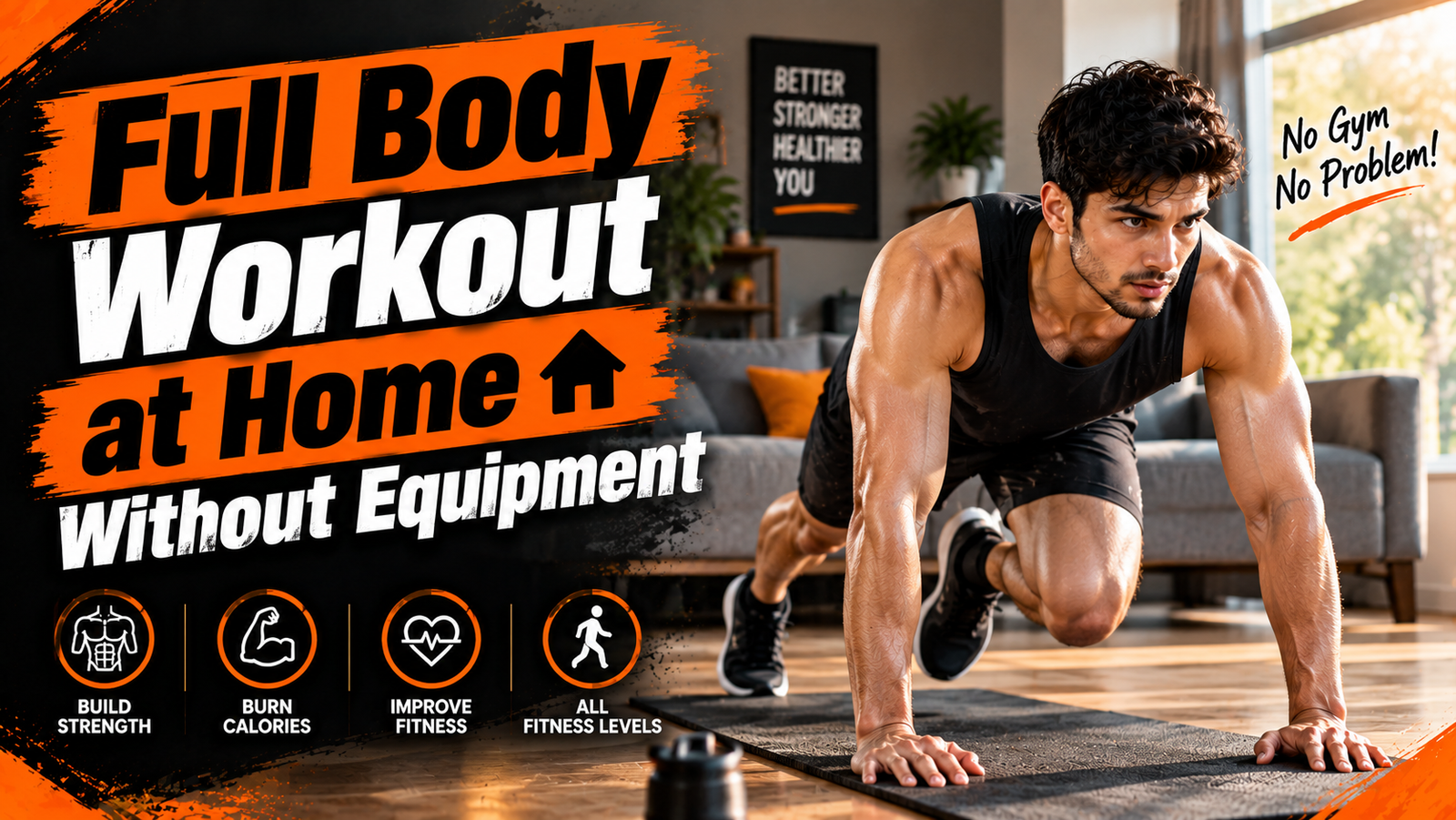
Full Body Workout at Home Without Equipment
You do not need dumbbells, resistance machines, or a gym membership to work your entire body.
A well-planned full body workout at home can use your own body weight to challenge your legs, hips, chest, shoulders, arms, back, and core. With a little floor space and a few minutes of uninterrupted time, you can build a practical workout around movements that are easy to learn and modify.
This is especially useful when you are working from home, travelling, trying to save money on gym fees, or simply prefer exercising in your own space.
The important part is not having a large collection of exercises. It is knowing how to combine basic movements so that your workout covers the major areas of the body.
This guide explains how to build a full body workout at home without equipment, which exercises to choose, how to modify them for beginners, and how to make the routine progressively more challenging.
What Is a Full Body Workout?
A full body workout is a training session that involves multiple major muscle groups during the same workout.
Instead of having one day dedicated only to legs and another dedicated only to the chest, a full body session might include:
- A squat movement for the lower body
- A pushing movement for the upper body
- A hip-focused movement
- A core exercise
- A movement that raises your heart rate
- BMI calculator
- Calorie calculator
- Macro calculator
- Protein calculator
- Body fat calculator
- One rep max calculator
The exact exercises can change depending on your fitness level and goals.
For someone training at home without equipment, bodyweight exercises are a practical starting point because many of them require nothing more than your own body and a safe surface.
Can You Get a Full Body Workout Without Equipment?
Yes.
Your body provides resistance, and you can manipulate that resistance by changing your position, range of motion, speed, balance, and exercise variation.
For example, a basic squat can eventually progress into a split squat or single-leg variation.
A wall push-up can progress toward an incline push-up and eventually a standard floor push-up.
This means a no-equipment workout does not have to remain easy forever.
However, bodyweight training has limitations. If your primary goal is maximizing strength or building substantial muscle mass, external resistance can eventually become useful. For general fitness, muscular endurance, movement practice, and beginner strength development, bodyweight exercises can be highly practical.
The Main Movement Patterns to Include
A balanced full body routine is easier to build when you think in terms of movement patterns rather than randomly selecting exercises.
1. Squat
Squatting involves bending at the hips and knees.
Examples:
- Bodyweight squat
- Chair squat
- Squat to calf raise
- Split squat
2. Hinge
A hip hinge teaches you to move from the hips while keeping your torso controlled.
Examples:
- Bodyweight hip hinge
- Good morning
- Glute bridge
3. Push
Pushing exercises train muscles around the chest, shoulders, and arms.
Examples:
- Wall push-up
- Incline push-up
- Knee push-up
- Standard push-up
4. Single-Leg Movement
Working one leg at a time can challenge strength and balance.
Examples:
- Reverse lunge
- Split squat
- Step-back lunge
- Supported single-leg squat variation
5. Core Stability
Your core helps transfer force and maintain control during movement.
Examples:
- Dead bug
- Bird dog
- Plank
- Side plank
6. Locomotion or Cardio
A short full body workout can also include movements that increase your heart rate.
Examples:
- Marching in place
- Fast feet
- Step jacks
- Mountain climbers
- Low-impact jumping jacks
You do not need to include every movement pattern in every session. The idea is to create enough variety across your training.
Best Full Body Exercises at Home Without Equipment
Let's look at the exercises you can use to build your routine.
1. Bodyweight Squats
The bodyweight squat is one of the simplest ways to train the lower body without weights.
How to do it
- Stand with your feet in a comfortable stance.
- Keep your chest relaxed and your eyes facing forward.
- Push your hips back as you bend your knees.
- Lower yourself only as far as you can control comfortably.
- Push through your feet to return to standing.
You do not need to force yourself into a very deep squat.
Your comfortable range of motion may be different from someone else's.
Beginner variation
Perform a chair squat.
Stand in front of a sturdy chair and lower yourself toward it. Lightly touch the chair before standing again.
This gives beginners a clear target and can provide additional confidence.
Progression
Once regular squats become easy, try:
- Slower squats
- Pause squats
- Split squats
- Squat-to-calf-raise combinations
2. Push-Ups
Push-ups are a useful bodyweight pushing exercise for the chest, shoulders, arms, and trunk.
But you do not have to begin with a standard floor push-up.
Push-Up Progression
Level 1: Wall push-up
Level 2: High incline push-up
Level 3: Lower incline push-up
Level 4: Knee push-up
Level 5: Standard push-up
Choose the version that allows you to maintain control.
How to Perform a Basic Push-Up
Place your hands on the floor at a comfortable width.
Keep your body reasonably straight as you lower your chest toward the floor.
Push the floor away to return to the starting position.
Avoid rushing through repetitions.
If your hips sag or your body becomes difficult to control, use an easier variation.
3. Reverse Lunges
Reverse lunges are a practical lower-body exercise that can also challenge balance.
How to do them
- Stand tall.
- Step one foot backward.
- Lower your body under control.
- Push through the front foot.
- Return to your starting position.
- Switch sides.
Compared with moving forward into a lunge, stepping backward may feel easier for some beginners because you can often control the movement more deliberately.
Beginner modification
Hold onto a stable surface for balance.
You can also make the movement shallower.
Progression
Try slowing down the lowering phase or moving toward a split squat variation.
4. Glute Bridges
If you want an exercise that targets the hips and glutes without standing, the glute bridge is an easy addition.
How to do it
Lie on your back with your knees bent and feet resting on the floor.
Press through your feet and lift your hips.
Pause briefly at the top while keeping your movement controlled.
Lower your hips and repeat.
Common mistake
Do not turn the exercise into a fast bouncing movement.
A slower, controlled repetition makes it easier to focus on the intended movement.
Progression
When regular bridges become comfortable, you can experiment with:
- Longer pauses
- Slower repetitions
- Single-leg bridge variations
Only progress when you can perform the basic version comfortably.
5. Bird Dog
The bird dog is a useful bodyweight movement for practicing core stability and coordination.
Start on your hands and knees.
Extend one arm and the opposite leg.
Pause briefly.
Return them to the starting position and switch sides.
The goal is not to lift your limbs as high as possible.
Instead, try to keep your torso steady while your arms and legs move.
This makes the exercise more about control than speed.
6. Plank
The plank is another simple exercise for training the trunk.
Start with your hands or forearms supported on the floor.
Keep your body in a controlled position and breathe normally.
Beginners can perform a knee-supported plank or use an elevated surface.
Important tip
Do not assume that a longer plank is automatically better.
If your position starts breaking down, end the set.
Quality matters more than chasing an impressive number of seconds.
7. Mountain Climbers
Mountain climbers can add a more dynamic element to your workout.
From a supported high-plank position, bring one knee toward your chest, return it, and alternate sides.
You can perform the movement slowly or increase the pace depending on your ability.
Low-impact version
Place your hands on a sturdy elevated surface and step your feet backward and forward one at a time.
This reduces the demand compared with a fast floor-based version.
8. Calf Raises
Calf raises require very little space and can easily fit into a home workout.
Stand upright and slowly rise onto the balls of your feet.
Pause briefly before lowering your heels.
For balance, use a wall or another stable surface.
You can make the exercise more challenging later by working one leg at a time.
Beginner Full Body Workout at Home
If you are new to exercise, do not try to copy an advanced workout immediately.
Start with a manageable routine.
Beginner Routine
Perform each exercise for approximately 30–40 seconds, followed by enough recovery to prepare for the next movement.
1. March in place
Use this as a gentle way to start moving.
2. Chair squats
Control the lowering phase.
3. Wall push-ups
Keep your body aligned and move at a comfortable pace.
4. Reverse step-backs
Use support if balance is difficult.
5. Glute bridges
Focus on controlled hip movement.
6. Bird dogs
Move slowly and maintain stability.
7. Calf raises
Use a wall for support if necessary.
8. Easy marching
Finish with gentle movement rather than stopping abruptly.
For a beginner, one round may be enough at first.
As your fitness improves, you can gradually add another round or increase the work interval.
20-Minute Full Body Workout Without Equipment
If you have a little more time, you can create a more complete session.
Warm-Up — 3 Minutes
Start with:
- Easy marching
- Arm movements
- Shoulder rolls
- Gentle hip movement
- Controlled bodyweight squats
Main Workout — 14 Minutes
Perform two rounds of:
- Squats — 45 seconds
- Incline or standard push-ups — 45 seconds
- Reverse lunges — 45 seconds
- Glute bridges — 45 seconds
- Mountain climbers — 30 seconds
- Bird dogs — 45 seconds
- Plank — 30 seconds
Take short recovery periods as needed.
Cooldown — 3 Minutes
Finish with easy walking and gentle mobility.
The workout does not need to leave you exhausted to be useful.
How to Structure a Full Body Workout at Home
A simple formula can help you create your own routines.
Step 1: Choose One Lower-Body Exercise
Examples:
- Squat
- Reverse lunge
- Split squat
Step 2: Choose One Upper-Body Push
Examples:
- Wall push-up
- Incline push-up
- Standard push-up
Step 3: Choose One Hip Exercise
Examples:
- Glute bridge
- Hip hinge
- Single-leg bridge
Step 4: Choose One Core Exercise
Examples:
- Dead bug
- Bird dog
- Plank
Step 5: Add a Cardio Movement
Examples:
- Marching
- Step jacks
- Mountain climbers
- Fast feet
Now you have the basic ingredients for a full body session.
You can perform these exercises as a circuit or complete several sets of each movement before moving to the next.
How Many Days a Week Should You Do a Full Body Workout?
Your ideal schedule depends on your fitness level, training history, goals, and recovery.
For someone starting out, two or three full body sessions per week can be a practical starting point.
For example:
| Day | Activity |
|---|---|
| Monday | Full body workout |
| Tuesday | Walking or light movement |
| Wednesday | Rest or mobility |
| Thursday | Full body workout |
| Friday | Walking or light cardio |
| Saturday | Optional full body workout |
| Sunday | Rest or gentle movement |
You do not need to perform the same workout every session.
You can change exercise variations while keeping the major movement patterns similar.
Full Body Workout vs Split Workout
A full body routine is not automatically better than a split routine.
They simply organize training differently.
| Feature | Full Body Workout | Split Workout |
|---|---|---|
| Muscle groups trained | Several in one session | Usually fewer per session |
| Weekly frequency | Often 2–4 sessions | Can involve more training days |
| Time efficiency | High | Depends on the split |
| Beginner friendly | Often yes | Can also work |
| Home training | Very practical | Also possible |
| Recovery | Depends on intensity | Muscle groups can be rotated |
For people with unpredictable schedules, full body training can be convenient because missing one workout does not necessarily mean an entire body part gets skipped for the week.
Important Safety Tips
A no-equipment workout is still exercise, so basic precautions matter.
Before starting:
- Clear your workout area.
- Make sure the floor is stable.
- Wear appropriate footwear if needed.
- Choose exercise variations that match your ability.
- Start gradually if you have been inactive.
During your workout:
- Breathe normally.
- Avoid uncontrolled movements.
- Rest when necessary.
- Do not force painful ranges of motion.
- Stop if you experience significant pain, dizziness, chest discomfort, or unusual symptoms.
If you have an injury, medical condition, or concerns about starting a new exercise program, consider getting guidance from an appropriate healthcare or exercise professional.
The Main Goal: Build a Routine You Can Keep
A successful home workout does not have to look impressive.
You do not need dozens of exercises or complicated combinations.
A routine containing squats, push-ups, lunges, glute bridges, a core exercise, and some form of cardiovascular movement can cover a lot of ground.
The bigger challenge is usually consistency.
If you can comfortably complete a workout twice or three times each week, you have created something you can build on.
Start with the easiest version that feels appropriate.
Learn the movement.
Repeat it consistently.
Then gradually make it more challenging.
That approach is much more sustainable than trying to turn your first home workout into an extreme fitness test.
Key Takeaway From Part 1
A full body workout at home can be simple, effective, and completely equipment-free.
The foundation is built around a few basic movement patterns: squat, hinge, push, single-leg work, core stability, and cardiovascular movement.
You can begin with beginner-friendly variations and progress toward more demanding exercises as your ability improves.
The objective is not to make every workout harder than the last.
The objective is to create a workout routine that your body can handle, your schedule can accommodate, and you can continue doing consistently.
Full Body Workout at Home Without Equipment — Part 2
15-Minute Full Body Workout at Home
If 20 or 30 minutes feels difficult to fit into your day, a focused 15-minute session can still cover several major movement patterns.
The key is to avoid spending too much time changing exercises.
2-Minute Warm-Up
Start with:
- 30 seconds easy marching
- 30 seconds arm swings
- 30 seconds bodyweight squats
- 30 seconds gentle step-touches
12-Minute Main Workout
Perform each exercise for 45 seconds, followed by 15 seconds of transition.
- Bodyweight squats
- Push-ups or incline push-ups
- Reverse lunges
- Glute bridges
- Mountain climbers
- Bird dogs
- Squats
- Push-ups
- Reverse lunges
- Glute bridges
- Marching with knee raises
- Plank
1-Minute Finish
Walk slowly around the room and allow your breathing to settle.
If 45-second intervals are too demanding, shorten the work period and take more recovery.
30-Minute Full Body Home Workout
When you have more time, you can give each movement more attention rather than simply trying to make the workout faster.
Warm-Up — 5 Minutes
Start with:
- Marching
- Side steps
- Arm circles
- Hip hinges
- Controlled squats
Strength Circuit — 20 Minutes
Complete 2–3 rounds depending on your fitness level.
Bodyweight squats: 10–15 repetitions
Push-ups: 6–15 repetitions
Reverse lunges: 8–12 repetitions per side
Glute bridges: 12–20 repetitions
Bird dogs: 8–12 repetitions per side
Plank: 20–45 seconds
Rest when needed between exercises.
Finisher — 3 Minutes
Choose one:
- Fast marching
- Step jacks
- Low-impact mountain climbers
- Brisk movement around your room
Cooldown — 2 Minutes
Finish with gentle movement and relaxed breathing.
The additional time gives you more room to work on technique, take appropriate recovery periods, and perform additional sets.
Full Body Workout for Weight Loss
A home workout can contribute to weight management by adding physical activity to your day.
However, it is important not to treat exercise as a way to "cancel out" food.
Long-term weight management involves your overall eating pattern, physical activity, sleep, recovery, and other lifestyle factors.
For a weight-loss-focused home workout, you can combine resistance-style bodyweight movements with continuous movement.
Example Routine
Perform the following for approximately 40 seconds each:
- Squats
- Fast marching
- Reverse lunges
- Incline push-ups
- Step jacks
- Glute bridges
- Mountain climbers
- Standing knee raises
- Plank
- Easy marching
Repeat the circuit according to your fitness level.
The purpose is to create a balanced session, not to chase the highest possible calorie burn.
What Matters Outside the Workout
If weight loss is your goal, also pay attention to:
- Your overall food intake
- Protein and fiber intake
- Portion sizes
- Daily walking
- Sleep
- Stress
- Recovery
- Consistency
A 20-minute workout cannot compensate for an otherwise inactive lifestyle by itself.
Popular exercises
Can You Build Muscle With a No-Equipment Workout?
You can develop strength and muscular endurance with bodyweight training, particularly if you are a beginner or returning to exercise.
The challenge is that your bodyweight provides a fixed form of resistance.
As you become stronger, the basic version of an exercise may eventually stop providing enough challenge.
This is where progression becomes important.
For example:
Squat → pause squat → split squat → single-leg variation
Or:
Wall push-up → incline push-up → knee push-up → standard push-up → more challenging push-up variation
You can continue making an exercise more demanding without immediately buying equipment.
For substantial muscle growth, however, many people eventually benefit from additional resistance because it makes progressive overload easier to manage.
How to Progress a Full Body Workout Without Equipment
Progression does not simply mean doing more repetitions.
You have several options.
1. Increase Repetitions
If you can comfortably perform 8 controlled push-ups, you may eventually work toward 10 or 12.
Do not increase repetitions if your technique deteriorates.
2. Increase Sets
Instead of one set, perform two.
Later, you may perform three sets when appropriate.
3. Use a More Difficult Variation
Examples:
Lower body:
Chair squat → squat → split squat → single-leg variation
Upper body:
Wall push-up → incline push-up → floor push-up
Core:
Knee-supported plank → standard plank → side plank or more challenging variation
4. Slow the Repetition
A controlled lowering phase can make a familiar movement more demanding.
For example, take several seconds to lower into a squat before standing.
5. Add a Pause
Pause briefly at the most challenging part of the movement.
A pause squat is more demanding than simply bouncing through repetitions.
6. Improve Range of Motion
If you can safely and comfortably use a greater range of motion, the exercise may become more challenging.
Do not force a range that causes pain.
7. Reduce Unnecessary Rest
This can increase the cardiovascular demand of a circuit.
However, for strength-focused training, adequate recovery may be more useful than constantly shortening rest periods.
Bodyweight Exercise Progression Examples
| Exercise | Easier Version | Standard Version | More Challenging Option |
|---|---|---|---|
| Squat | Chair squat | Bodyweight squat | Split squat |
| Push-up | Wall push-up | Floor push-up | Slow or paused push-up |
| Lunge | Supported step-back | Reverse lunge | Split squat |
| Glute bridge | Two-leg bridge | Controlled bridge | Single-leg bridge |
| Plank | Knee plank | Standard plank | Side plank |
| Mountain climber | Elevated step-in | Standard mountain climber | Faster controlled variation |
You do not need to progress through every variation.
Move forward when your current version feels controlled and appropriately challenging.
Full Body Workout for Beginners With Very Low Fitness
If you have been inactive for a long time, your first workouts should not feel like punishment.
Start with movements that allow you to practice basic strength and coordination.
Beginner-Friendly Session
1. March in place — 60 seconds
Keep your pace comfortable.
2. Chair sit-to-stand — 8–12 repetitions
Use your hands for support if necessary.
3. Wall push-up — 8–12 repetitions
Move slowly.
4. Supported reverse step — 6–10 repetitions per side
Hold onto a stable surface if needed.
5. Glute bridge — 8–15 repetitions
Keep the movement controlled.
6. Bird dog — 6–10 repetitions per side
Focus on balance.
7. Calf raise — 10–15 repetitions
Use support if required.
8. Easy walk — 1–2 minutes
Finish gradually.
You can repeat this routine two or three times per week if it fits your ability and recovery.
Full Body Workout for Intermediate Fitness
If basic bodyweight exercises have become comfortable, you can increase the challenge.
Intermediate Circuit
Complete 2–3 rounds:
- 12–15 squats
- 8–15 push-ups
- 10 reverse lunges per side
- 15 glute bridges
- 8 bird dogs per side
- 30–45 seconds mountain climbers
- 30–45 seconds plank
Rest between exercises as needed.
The objective is to maintain consistent technique throughout the session.
A Full Body Workout for Busy Workdays
Your workout does not have to happen at one particular time.
If you work from home or have a desk-based job, you can divide your movement throughout the day.
Morning
Complete a short strength circuit.
Midday
Take a brisk 10–15-minute walk.
Afternoon
Perform a few mobility exercises and bodyweight movements.
Evening
Use another short session if you have the energy and recovery capacity.
This approach can be easier than trying to find one uninterrupted hour.
It also gives you more opportunities to interrupt long periods of sitting.
Full Body Workout vs Walking
Walking and bodyweight training serve different purposes.
Walking is an accessible form of aerobic activity and can be an excellent way to increase daily movement.
A bodyweight workout can provide more direct strength and muscular-endurance work.
For many people, combining them is more practical than choosing only one.
For example:
Monday: Full body workout + walking
Tuesday: Walking
Wednesday: Full body workout
Thursday: Walking or mobility
Friday: Full body workout
Weekend: Walking, recreation, or rest
This combination gives you both structured exercise and lower-intensity everyday movement.
Common Mistakes During Home Full Body Workouts
Mistake 1: Doing Too Many Exercises
More exercises do not automatically produce better results.
A routine with six well-chosen movements can be more useful than a routine containing 20 exercises performed without focus.
Mistake 2: Choosing Exercises That Are Too Difficult
If you cannot control a movement, it is probably too advanced for your current ability.
Use a regression.
There is no benefit in choosing an exercise simply because it looks impressive.
Mistake 3: Turning Every Workout Into Cardio
Moving quickly from exercise to exercise can make your workout feel intense.
But intensity is not the only goal.
If you want to improve strength, give strength exercises enough attention and recovery.
Mistake 4: Ignoring the Lower Body
Some people focus heavily on push-ups and core exercises while neglecting their legs.
A balanced routine should include movements such as squats, lunges, or other lower-body exercises.
Mistake 5: Ignoring Recovery
Your body adapts during recovery.
More exercise is not always better if you are constantly exhausted or unable to maintain good movement quality.
Mistake 6: Changing the Routine Every Day
Constantly searching for a new workout can make progression difficult to track.
Repeating a routine for several weeks allows you to see whether you are improving.
Mistake 7: Expecting Immediate Results
Fitness develops over time.
Your first signs of progress may be better coordination, improved exercise control, less fatigue during the routine, or the ability to perform more repetitions.
Visible physical changes may take longer.
How Long Should a Full Body Workout at Home Be?
There is no universal ideal workout duration.
A useful session could be:
10 minutes: quick movement session
15 minutes: compact full body routine
20 minutes: balanced home workout
30 minutes: more complete training session
45+ minutes: additional volume or more specialized training
The right duration depends on your schedule and goals.
If you are consistently completing 15-minute workouts, that may be more useful than planning 60-minute workouts that you rarely perform.
How Many Repetitions Should You Do?
The answer depends on the exercise and your training goal.
For beginners, a practical starting point may be around 8–15 controlled repetitions for many bodyweight strength movements.
Timed exercises can also work well.
For example:
- 30 seconds of work
- 30 seconds of rest
Or:
- 40 seconds of work
- 20 seconds of transition
You do not need to follow one exact repetition number.
The better target is a level of difficulty that allows you to perform the movement safely while still making the set challenging.
How to Know When Your Workout Is Getting Easier
Progress can show up in several ways.
You may notice:
- You can perform more repetitions.
- You need fewer breaks.
- Your balance improves.
- Your movement feels more controlled.
- You recover more quickly.
- You can use a harder exercise variation.
- The same workout feels less tiring.
- You can maintain better technique.
These are useful signs that your fitness is developing.
Do not judge progress only by body weight or appearance.
A Simple 4-Week Home Workout Progression
You can use the following structure to build consistency.
Week 1: Learn
Focus on exercise technique.
Perform two sessions using easy variations.
Week 2: Repeat
Perform two or three sessions.
Try to make each repetition more controlled.
Week 3: Progress
Add a few repetitions, increase the work interval, or introduce one more challenging exercise variation.
Week 4: Consolidate
Keep the new difficulty level and focus on consistency.
You do not have to increase everything simultaneously.
Choose one variable to progress at a time.
Sample 4-Week Schedule
| Week | Monday | Wednesday | Friday |
|---|---|---|---|
| Week 1 | Beginner full body | Beginner full body | Optional light session |
| Week 2 | Full body | Full body | Full body |
| Week 3 | Progressed full body | Full body | Progressed full body |
| Week 4 | Full body | Full body | Full body |
On other days, you can walk, perform gentle mobility, participate in recreational activity, or rest.
How to Make Home Workouts More Convenient
Your environment can make a surprisingly big difference.
Keep a Clear Workout Area
You do not need an entire room.
A small area where you can safely lie down and move your arms and legs may be enough.
Keep Your Routine Written Down
Avoid wasting time deciding what exercise to perform next.
Save your workout on your phone or keep it somewhere visible.
Choose a Consistent Training Time
Possible options include:
- Before work
- During lunch
- After work
- Before dinner
- Early evening
The best time is the one you can regularly maintain.
Keep the Barrier Low
You do not always need special clothing, equipment, or a complicated warm-up.
For a short session, make starting as easy as possible while still exercising safely.
What If You Miss a Workout?
Do not try to "punish" yourself with an extremely difficult session the next day.
Simply return to your normal routine.
Missing one workout is not the same as abandoning your fitness plan.
Consistency is measured over weeks and months, not by whether every single day goes perfectly.
When Should You Add Equipment?
You can continue bodyweight training for quite a while, particularly if your goal is general fitness.
However, equipment may become useful when:
- Your bodyweight exercises are no longer challenging.
- You want more resistance for strength training.
- You want to make progressive overload easier.
- You want more exercise variety.
- You have specific muscle-building goals.
You do not have to buy a complete home gym.
Even simple resistance equipment can expand your options later.
But equipment is not a requirement for starting.
A Practical No-Equipment Workout Formula
If you want to create your own workout instead of following a fixed routine, use this structure:
Pick 1 Lower-Body Exercise
Squat or lunge.
Pick 1 Upper-Body Exercise
Push-up variation.
Pick 1 Hip Exercise
Glute bridge or hip hinge.
Pick 1 Core Exercise
Bird dog, dead bug, or plank.
Pick 1 Cardio Exercise
Marching, step jacks, or mountain climbers.
Then choose one of these formats:
Circuit: Perform each exercise once and repeat.
Sets: Complete several sets of each movement.
Intervals: Work for a set time followed by recovery.
This simple framework can produce dozens of different workouts without requiring complicated programming.
The Best Home Workout Is Not the Hardest One
It is easy to assume that a workout is effective only when you are exhausted afterward.
That is not a useful rule.
A well-designed workout should challenge you appropriately while still allowing you to recover and train again.
For some people, that may mean a gentle beginner session.
For others, it may mean a demanding bodyweight circuit.
Your training should meet your current level rather than someone else's.
As your ability improves, the workout can improve with you.
Key Takeaway From Part 2
A full body workout at home without equipment can be adjusted for beginners, intermediate exercisers, busy professionals, and people with different fitness goals.
You can make bodyweight exercises harder by increasing repetitions, adding sets, slowing movements, using pauses, improving range of motion, or progressing to more challenging variations.
You can also combine short home workouts with walking and everyday movement to create a more active lifestyle.
The most effective approach is usually not the most complicated one.
Choose movements you can perform well, train consistently, recover properly, and increase the challenge gradually.
Full Body Workout at Home Without Equipment — Part 3
Conclusion: You Can Train Your Whole Body at Home
A good workout does not depend on having a room full of fitness equipment.
With exercises such as squats, lunges, push-ups, glute bridges, bird dogs, planks, and bodyweight cardio movements, you can create a practical full body workout at home using very little space.
The biggest advantage of bodyweight training is flexibility.
You can make an exercise easier when you are starting out, keep the same movement as you get stronger, and then progress to a more demanding variation when the original version no longer challenges you enough.
You can also adjust the length of your workout.
If you have only 10 minutes, perform a short circuit. If you have 20–30 minutes, add more sets, exercises, or recovery time. The workout can change with your schedule without completely changing your training approach.
Most importantly, do not measure the quality of your workout only by how tired you feel afterward.
A useful workout should give your body an appropriate challenge while allowing you to recover and train consistently.
Start With the Basics
If you are new to home workouts, begin with:
- Squats or chair squats
- Wall or incline push-ups
- Reverse lunges
- Glute bridges
- Bird dogs
- A simple plank variation
- Marching or another low-impact cardio movement
Perform the exercises at a controlled pace.
Once they become comfortable, gradually increase the challenge.
Remember the Bigger Picture
A home workout is only one part of an active lifestyle.
You can support your fitness by combining structured workouts with:
- Regular walking
- Active hobbies
- Mobility work
- Adequate sleep
- Balanced nutrition
- Recovery days
- Less prolonged sitting
You do not have to make every part of your routine perfect.
A simple workout that you consistently perform is more useful than a complicated plan that never becomes a habit.
Key Takeaways
- A full body workout at home can train multiple major muscle groups without gym equipment.
- Bodyweight exercises can be modified for beginners and progressed as your fitness improves.
- A balanced session can include squatting, pushing, single-leg work, hip-focused movements, core training, and cardio.
- You can complete useful workouts in 10, 15, 20, or 30 minutes depending on your schedule.
- Beginners should prioritize movement quality rather than exercise intensity.
- Progress can come from more repetitions, additional sets, slower movements, pauses, greater range of motion, or harder exercise variations.
- You do not need to make every workout extremely difficult.
- Walking and everyday physical activity can complement structured home workouts.
- Recovery is part of training and should not be ignored.
- Missing one workout does not ruin your progress.
- Equipment can be added later if your goals require more resistance.
- The best home workout is one that fits your current ability and that you can perform consistently.
Your Simple Full Body Home Workout
If you want to start immediately, use this straightforward routine.
Warm-Up — 2 Minutes
- March in place
- Arm swings
- Gentle squats
- Side steps
Main Workout
Perform 8–15 controlled repetitions where appropriate:
1. Bodyweight squats
2. Incline or standard push-ups
3. Reverse lunges
4. Glute bridges
5. Bird dogs
6. Calf raises
7. Mountain climbers or marching
8. Plank
Rest when needed.
If you are a beginner, start with one round.
As your fitness develops, you can perform another round or move toward more challenging variations.
CTA: Start Your Full Body Workout at Home Today
You do not need to wait until you have the perfect equipment, the perfect schedule, or a gym membership.
Clear a small, safe space and start with the exercises you can perform comfortably.
Try one full body workout at home this week.
Once the routine becomes familiar, gradually increase the challenge and combine your workouts with regular walking and other physical activity.
If you are dealing with an injury, a medical condition, or unusual pain during exercise, consider speaking with an appropriate healthcare professional before starting or changing your exercise routine.
Start simple. Train consistently. Progress gradually.
Frequently Asked Questions
1. Can I do a full body workout at home without equipment?
Yes. Many full body workouts can be performed using bodyweight exercises such as squats, lunges, push-ups, glute bridges, bird dogs, planks, and mountain climbers. Exercise variations can be adjusted according to your fitness level.
2. What is the best full body workout at home for beginners?
Beginners can start with simple movements such as chair squats, wall push-ups, supported reverse lunges, glute bridges, bird dogs, calf raises, and marching. Start with manageable amounts of work and focus on learning the movements.
3. How long should a full body workout at home be?
A home workout can be 10, 15, 20, 30 minutes, or longer. The appropriate duration depends on your goals, fitness level, available time, and recovery. A shorter workout can still be useful when performed consistently.
4. Can I build muscle with a full body workout at home without weights?
Bodyweight training can help improve strength and muscular endurance, particularly for beginners. As you become stronger, you may need harder exercise variations or additional resistance to continue progressing toward certain muscle-building goals.
5. How many days a week should I do a full body workout?
For many beginners, two or three full body sessions per week can be a practical starting point. Your ideal frequency depends on workout intensity, fitness level, recovery, and other physical activities you perform.
6. Can a full body home workout help with weight loss?
It can contribute to overall physical activity and support a weight-management plan. However, weight loss depends on overall energy balance and lifestyle factors such as nutrition, daily movement, sleep, and consistency.
7. What exercises should a full body workout include?
A balanced routine can include a lower-body exercise such as squats, an upper-body pushing exercise such as push-ups, a hip-focused exercise such as glute bridges, a core exercise such as bird dogs or planks, and a cardiovascular movement.
8. How can I make a no-equipment workout harder?
You can increase repetitions, add sets, slow down repetitions, introduce pauses, increase a comfortable range of motion, reduce unnecessary rest, or progress to a more challenging exercise variation.
9. Can I do a full body workout every day?
You can be physically active every day, but challenging full body strength sessions may require recovery between workouts. Alternating strength workouts with walking, mobility, lighter activity, or rest can be a more practical approach.
10. Do I need to warm up before a home workout?
A brief warm-up can help you transition from rest to exercise and gives you an opportunity to practice the movements at an easier intensity. For a short workout, a few minutes of marching, easy squats, arm movements, and other gentle dynamic movements can be sufficient for many people.
Stop reading, start moving
Reading about training is the easy part. Fifteen minutes today beats a fortnight of research - and all of it is free.
Start Free