10-Minute Workouts for Busy People: No Equipment Needed
Discover simple 10-minute workouts for busy people that require no equipment. Try quick full-body, cardio, strength, and low-impact routines at home or anywhere.
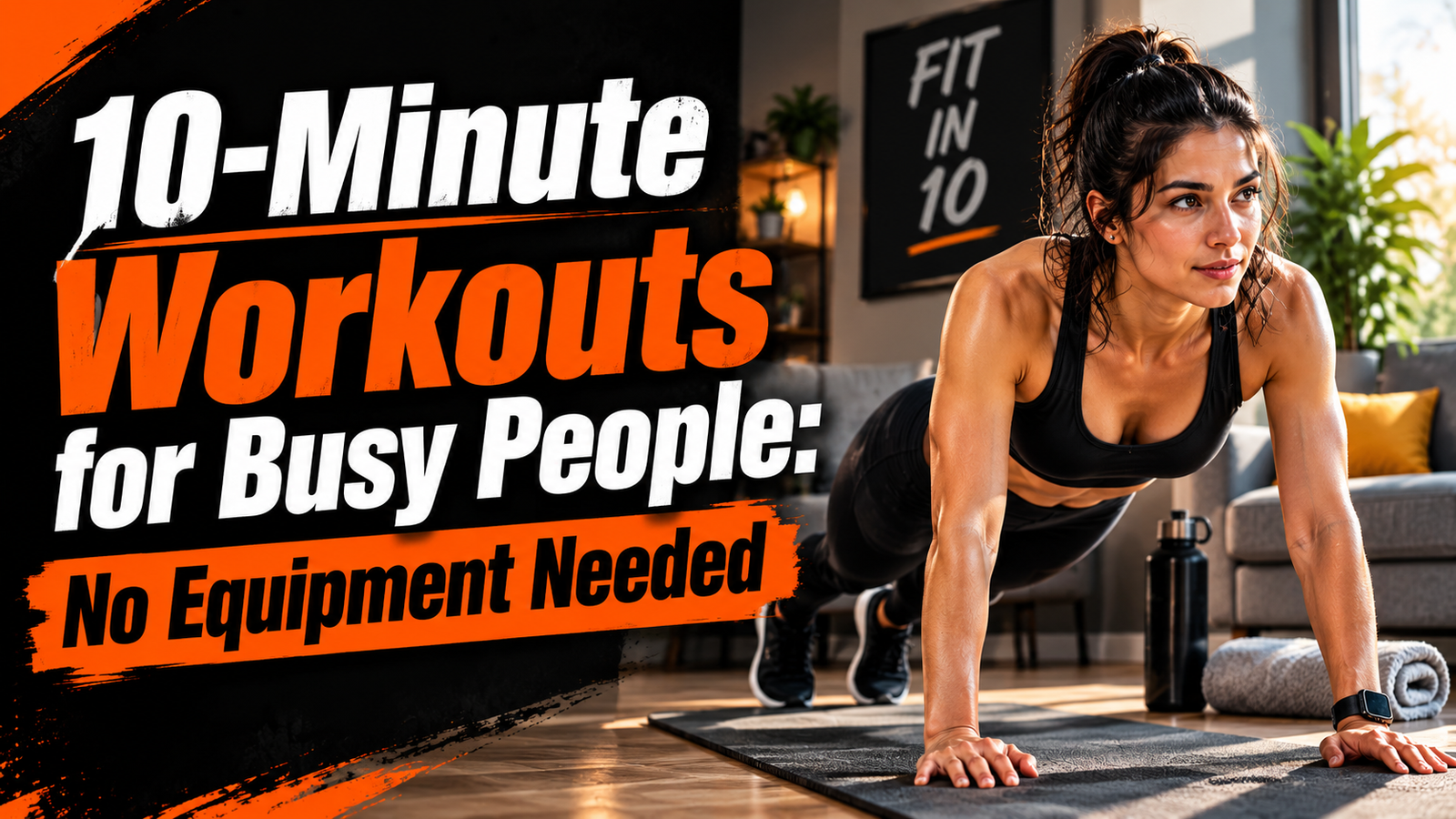
10-Minute Workouts for Busy People: No Equipment Needed
Finding time to exercise can be difficult when your day is packed with work, commuting, family responsibilities, household tasks, and everything else on your schedule. The good news is that you do not always need a long gym session to get moving.
These 10-minute workouts for busy people are designed to be simple, practical, and equipment-free. You can do them at home, in a hotel room, during a work break, or almost anywhere you have enough space to move safely.
A short workout may not replace every longer training session, but it can be a useful way to build consistency, improve fitness, and reduce the barrier to exercise.
The key is to make those 10 minutes count.
Why 10-Minute Workouts Can Be Useful for Busy People
One of the biggest challenges with exercise is not necessarily knowing what to do. It is finding a routine that fits into real life.
A workout that requires an hour of free time can be difficult to maintain when your schedule changes every day. A 10-minute routine can be easier to fit between meetings, before work, after waking up, or while dinner is cooking.
Short workouts can also help remove the common "I don't have enough time" barrier.
Instead of thinking:
"I need to exercise for an hour."
You can think:
"I have 10 minutes to move."
That small change can make exercise feel much more manageable.
Benefits of Short Workouts
Depending on the exercises and intensity, a 10-minute workout may help you:
- All Tools
- BMI calculator
- Calorie calculator
- Ideal weight calculator
- Increase daily physical activity
- Improve muscular endurance
- Strengthen major muscle groups
- Raise your heart rate
- Practice balance and coordination
- Break up long periods of sitting
- Build an exercise habit
- Make it easier to stay consistent
Your results will depend on factors such as exercise selection, intensity, fitness level, recovery, nutrition, and how regularly you train.
What Makes a Good 10-Minute Workout?
A short workout should not simply be a longer workout squeezed into 10 minutes.
The goal is to choose exercises that give you a useful training effect without unnecessary complexity.
A practical 10-minute workout can include:
- A short warm-up
- Several compound or full-body movements
- A manageable level of intensity
- Simple transitions between exercises
- A brief cooldown when appropriate
Because you have limited time, exercises that work multiple muscle groups can be particularly useful.
Examples include:
- Squats
- Lunges
- Push-ups
- Glute bridges
- Mountain climbers
- Marching in place
- Planks
- Bird dogs
You do not need expensive equipment to perform many of these movements.
10-Minute Full-Body Workout With No Equipment
If you want one simple routine to start with, try this beginner-friendly full-body workout.
The Routine
Perform each exercise for 40 seconds, followed by 20 seconds of rest or transition.
Complete one round of:
- Bodyweight squats
- Wall or incline push-ups
- Alternating reverse lunges
- Glute bridges
- Marching in place
- Bird dogs
- Standing knee raises
- Modified mountain climbers
- Dead bugs
- Plank
If 10 exercises feel too demanding at first, perform fewer exercises and gradually build up.
The goal is not to finish exhausted. The goal is to perform controlled movements that match your current fitness level.
1. Bodyweight Squats
Stand with your feet approximately shoulder-width apart.
Push your hips back and bend your knees as you lower yourself. Keep your chest comfortable and your feet planted. Stand back up under control.
Works: thighs, glutes, and other lower-body muscles.
Beginner modification: Use a chair for support or perform a sit-to-stand movement.
2. Wall or Incline Push-Ups
Place your hands against a wall or stable elevated surface. Keep your body controlled as you bend your elbows and bring your chest toward the surface. Push back to the starting position.
Works: chest, shoulders, arms, and core.
As you become stronger, you can progress from wall push-ups to incline push-ups and eventually floor push-ups if appropriate.
3. Reverse Lunges
Stand tall and step one foot backward. Lower your body as comfortably as possible, then push through the front foot to return to standing.
Alternate sides.
Works: legs and glutes while also challenging balance.
Beginner modification: Hold onto a sturdy support or reduce the depth of the movement.
4. Glute Bridges
Lie on your back with your knees bent and feet on the floor.
Press through your feet and gently lift your hips. Pause briefly at the top before lowering with control.
Works: glutes and the muscles around the hips.
This can be especially useful in a routine that also includes plenty of sitting, although it should not be considered a treatment for sitting-related pain.
5. Marching in Place
Stand tall and march while moving your arms naturally.
You can increase the pace if comfortable or keep the movement gentle for a lower-impact workout.
Works: cardiovascular fitness and coordination.
6. Bird Dogs
Start on your hands and knees.
Extend one arm and the opposite leg while maintaining a controlled position. Return to the starting position and switch sides.
Works: core stability, balance, and coordination.
Move slowly rather than trying to perform as many repetitions as possible.
7. Standing Knee Raises
Stand tall and raise one knee toward your comfortable range of motion. Lower it and alternate sides.
Use your arms naturally to help maintain rhythm.
Works: hip flexors, core, balance, and general movement capacity.
8. Modified Mountain Climbers
Start in a high-plank position if comfortable. Bring one knee toward your chest, return it, and alternate sides.
For a lower-impact option, perform the movement with your hands elevated on a sturdy surface.
Works: shoulders, core, hips, and cardiovascular fitness.
9. Dead Bugs
Lie on your back with your knees bent and arms raised.
Slowly extend one leg and the opposite arm while keeping the movement controlled. Return to the starting position and alternate sides.
Works: core control and coordination.
If maintaining control is difficult, reduce the range of motion.
10. Plank
Place your hands or forearms on the floor and maintain a stable body position.
Keep the exercise short enough that you can maintain good technique.
Beginner option: Perform the plank with your knees supported.
The purpose is controlled core work, not simply holding the position for as long as possible.
A 10-Minute Low-Impact Workout for Beginners
Not everyone needs jumping, running, or high-impact movements to get a useful workout.
If you are new to exercise, returning after a long break, or simply prefer gentler movement, try this low-impact routine.
10-Minute Beginner Routine
Perform each movement for about 45 seconds, then transition for 15 seconds.
- March in place
- Chair squats
- Wall push-ups
- Standing knee raises
- Glute bridges
- Bird dogs
- Calf raises
- Side-to-side steps
- Standing hip hinges
- Slow marching
Keep the intensity at a level where you can maintain control.
If you experience significant pain, dizziness, unusual shortness of breath, or another concerning symptom, stop exercising and seek appropriate medical guidance.
10-Minute Cardio Workout Without Equipment
You can also use a short workout to increase cardiovascular activity.
Try the following sequence:
Minute 1: March in Place
Start at an easy pace and gradually increase your movement.
Minute 2: Fast March
Increase your pace while keeping the movement controlled.
Minute 3: Step Touches
Step from side to side and move your arms naturally.
Minute 4: Knee Raises
Alternate knees while maintaining a comfortable rhythm.
Minute 5: Rest or Easy March
Use this minute to recover.
Minute 6: Fast March
Increase the pace again if appropriate.
Minute 7: Step Touches
Keep moving continuously.
Minute 8: Low-Impact Mountain Climbers
Use an elevated surface if necessary.
Minute 9: Fast March
Work at a challenging but manageable pace.
Minute 10: Easy March
Gradually reduce your pace.
This type of routine can be adapted to your fitness level. You do not need to exercise at maximum intensity for a short workout to be worthwhile.
10-Minute Strength Workout at Home
A short strength-focused workout can be built around bodyweight exercises.
Try:
Squats — 45 seconds
Rest or transition for 15 seconds.
Push-ups — 45 seconds
Use a wall or incline variation if needed.
Rest or transition for 15 seconds.
Reverse lunges — 45 seconds
Alternate legs or perform supported lunges.
Rest or transition for 15 seconds.
Glute bridges — 45 seconds
Move slowly and maintain control.
Rest or transition for 15 seconds.
Bird dogs — 45 seconds
Focus on stability rather than speed.
Rest or transition for 15 seconds.
Plank — 45 seconds
Use a modified version if necessary.
Rest or transition for 15 seconds.
Repeat selected exercises if you still have time and can maintain good form.
How to Fit a 10-Minute Workout Into a Busy Day
The best workout schedule is one that you can realistically follow.
You can use your 10 minutes at different points throughout the day.
Before Work
A short morning routine can help you start the day with movement before other responsibilities take over.
Example:
7:00 AM: 10-minute full-body workout
Then continue with your normal morning routine.
During a Work Break
If you work at a desk, use part of a break for movement.
Try:
- 2 minutes of walking
- 2 minutes of squats and sit-to-stands
- 2 minutes of marching
- 2 minutes of mobility
- 2 minutes of easy walking
After Work
A short workout immediately after work can create a transition between work and personal time.
This can be particularly useful if you tend to lose motivation later in the evening.
While Traveling
No-equipment workouts are also practical for hotel rooms or other temporary spaces.
Choose quiet exercises such as:
- Squats
- Lunges
- Wall push-ups
- Glute bridges
- Bird dogs
- Planks
- Marching
Always make sure the area is safe and provides enough space.
Is 10 Minutes of Exercise Enough?
A 10-minute workout is better viewed as one practical piece of an active lifestyle rather than a complete solution for every fitness goal.
For someone who currently does very little exercise, adding 10 minutes of purposeful movement may be a meaningful step.
For someone who already trains regularly, a 10-minute workout can serve as:
- A quick conditioning session
- A mobility break
- A short strength circuit
- A travel workout
- A backup routine on busy days
The amount of exercise you need depends on your goals, current fitness, health, and overall activity.
The important point is that exercise does not have to be all-or-nothing.
Ten minutes today can be more useful than waiting for the perfect one-hour workout that never happens.
How Often Should You Do a 10-Minute Workout?
There is no single schedule that works for everyone.
A beginner might start with 2–3 short workouts per week and add more movement as their fitness and schedule allow.
Someone with more experience may use short sessions more frequently, especially when combining them with walking, sports, cycling, or longer workouts.
A simple weekly structure could look like this:
| Day | 10-Minute Activity |
|---|---|
| Monday | Full-body strength |
| Tuesday | Brisk walking or easy cardio |
| Wednesday | Full-body strength |
| Thursday | Mobility or walking |
| Friday | Cardio circuit |
| Saturday | Optional activity |
| Sunday | Rest or gentle movement |
The goal is not to make every day intense.
Allow your body enough time to recover, particularly when performing challenging strength or cardio sessions.
How to Make a 10-Minute Workout More Effective
The solution is not always to make the workout harder.
Instead, focus on quality.
1. Reduce Unnecessary Rest
Prepare your workout space and exercises before starting so you are not spending half of the 10 minutes deciding what to do.
2. Use Compound Movements
Exercises such as squats, lunges, push-ups, and mountain climbers can involve multiple muscle groups.
3. Maintain Good Technique
More repetitions do not automatically mean a better workout.
Controlled movement is generally more useful than rushing through exercises with poor form.
4. Adjust the Intensity
Make exercises easier or harder based on your current ability.
For example:
Push-up progression:
Wall push-up → incline push-up → knee push-up → standard push-up
You can progress gradually rather than jumping directly to a difficult variation.
5. Stay Consistent
A simple routine performed regularly may be easier to maintain than an advanced routine that you only do occasionally.
The 10-Minute Rule for Busy Days
One useful strategy is to create a personal 10-minute rule.
When your schedule is overloaded, commit to doing just 10 minutes.
After 10 minutes, you can stop if you want.
If you feel good and have more time, you can continue.
This removes the pressure to complete a long workout and makes exercise easier to start.
For example:
Normal day: 30–45 minute workout
Busy day: 10-minute workout
Extremely busy day: 5–10 minutes of walking and mobility
This approach helps keep movement part of your routine even when life becomes unpredictable.
Key Takeaway From Part 1
You do not need a gym membership, expensive equipment, or a large block of free time to start exercising.
A well-designed 10-minute workout for busy people can combine strength, cardio, mobility, and core exercises using only your body weight.
Start with movements you can perform safely and consistently. As your fitness improves, gradually increase the challenge rather than trying to do everything at once.
The best short workout is the one you can actually fit into your life and repeat.
Advanced 10-Minute Workouts for Busy People
Once you are comfortable with the basic routines, you can make your 10-minute workouts more structured.
The goal is not to make every session extremely difficult. Instead, choose a format that matches your fitness level and your goal.
Here are several practical formats you can rotate throughout the week.
10-Minute Full-Body Circuit
A circuit keeps you moving from one exercise to another with limited rest.
Try:
- 45 seconds bodyweight squats
- 15 seconds rest
- 45 seconds push-ups or incline push-ups
- 15 seconds rest
- 45 seconds reverse lunges
- 15 seconds rest
- 45 seconds glute bridges
- 15 seconds rest
- 45 seconds mountain climbers
- 15 seconds rest
- 45 seconds bird dogs
- 15 seconds rest
- 45 seconds standing knee raises
- 15 seconds rest
- 45 seconds plank
- 15 seconds rest
- 45 seconds marching
- 15 seconds rest
- 45 seconds easy movement or breathing
Choose easier variations if necessary.
The objective is to maintain good technique throughout the session.
10-Minute Workout for Weight Loss
If your goal is weight management, a short workout can be one part of a larger strategy that includes regular physical activity, adequate sleep, and appropriate nutrition.
A 10-minute workout does not need to be designed around maximum calorie burn.
Instead, combine movements that use several large muscle groups with continuous activity.
Example Routine
Minute 1: Fast marching
Minute 2: Bodyweight squats
Minute 3: Step-back lunges
Minute 4: Incline push-ups
Minute 5: Marching with knee raises
Minute 6: Glute bridges
Minute 7: Low-impact mountain climbers
Minute 8: Squats to calf raises
Minute 9: Fast marching
Minute 10: Easy movement and recovery
You can increase the pace as your fitness improves.
However, weight loss generally depends on your overall energy balance over time, not on one short workout.
A consistent 10-minute routine can help increase activity, but nutrition and total daily movement also matter.
10-Minute Workout for Building Strength
Short workouts can also support strength development, particularly for beginners.
Focus on controlled bodyweight movements and gradually make them more challenging.
Strength Circuit
Perform each exercise for approximately 40 seconds with 20 seconds to transition.
- Squats
- Push-ups
- Reverse lunges
- Glute bridges
- Pike push-ups or elevated push-ups
- Single-leg glute bridge
- Plank
- Bird dog
- Split squat
- Slow mountain climbers
You do not need to perform every exercise at maximum effort.
For strength-focused training, exercise quality and progressive overload become increasingly important.
10-Minute Core Workout
If you want a short session focused on core stability, try:
1. Dead Bug
Perform controlled alternating repetitions.
2. Bird Dog
Focus on keeping your torso stable.
3. Glute Bridge
Keep the movement controlled.
4. Forearm Plank
Hold for a manageable period.
5. Side Plank
Use your knees for support if needed.
6. Heel Taps
Move slowly rather than rushing.
7. Plank Shoulder Taps
Reduce the range or use an elevated surface if necessary.
8. Dead Bug
Finish with another controlled set.
Core training should not be limited to exercises that create a burning sensation. Stability, control, breathing, and the ability to maintain a good position are also useful goals.
10-Minute Workout for Office Workers
If you spend much of the day sitting, you can use a short movement session to break up your workday.
You do not necessarily need to change into workout clothes.
Try this routine:
1 minute: Walk around your room or office
1 minute: Chair sit-to-stands
1 minute: Wall push-ups
1 minute: Standing calf raises
1 minute: Alternating knee raises
1 minute: Shoulder and upper-back movements
1 minute: Bodyweight squats
1 minute: Standing hip hinges
1 minute: Easy walking
1 minute: Deep breathing and gentle mobility
This type of session is particularly useful when your alternative is remaining seated for another uninterrupted block of time.
It should complement regular exercise rather than replace all other physical activity.
10-Minute Morning Workout
If mornings are the easiest time for you to exercise, keep the routine simple.
Morning Routine
Minute 1: Easy marching
Minute 2: Bodyweight squats
Minute 3: Arm circles and shoulder movements
Minute 4: Reverse lunges
Minute 5: Wall or incline push-ups
Minute 6: Glute bridges
Minute 7: Bird dogs
Minute 8: Standing knee raises
Minute 9: Easy full-body movement
Minute 10: Slow breathing and gentle mobility
You can perform this routine before breakfast if that feels comfortable, but there is no requirement to exercise fasted.
The most important factor is choosing a time that fits your routine.
10-Minute Evening Workout
Some people prefer exercising after work.
An evening workout can help create a clear transition between work and personal time.
Try:
- 2 minutes of easy walking
- 2 minutes of squats and lunges
- 2 minutes of push-ups
- 2 minutes of glute and core exercises
- 2 minutes of easy mobility
If vigorous exercise close to bedtime makes it harder for you to sleep, consider using a lower-intensity routine instead.
How to Progress a 10-Minute Workout
Doing the same workout forever may eventually become too easy.
You can increase the challenge gradually without making the workout much longer.
Progression Method 1: Improve Technique
Before adding more repetitions, make sure you can perform the exercise with control.
For example:
Instead of doing 20 rushed squats, perform 12–15 controlled squats with a comfortable range of motion.
Progression Method 2: Increase Repetitions
If your form remains strong, gradually increase repetitions during a timed interval.
For example:
Week 1: 10 squats
Week 2: 12 squats
Week 3: 14 squats
The exact numbers are less important than gradual progression.
Progression Method 3: Use a More Challenging Variation
You can progress from:
- Wall push-ups → incline push-ups
- Incline push-ups → floor push-ups
- Chair squats → bodyweight squats
- Supported lunges → reverse lunges
- Regular glute bridges → single-leg variations
Progression Method 4: Reduce Rest
If the workout has become comfortable, slightly reducing transition time can increase the overall challenge.
Do this gradually.
Progression Method 5: Increase Control
Slow repetitions can make a familiar exercise more challenging.
For example, take several seconds to lower into a squat rather than dropping quickly.
10-Minute Workout Progression Table
| Level | Workout Approach | Example |
|---|---|---|
| Beginner | Easy movements and more recovery | Wall push-ups, chair squats |
| Early intermediate | Standard bodyweight exercises | Squats, lunges, floor push-ups |
| Intermediate | More repetitions or harder variations | Split squats, standard push-ups |
| Advanced | Complex movements and higher intensity | Jump squats, advanced push-up variations |
Not everyone needs to reach the advanced level.
Your ideal workout should match your current ability and goals.
How to Make No-Equipment Workouts Harder
You can create more challenge even when you do not have dumbbells or gym machines.
Increase Range of Motion
If you can comfortably move through a larger range, this can increase the challenge of some exercises.
Slow Down
Controlled repetitions can increase the time your muscles spend working.
Use Single-Limb Exercises
Examples include:
- Single-leg glute bridges
- Split squats
- Single-leg calf raises
- Supported single-leg balance exercises
These movements can be more demanding than their two-leg versions.
Add Pauses
Pause briefly at the most challenging point of an exercise.
For example, pause at the bottom of a squat before standing.
Use More Difficult Variations
Progress only when the easier version is comfortable and controlled.
Common Mistakes When Doing 10-Minute Workouts
Short workouts are convenient, but there are several mistakes worth avoiding.
Mistake 1: Trying to Exercise as Hard as Possible
A 10-minute workout does not have to leave you completely exhausted.
High intensity is only one training variable.
Better approach: Choose an intensity you can handle while maintaining good technique.
Mistake 2: Skipping Movement Preparation
Starting immediately with difficult exercises may not feel comfortable.
Use the first minute or two for easier movements when needed.
Mistake 3: Choosing Too Many Exercises
A long list of complicated exercises can waste time.
Better approach: Choose 5–10 simple movements that match your goal.
Mistake 4: Ignoring Technique
Because the workout is short, some people rush.
Speed should not come at the expense of control.
Mistake 5: Doing the Same Workout Every Day
Recovery matters.
You can rotate strength, cardio, mobility, walking, and rest days instead of repeating the same demanding routine daily.
Mistake 6: Expecting a 10-Minute Workout to Do Everything
Short workouts are useful, but your overall activity matters.
Walking, recreational activity, sports, cycling, household movement, and longer workouts can all contribute to an active lifestyle.
Mistake 7: Increasing Difficulty Too Quickly
Progress gradually.
If an exercise becomes painful or your technique breaks down, return to an easier variation.
10-Minute Workout vs 30-Minute Workout
Both can be useful.
The better option depends on your available time, goals, fitness level, and consistency.
| Factor | 10-Minute Workout | 30-Minute Workout |
|---|---|---|
| Time commitment | Very low | Moderate |
| Easy to fit into busy days | Excellent | Good |
| Exercise variety | Limited | Greater |
| Strength training | Possible | More flexibility |
| Cardio training | Possible | More time available |
| Beginner friendly | Yes | Yes |
| Habit building | Excellent | Good |
| Recovery needs | Usually lower | Can be higher depending on intensity |
A 10-minute workout should not be viewed as a replacement for every longer session.
Instead, it is another useful tool.
Can You Split Exercise Into Multiple 10-Minute Sessions?
Yes, short periods of activity can be practical when a continuous workout does not fit your schedule.
For example:
Morning: 10-minute strength workout
Afternoon: 10-minute brisk walk
Evening: 10-minute mobility session
This gives you three separate opportunities to move during the day.
The exact approach should depend on your schedule and goals.
If you are new to exercise, splitting activity into smaller sessions may feel more manageable than trying to complete one long workout.
What to Do If You Only Have 5 Minutes
Some days will be too busy even for 10 minutes.
Instead of abandoning movement completely, use five minutes.
Try:
Minute 1: March in place
Minute 2: Squats or chair sit-to-stands
Minute 3: Wall push-ups
Minute 4: Alternating reverse lunges or supported step-backs
Minute 5: Easy walking and breathing
You can also use five minutes for mobility or a quick walk.
The goal is to avoid an all-or-nothing mindset.
How Busy Professionals Can Build a Workout Habit
A short workout becomes much easier when you remove unnecessary decisions.
Keep Your Routine Visible
Write your routine somewhere you will see it.
Pick a Consistent Time
For example:
- Immediately after waking
- Before lunch
- During an afternoon break
- Immediately after finishing work
Prepare Your Space
Clear enough floor space before starting.
Use a Simple Routine
You do not need a new workout every day.
Repeating a basic routine can make the habit easier to maintain.
Have a Backup Plan
If your normal 30-minute workout is not possible, use your 10-minute routine instead.
This keeps one busy day from becoming an entire inactive week.
A Sample 7-Day 10-Minute Workout Plan
Here is a simple weekly structure for generally healthy adults who want to build a consistent movement habit.
| Day | Workout |
|---|---|
| Monday | 10-minute full-body strength |
| Tuesday | 10-minute cardio |
| Wednesday | 10-minute mobility + core |
| Thursday | 10-minute full-body strength |
| Friday | 10-minute low-impact cardio |
| Saturday | 10-minute optional workout or walk |
| Sunday | Rest or gentle movement |
You can adjust this schedule according to your fitness level.
If you already perform longer workouts, these short sessions can be used as supplementary activity rather than your entire training program.
How Nutrition Fits Into Short Workouts
Exercise is only one part of overall health and fitness.
If your goal is weight loss, a short workout should be combined with sustainable eating habits rather than treated as a way to compensate for food intake.
If your goal is muscle gain or strength, adequate protein, calories, recovery, and progressive resistance training become increasingly important.
For a general fitness goal, focus on:
- A varied diet
- Adequate protein
- Fruits and vegetables
- Whole grains and other nutrient-rich carbohydrate sources
- Healthy fat sources
- Sufficient fluids
- Appropriate portion sizes
For Indian households, simple options can include dal, beans, curd, paneer, eggs, vegetables, fruit, whole grains, and other foods that fit your dietary preferences.
Individual nutritional needs vary, particularly if you have a medical condition or specific dietary requirement.
Safety Tips for 10-Minute Workouts
Short workouts still require sensible exercise practices.
Before exercising:
- Choose a safe surface.
- Wear suitable footwear when needed.
- Keep enough space around you.
- Start with an appropriate intensity.
- Use exercise variations that match your ability.
During the workout:
- Focus on controlled movement.
- Breathe normally.
- Take additional rest when needed.
- Stop if you experience significant pain or concerning symptoms.
If you have a medical condition, recent injury, significant joint problems, or concerns about starting exercise, consider speaking with a qualified healthcare professional or exercise professional before beginning a new program.
The Best 10-Minute Workout Is the One You Can Repeat
There is no single perfect 10-minute workout.
A busy office worker may benefit from a simple full-body circuit.
A beginner may prefer low-impact exercises.
Someone focused on strength may prioritize squats, push-ups, lunges, and core exercises.
Another person may simply need a short walk to break up a sedentary day.
The important principle is consistency.
Instead of asking:
"What is the hardest workout I can fit into 10 minutes?"
Ask:
"What workout can I safely perform today and continue doing regularly?"
That question leads to a more sustainable approach to fitness.
Practical 10-Minute Workout Strategy
If you are unsure where to begin, use this simple framework:
Step 1: Pick Your Goal
Choose one:
- General fitness
- Strength
- Cardio
- Mobility
- Weight management
- Breaking up sitting time
Step 2: Choose 5–8 Exercises
Keep them simple.
Step 3: Set a Timer
Use work and rest intervals that match your ability.
Step 4: Focus on Technique
Do not rush simply because the session is short.
Step 5: Record Your Progress
You can track:
- Number of sessions
- Exercise variations
- Repetitions
- How difficult the workout felt
- Walking or other daily activity
Step 6: Progress Gradually
Increase difficulty only when your current routine feels manageable.
Key Takeaway From Part 2
A 10-minute workout can be adapted for strength, cardio, mobility, core training, weight management, or simply breaking up long periods of sitting.
The biggest advantage is often convenience.
When exercise fits easily into your day, you have fewer barriers to getting started.
Build around simple movements, adjust intensity to your fitness level, progress gradually, and remember that short workouts work best when they are part of an overall active lifestyle.
Consistency beats perfection.
Conclusion: Make 10 Minutes Count
You do not need a gym, expensive equipment, or a large amount of free time to become more active.
The best 10-minute workouts for busy people are simple enough to fit into real life and flexible enough to adapt to different fitness levels.
You can use bodyweight exercises such as squats, lunges, push-ups, glute bridges, planks, and marching to create effective short routines at home, at work, or while travelling.
If you are a beginner, start with low-impact movements and focus on technique. As you become more comfortable, gradually increase repetitions, improve exercise variations, reduce unnecessary rest, or make movements more challenging.
Most importantly, do not fall into the all-or-nothing mindset.
A 10-minute workout may not accomplish everything a longer training session can, but it can help you stay active when your schedule is busy. Combined with regular walking, everyday movement, nutritious food, adequate recovery, and longer workouts when possible, short sessions can become a practical part of a healthy lifestyle.
You do not need a perfect schedule to exercise. You need a routine that works with the schedule you actually have.
Key Takeaways
- 10 minutes can be enough to get meaningful movement into a busy day.
- No equipment is required for many effective bodyweight exercises.
- Full-body exercises can help you make better use of limited time.
- Beginners should start with manageable intensity and simpler exercise variations.
- You can use short workouts for strength, cardio, mobility, core training, or general fitness.
- Gradually increase the challenge as your fitness improves.
- Do not sacrifice exercise technique simply to complete more repetitions.
- A 10-minute workout can be used as a backup when a longer workout is not possible.
- Breaking up long periods of sitting with movement can complement structured workouts.
- Your overall activity, nutrition, sleep, and recovery matter alongside short workouts.
- Consistency is generally more useful than waiting for the perfect one-hour workout.
A Simple Action Plan for Today
If you have been struggling to find time for exercise, start with one simple session today.
Your 10-Minute Starter Workout
Minute 1: March in place
Minute 2: Bodyweight squats
Minute 3: Wall or incline push-ups
Minute 4: Reverse lunges
Minute 5: Glute bridges
Minute 6: Marching with knee raises
Minute 7: Bird dogs
Minute 8: Low-impact mountain climbers
Minute 9: Plank or modified plank
Minute 10: Easy walking and breathing
Adjust the exercises and intensity to your ability.
Once this becomes comfortable, you can begin progressing the routine or alternate it with other 10-minute workouts.
CTA: Start Your 10-Minute Workout Today
Busy schedules do not have to mean giving up on exercise.
Choose 10 minutes today, put your phone aside, create a safe space, and complete a simple bodyweight routine.
If you want more structured fitness guidance, explore beginner-friendly workout plans and combine short workouts with walking, strength training, mobility work, and healthy nutrition.
Start small, stay consistent, and build from there.
All Tools
Frequently Asked Questions
1. Are 10-minute workouts effective?
Yes, 10-minute workouts can be useful for increasing physical activity, improving fitness, and building an exercise habit. Their effectiveness depends on the exercises, intensity, fitness level, goals, and consistency.
2. Can I lose weight with a 10-minute workout?
A 10-minute workout can contribute to an active lifestyle and may support weight management, but weight loss depends on your overall energy balance and lifestyle. Nutrition, daily movement, sleep, and regular exercise also play important roles.
3. What is the best 10-minute workout for busy people?
A simple full-body routine can be a good choice because it can combine lower-body, upper-body, core, and cardiovascular movements. Squats, push-ups, lunges, glute bridges, marching, and planks are examples.
4. Can I do a 10-minute workout every day?
You can include some form of movement every day, but the type and intensity should vary according to your fitness level and recovery needs. Challenging strength workouts do not necessarily need to be performed every day.
5. Do I need equipment for a 10-minute workout?
No. Many 10-minute workouts can be performed using only bodyweight exercises. A chair, wall, or other stable household surface can sometimes be used for exercise modifications or support.
6. What is the best 10-minute workout for beginners?
Beginners can start with low-impact movements such as marching, chair squats, wall push-ups, glute bridges, calf raises, bird dogs, and gentle mobility exercises.
7. Can a 10-minute workout replace a gym workout?
Not necessarily. A 10-minute workout can be a useful alternative when time is limited, but longer workouts provide more time for exercise variety, strength training, cardiovascular work, and progressive training.
8. Can I split my workout into two or three 10-minute sessions?
Yes, splitting physical activity into shorter sessions can be a practical strategy when you cannot find one longer block of free time. For example, you could exercise for 10 minutes in the morning and take a 10-minute walk later.
9. How can I make a 10-minute workout harder?
You can gradually increase repetitions, use more challenging exercise variations, reduce unnecessary rest, increase range of motion, slow down repetitions, or add pauses. Progress gradually and maintain good technique.
10. What should I do if I only have 10 minutes to exercise?
Choose a few simple exercises that match your goal and fitness level. A combination of squats, push-ups, lunges, glute bridges, marching, and core exercises can create a practical full-body session.
Stop reading, start moving
Reading about training is the easy part. Fifteen minutes today beats a fortnight of research - and all of it is free.
Start Free