Zone 2 Walking: What It Is and How to Do It
Learn what Zone 2 walking is, how to find your walking intensity, how long to walk, and how to build a beginner-friendly Zone 2 walking routine.
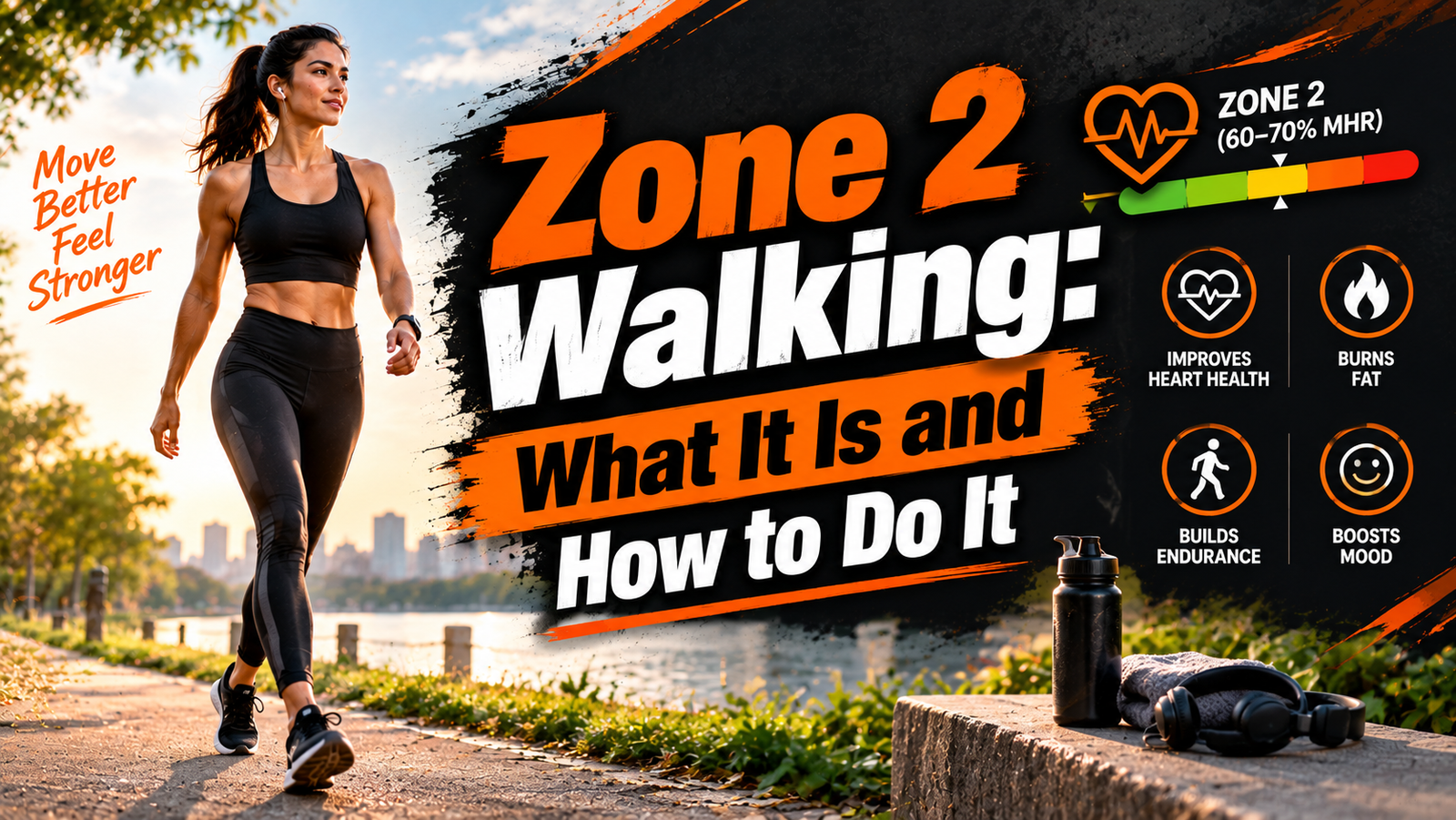
Zone 2 Walking: What It Is and How to Do It
Walking is one of the simplest ways to become more active, but you may have heard a newer fitness term that sounds more technical: Zone 2 walking.
So, what exactly is Zone 2 walking?
In simple terms, Zone 2 walking means walking at a relatively easy-to-moderate aerobic intensity that you can sustain for a longer period. You are working harder than during a very relaxed stroll, but you are not pushing yourself to the point where you are struggling to breathe.
The idea is to spend time exercising at an intensity that supports aerobic fitness while remaining manageable enough for sustained activity.
For many people, walking can be an accessible way to train in this intensity range. However, there is no single walking speed that automatically puts everyone in Zone 2. Your appropriate intensity depends on factors such as fitness level, age, terrain, heart rate response, and individual physiology.
This guide explains Zone 2 walking, how to recognize the intensity, whether you need a heart-rate monitor, how long to walk, common mistakes, and how beginners can create a practical routine.
What Is Zone 2?
Zone 2 is a term used in exercise training to describe a relatively low-to-moderate aerobic intensity.
Heart-rate training often divides exercise intensity into different zones. The exact definitions can vary depending on the method being used, the device, and the training system.
In a simplified five-zone model:
| Zone | General Effort | Typical Feeling |
|---|---|---|
| Zone 1 | Very easy | Relaxed and comfortable |
| Zone 2 | Easy to moderate | Steady and sustainable |
| Zone 3 | Moderate to hard | Noticeably challenging |
| Zone 4 | Hard | Difficult to sustain |
| Zone 5 | Very hard | Near-maximal effort |
Zone 2 is therefore not the same as maximum-effort cardio.
You should generally be able to maintain the activity for a meaningful period without feeling like you are racing against the clock.
An Important Point About Zone Definitions
There is no single universal formula that perfectly determines your Zone 2 heart rate.
Different approaches may use:
- All Tools
- Push Ups
- Squats
- Burpees
- All workouts
- Diet plan
- Maximum heart rate
- Heart-rate reserve
- Resting heart rate
- Lactate-related thresholds
- Ventilatory thresholds
- Individual exercise testing
For everyday walking, you do not necessarily need laboratory testing to get started.
A combination of heart rate, perceived effort, and your ability to talk can provide a practical starting point.
What Does Zone 2 Walking Feel Like?
One of the easiest ways to understand Zone 2 walking is to focus on how the effort feels.
During a suitable Zone 2 walk, you should generally feel like you are exercising, but not struggling.
You may notice:
- Your breathing is faster than at rest.
- Your heart rate is elevated.
- You feel warm after walking for a while.
- You can maintain the pace for a relatively long period.
- You can generally speak in sentences.
- You are not constantly stopping to recover.
This is different from a completely relaxed walk where your breathing barely changes.
It is also different from a very hard walk where talking becomes difficult.
The Talk Test for Zone 2 Walking
The talk test is a simple way to judge exercise intensity without relying entirely on a fitness tracker.
Try speaking a full sentence while walking.
If you can comfortably hold a conversation but can tell that you are exercising, you may be around a moderate aerobic intensity.
If you can barely speak because you are breathing too heavily, the intensity is probably higher.
If you can talk effortlessly without noticing any increase in breathing, you may be walking at a very easy intensity.
The talk test is not a laboratory measurement of Zone 2, but it can be a useful practical tool for everyday exercise.
Does Zone 2 Walking Have to Be Slow?
No.
This is one of the most important things to understand.
Zone 2 is about intensity, not a fixed walking speed.
One person may reach a moderate aerobic intensity while walking at a relatively slow pace.
Another person with a higher fitness level may need to walk considerably faster, walk uphill, or use a treadmill incline to reach a similar physiological intensity.
For example:
Beginner
A beginner may reach the desired intensity with a comfortable outdoor walk.
Moderately Fit Walker
Someone with more fitness may need a faster pace to achieve a similar effort.
Highly Fit Person
A very fit person may find ordinary flat walking too easy and need a faster pace, incline, or another form of aerobic exercise.
This is why copying someone else's walking speed is not an accurate way to determine your own Zone 2.
How to Find Your Zone 2 Walking Intensity
There are several ways to estimate your training intensity.
Method 1: Perceived Effort
Use a scale from 1 to 10.
A rough practical target for moderate aerobic walking might feel around 3–4 out of 10, although individual perceptions vary.
You should feel that you are exercising without feeling close to your maximum effort.
Method 2: Talk Test
Use your ability to speak as a practical guide.
You should generally be able to speak in sentences while maintaining your walk.
Method 3: Heart-Rate Monitor
A smartwatch, chest strap, or other heart-rate monitor can provide real-time heart-rate information.
This can be useful if you want to monitor your intensity more closely.
However, consumer devices are not perfect, and heart-rate readings can vary depending on the device, fit, movement, temperature, stress, caffeine, hydration, and other factors.
Method 4: Professional Testing
Exercise testing can provide a more individualized assessment of aerobic thresholds.
This may be relevant for athletes or people who want detailed training information, but it is usually unnecessary for someone simply trying to add healthy aerobic walking to their routine.
How to Estimate Heart Rate for Zone 2
You may see formulas online that estimate Zone 2 using maximum heart rate.
One commonly used approach starts by estimating maximum heart rate and then calculating a percentage range.
For example, a basic maximum-heart-rate estimate is sometimes expressed as:
Estimated maximum heart rate = 220 − age
A percentage of that estimate may then be used to create training zones.
However, this is only a rough estimate.
Maximum heart rate can vary substantially between individuals of the same age, so formula-based zones should not be treated as exact personal measurements.
Another method uses heart-rate reserve, which incorporates resting heart rate.
The calculation is:
Heart-rate reserve = estimated maximum heart rate − resting heart rate
A target heart rate can then be estimated using a selected percentage of heart-rate reserve plus resting heart rate.
Again, these calculations are estimates rather than guarantees of your exact physiological Zone 2.
For everyday walking, combining heart-rate information with perceived effort and the talk test is often more practical.
Example: Using the Talk Test Instead of a Formula
Suppose you start walking at a relaxed pace.
After five minutes, your breathing is still almost unchanged.
You gradually increase your pace.
After another few minutes, you notice that your breathing is faster, your heart rate has increased, and you can still comfortably speak in complete sentences.
That may be a useful intensity for your aerobic walking session.
If you continue increasing your pace until you are struggling to speak, you have probably moved into a higher intensity.
The goal is not to find the fastest pace you can tolerate.
The goal is to find a sustainable aerobic effort.
How Long Should You Do Zone 2 Walking?
There is no single duration that everyone must follow.
If you are new to exercise, starting with a shorter session can be sensible.
For example:
Beginner: 15–20 minutes
Regular walker: 25–40 minutes
More experienced walker: 40–60 minutes or longer, depending on goals and recovery
These are practical examples rather than strict prescriptions.
You can gradually increase duration as your fitness and tolerance improve.
If 30 minutes feels comfortable, you might eventually walk for 40 minutes.
If 40 minutes is comfortable, you could gradually progress toward 45 or 50 minutes.
The important principle is gradual progression.
A Beginner Zone 2 Walking Workout
If you are completely new to structured walking, try this simple session.
25-Minute Beginner Session
5 minutes — Easy warm-up
Walk comfortably and allow your body to warm up.
10 minutes — Steady aerobic walking
Increase your pace until you feel that you are exercising but can still speak comfortably.
5 minutes — Steady walking
Maintain a similar comfortable aerobic effort.
5 minutes — Easy cool-down
Slow your pace gradually.
This session does not need to feel difficult.
The purpose is to become comfortable with sustained aerobic movement.
Why Warm-Up and Cool-Down Matter
A warm-up gives you time to transition gradually from rest to exercise.
For walking, a warm-up does not need to be complicated.
Start at a comfortable pace and gradually increase your speed.
A cool-down works in the opposite direction.
Instead of stopping suddenly after a brisk walk, reduce your pace for several minutes.
This can make the transition back to normal activity feel more comfortable.
Zone 2 Walking vs. Normal Walking
Not every walk has the same purpose.
A casual walk might be primarily about relaxation, transportation, or getting some movement.
Zone 2 walking is more intentional.
| Type of Walk | Effort | Main Purpose |
|---|---|---|
| Casual stroll | Very easy | General movement and relaxation |
| Easy walk | Easy | Active recovery and daily activity |
| Zone 2-style walk | Easy to moderate | Sustained aerobic exercise |
| Brisk/harder walk | Moderate to hard | Higher-intensity fitness work |
| Very hard walking | Hard | Shorter, challenging efforts |
You can include different types of walking in the same week.
There is no need to turn every walk into a Zone 2 workout.
Benefits of Zone 2 Walking
Zone 2 walking can be a practical form of aerobic exercise because it combines movement with a manageable level of effort.
Potential benefits of regular aerobic activity include:
- Improving cardiovascular fitness
- Supporting general physical health
- Increasing daily energy expenditure
- Building exercise consistency
- Improving exercise tolerance
- Providing a low-impact alternative to running for many people
- Helping reduce sedentary time
The exact benefits depend on the individual and the overall exercise routine.
Zone 2 should not be treated as a magic training zone that produces guaranteed fat loss or special results.
It is simply one way to structure aerobic exercise.
Is Zone 2 Walking Good for Weight Loss?
Zone 2 walking can contribute to a weight-management routine because walking uses energy and increases physical activity.
However, the phrase "Zone 2 burns fat" can be misleading if it is interpreted as meaning that Zone 2 automatically causes more body-fat loss.
Your body uses a mixture of energy sources during exercise.
More importantly, long-term changes in body weight are influenced by overall energy balance and lifestyle habits.
If weight loss is your goal, consider the bigger picture:
- BMI calculator
- Calorie calculator
- 28 Day Abs Starter
- Legs And Glutes
- Total physical activity
- Food intake
- Portion sizes
- Protein and fibre intake
- Sleep
- Stress
- Consistency
- Recovery
Zone 2 walking can be one useful component of that plan.
Who Can Try Zone 2 Walking?
Zone 2-style walking can be accessible to many people because walking is relatively simple and easy to modify.
It can be particularly useful for:
- Beginners who want structured aerobic exercise
- People who enjoy walking more than running
- People returning to regular exercise
- Individuals looking for a manageable cardio routine
- People who want to increase aerobic activity gradually
However, your exercise routine should match your individual health and fitness situation.
If you have a medical condition, significant joint problems, unexplained exercise-related symptoms, or have been inactive for a long period and are unsure how to begin, consider speaking with a qualified healthcare professional before significantly increasing exercise.
The Bottom Line
Zone 2 walking means walking at a sustainable aerobic intensity rather than simply walking at a particular speed.
You can estimate the intensity using your perceived effort, the talk test, heart-rate data, or a combination of these methods.
You do not need to walk extremely fast.
You also do not need an expensive fitness tracker to begin.
Start at a comfortable level, gradually increase your pace until you reach a steady aerobic effort, and maintain that intensity for a manageable amount of time.
For many people, the biggest benefit is not finding a perfect heart-rate number.
It is building a consistent habit of aerobic movement that fits into everyday life.
How to Know If You Are Actually Walking in Zone 2
One of the biggest challenges with Zone 2 walking is knowing whether your intensity is appropriate.
You do not need to become obsessed with a precise heart-rate number.
Instead, use several signals together.
1. Your Breathing
Your breathing should be noticeably faster than when you are sitting or walking very slowly.
However, you should not feel like you are gasping for air.
2. Your Ability to Talk
You should generally be able to speak in complete sentences.
If you can only say a few words before needing to breathe, slow down.
3. Your Perceived Effort
On a scale from 1 to 10, your effort should feel relatively comfortable but clearly active.
If your walk feels like a near-maximal workout, you are going too hard for a typical Zone 2 session.
4. Your Heart Rate
If you use a reliable heart-rate monitor, you can use heart rate as an additional reference.
Remember that heart rate can change because of:
- Heat
- Humidity
- Dehydration
- Stress
- Caffeine
- Poor sleep
- Medication
- Illness
- Hills or inclines
This means the same walking pace may produce different heart rates on different days.
Why Your Zone 2 Walking Pace Can Change
Do not expect your Zone 2 pace to remain exactly the same.
Your body responds to many factors.
For example, imagine you usually walk outdoors at a particular pace in mild weather.
On a hot and humid day, that same pace may make your heart rate rise more quickly.
You may need to slow down to maintain a similar aerobic effort.
On another day, you may feel fresh and walk faster while maintaining a similar perceived effort.
This is why effort is often more useful than chasing a fixed walking speed.
Zone 2 Walking on a Treadmill
A treadmill can make Zone 2 walking easier to control because you can adjust speed and incline precisely.
For example, you might begin with:
- 5 minutes at an easy pace
- Gradually increase speed
- Find a pace where breathing becomes steady but controlled
- Maintain that effort
- Reduce speed for the final few minutes
If flat treadmill walking is too easy, a small incline can increase the challenge.
However, do not assume that a particular treadmill speed or incline is automatically Zone 2.
Your personal response matters more than the treadmill setting.
Treadmill vs. Outdoor Zone 2 Walking
| Factor | Treadmill | Outdoor Walking |
|---|---|---|
| Pace control | Very precise | Depends on terrain |
| Weather | Not an issue | Can affect intensity |
| Incline | Easy to adjust | Depends on route |
| Environment | Controlled | More varied |
| Motivation | May feel repetitive | Can be more enjoyable |
| Monitoring | Easy to track | GPS/watch can help |
| Convenience | Useful at home/gym | Can be done almost anywhere |
Both can work well.
Choose whichever makes it easier for you to exercise consistently.
How to Build a Zone 2 Walking Routine
If you are new to aerobic training, avoid trying to do long sessions immediately.
A gradual approach can help you build consistency.
Week 1: Get Comfortable
Aim for 2–3 walking sessions.
Each session could be around 20–25 minutes, including an easy warm-up and cool-down.
Focus on learning what a sustainable aerobic effort feels like.
Week 2: Add Time
If Week 1 feels comfortable, gradually increase your main walking period.
You might aim for approximately 25–30 minutes per session.
Week 3: Build Consistency
Continue with 3 sessions and consider adding another easy aerobic walk if your schedule and recovery allow.
Week 4: Increase Duration
You could gradually move toward 30–40 minute sessions.
There is no requirement to increase every week.
If your body needs more time to adapt, repeat the same duration for another week.
Example Weekly Zone 2 Walking Plan
A simple weekly routine could look like this:
| Day | Workout |
|---|---|
| Monday | 30-minute Zone 2-style walk |
| Tuesday | Easy movement or rest |
| Wednesday | 30–35-minute Zone 2 walk |
| Thursday | Rest or easy walk |
| Friday | 30-minute Zone 2 walk |
| Saturday | Optional longer easy walk |
| Sunday | Rest |
This is only an example.
You can adjust the number of sessions and duration based on your fitness, schedule, and recovery.
Should You Do Zone 2 Walking Every Day?
You do not necessarily need a dedicated Zone 2 workout every day.
Daily movement is beneficial, but structured exercise should fit your overall routine.
For example, you might combine:
- Zone 2 walking
- Easy walking
- Strength training
- Mobility work
- Rest days
- Other recreational activities
A balanced routine can be easier to maintain than doing the same workout every day.
If you enjoy walking and recover well, you may choose to walk frequently, but not every walk needs to be at the same intensity.
Zone 2 Walking and Strength Training
If your goal is overall fitness, combining aerobic activity with strength training can be useful.
For example:
Monday: Zone 2 walking
Tuesday: Strength training
Wednesday: Zone 2 walking
Thursday: Rest or easy walking
Friday: Strength training + short easy walk
Saturday: Longer Zone 2 walk
Sunday: Rest
You can modify this schedule according to your goals.
Strength training and walking serve different purposes, so they can complement each other.
Zone 2 Walking for Beginners
One of the advantages of walking is that you can adjust the intensity very easily.
A beginner does not need to match the pace of someone who has been exercising for years.
Start with a comfortable walk.
After several minutes, gradually increase your pace.
Ask yourself:
- Is my breathing faster?
- Do I feel warm?
- Can I still speak in sentences?
- Could I maintain this effort for another 15–20 minutes?
If the answer is yes, you may be at a useful aerobic intensity.
If the walk feels extremely easy, increase the pace slightly.
If you are struggling to talk, reduce the pace.
How to Progress Your Zone 2 Walking
Progression does not always mean walking faster.
You have several options.
Option 1: Increase Duration
For example:
30 minutes → 35 minutes → 40 minutes
Option 2: Improve Walking Pace
If your fitness improves, you may naturally be able to walk faster while maintaining a similar effort.
Option 3: Add a Gentle Incline
A treadmill incline or gentle hill can increase the challenge.
Option 4: Add Another Weekly Session
For example:
2 sessions → 3 sessions → 4 sessions
Option 5: Improve Consistency
If you frequently miss workouts, simply becoming more consistent may be the most useful form of progression.
You do not have to change everything at once.
What If Walking Does Not Raise Your Heart Rate Enough?
Some people, particularly those with good aerobic fitness, may find ordinary flat walking too easy to reach the intensity they are targeting.
You can gradually increase the challenge by:
- Walking faster
- Choosing a route with gentle hills
- Using a treadmill incline
- Increasing the duration
- Using a more purposeful stride
If you still cannot reach your desired intensity through walking, another low-impact aerobic activity may be more suitable.
Examples include cycling, elliptical training, or other activities that allow you to comfortably sustain the desired effort.
Zone 2 Walking and Weight Loss
Zone 2 walking can support weight management because it adds physical activity without necessarily requiring very intense exercise.
However, be careful with claims that Zone 2 is uniquely capable of "burning fat."
Your body uses different fuel sources during exercise, and the proportion can change with intensity.
More fat oxidation during a particular workout does not automatically mean greater long-term body-fat loss.
For weight loss, the broader picture remains important.
Consider:
- Total daily movement
- Overall calorie intake
- Food quality and portions
- Exercise consistency
- Sleep
- Recovery
- Stress management
A sustainable walking routine can be valuable, but it should not be presented as a shortcut.
Zone 2 Walking vs. High-Intensity Cardio
Zone 2 and high-intensity exercise are different tools.
| Feature | Zone 2 Walking | High-Intensity Cardio |
|---|---|---|
| Effort | Easy to moderate | Hard to very hard |
| Duration | Usually longer | Usually shorter |
| Recovery demand | Generally lower | Generally higher |
| Accessibility | High for many people | Can be more challenging |
| Equipment | Often unnecessary | May require equipment depending on activity |
| Beginner-friendly | Often yes | Not always |
| Main approach | Sustainable aerobic work | Shorter challenging efforts |
You do not necessarily have to choose one forever.
A well-rounded exercise routine can include different intensities when appropriate.
Pros of Zone 2 Walking
1. Accessible
Walking requires very little equipment and can be performed in many environments.
2. Easy to Modify
You can change your pace, terrain, duration, or incline.
3. Sustainable
Many people find moderate walking easier to maintain than frequent high-intensity workouts.
4. Lower Impact Than Running
Walking generally creates less impact than running, although it can still place stress on the feet, ankles, knees, and hips.
5. Easy to Schedule
A walking session can often be divided into shorter periods during the day.
6. Useful for Building Exercise Habits
It can provide a simple starting point for people who want to become more active.
Potential Limitations of Zone 2 Walking
Zone 2 walking is not perfect for every person or every goal.
Potential limitations include:
- Flat walking may be too easy for very fit individuals.
- Heart-rate zones can be difficult to estimate accurately.
- Fitness trackers are not always perfectly accurate.
- Walking pace can vary substantially between people.
- Weather can affect outdoor intensity.
- Some people may find long walks repetitive.
- Walking alone may not provide enough resistance training for complete fitness.
These limitations do not make Zone 2 walking ineffective.
They simply show why your exercise routine should be matched to your goals.
Common Zone 2 Walking Mistakes
Mistake 1: Walking Too Hard
Many people assume that harder is always better.
If you are constantly out of breath, you may be exercising at a higher intensity than intended.
Slow down.
Mistake 2: Walking Too Slowly
The opposite can also happen.
If your walk feels exactly like standing or casually moving around the house, you may not be providing much aerobic challenge.
Increase your pace slightly if appropriate.
Mistake 3: Obsessing Over a Heart-Rate Number
Heart rate is useful information, but it is not the only indicator.
Stress, temperature, hydration, sleep, caffeine, medication, and other factors can affect your heart rate.
Use it as one piece of information rather than an absolute rule.
Mistake 4: Copying Someone Else's Pace
Your Zone 2 walking pace is individual.
Do not assume that someone walking beside you at a particular speed is training at the same intensity.
Mistake 5: Ignoring Terrain
A pace that feels easy on flat ground may feel significantly harder uphill.
Adjust your speed according to the terrain.
Mistake 6: Increasing Duration Too Quickly
If you suddenly go from 20-minute walks to 90-minute walks every day, your body may not have enough time to adapt.
Increase gradually.
Mistake 7: Treating Zone 2 as a Magic Weight-Loss Method
Zone 2 can be useful exercise, but it does not bypass the fundamentals of nutrition, activity, and sustainable habits.
How to Track Your Zone 2 Walking
You can track your sessions using as much or as little technology as you prefer.
Basic Tracking
Record:
- Date
- Walking duration
- Distance
- How the session felt
Heart-Rate Tracking
If you have a smartwatch or chest strap, record your average or general heart-rate range.
Advanced Tracking
More experienced exercisers may track:
- Pace
- Heart rate
- Distance
- Elevation
- Duration
- Perceived effort
- Recovery
Do not let tracking become so complicated that it prevents you from actually enjoying the walk.
Signs That Your Fitness May Be Improving
Over several weeks, you may notice that:
- The same route feels easier.
- You can walk for longer.
- You recover faster after walking.
- You can maintain a faster pace at a similar perceived effort.
- Hills feel less difficult.
- Your breathing feels more controlled.
These changes can be useful signs of improved exercise tolerance.
You do not need to chase a specific heart-rate number to notice progress.
How to Use Zone 2 Walking in Hot Indian Weather
If you are walking outdoors in a hot or humid climate, your heart rate and perceived effort may increase even at a familiar pace.
This is particularly relevant in many parts of India during warmer months.
Consider:
- Walking during cooler parts of the day
- Choosing shaded routes
- Carrying water for longer sessions
- Wearing breathable clothing
- Reducing your pace when conditions are uncomfortable
- Moving indoors when heat or air quality makes outdoor exercise unsuitable
Do not force your usual pace simply because your fitness tracker shows a particular target.
Environmental conditions matter.
Zone 2 Walking on Different Terrains
Flat Road
Usually easier to maintain a consistent pace.
Gentle Hill
Can increase intensity without requiring a major increase in speed.
Steep Hill
May quickly push you into a higher intensity.
Treadmill
Allows precise control of speed and incline.
Trail
Provides changing terrain and can make intensity less predictable.
The same person may need different speeds on each surface to maintain a similar effort.
A Practical 4-Week Zone 2 Walking Progression
If you want a structured starting point, this is one example:
| Week | Sessions | Approx. Main Walking Time |
|---|---|---|
| Week 1 | 2–3 | 15–20 min |
| Week 2 | 3 | 20–30 min |
| Week 3 | 3 | 25–35 min |
| Week 4 | 3–4 | 30–40 min |
Include warm-up and cool-down time separately.
You can repeat a week instead of progressing if the current level still feels challenging.
The purpose is to build a sustainable aerobic habit rather than finish the progression as quickly as possible.
Your Zone 2 Walking Checklist
Before a session:
- [ ] Choose a safe walking route.
- [ ] Wear comfortable footwear.
- [ ] Consider weather and air quality.
- [ ] Decide whether you will use a heart-rate monitor.
- [ ] Start with an easy warm-up.
During the session:
- [ ] Gradually increase your pace.
- [ ] Check your breathing.
- [ ] Use the talk test.
- [ ] Avoid turning every session into a race.
- [ ] Adjust for hills, heat, and fatigue.
After the session:
- [ ] Cool down gradually.
- [ ] Hydrate as appropriate.
- [ ] Note how the session felt.
- [ ] Allow adequate recovery.
- [ ] Look at progress over weeks rather than one workout.
The Most Important Principle
You do not need to find the "perfect" Zone 2 heart rate before you can benefit from walking.
For most people, the practical goal is to perform regular aerobic activity at a sustainable intensity.
Use your breathing, perceived effort, talk ability, and heart-rate data together.
Then focus on consistency.
A 30-minute walk that you perform regularly is more useful than a theoretically perfect training zone that you rarely use.
Zone 2 walking works best when it becomes part of a realistic lifestyle rather than another complicated fitness rule.
Conclusion
Zone 2 walking is a simple way to make your regular walks more intentional.
Instead of focusing only on distance, steps, or speed, Zone 2 walking focuses on maintaining a sustainable aerobic effort. You should feel that you are exercising, but you should still be able to speak in sentences without struggling for breath.
You do not need to walk at one specific speed to achieve this intensity. Your ideal pace depends on your fitness level, terrain, weather, age, heart-rate response, and other individual factors.
For beginners, the simplest approach is to start with comfortable walking and gradually increase your pace until your breathing becomes noticeably faster while remaining controlled. The talk test and perceived effort can be useful alongside heart-rate information.
A smartwatch or heart-rate monitor can provide additional information, but you do not need expensive equipment to start walking.
The most important factor is consistency.
Rather than trying to find a perfect heart-rate number or turning every walk into a challenging workout, focus on building a routine that you can maintain.
If you enjoy walking, Zone 2-style sessions can become a practical part of your weekly fitness routine.
Key Takeaways
- Zone 2 walking is sustained aerobic walking at a relatively easy-to-moderate intensity.
- Zone 2 does not mean one fixed walking speed for everyone.
- Your fitness level, terrain, weather, and individual physiology can affect your walking intensity.
- The talk test is a simple way to estimate whether your effort is appropriate.
- You can also use perceived effort and heart-rate data.
- Heart-rate formulas provide estimates and should not be treated as exact measurements.
- Beginners can start with short sessions and gradually increase duration.
- A 20–30 minute session can be a practical starting point for many people.
- You can make walking more challenging by increasing pace, using gentle inclines, or walking for longer.
- Not every walk needs to be a Zone 2 workout.
- Zone 2 walking can complement strength training and other forms of exercise.
- Zone 2 walking can support weight management as part of an overall active lifestyle, but it is not a magic fat-loss method.
- Hot weather, humidity, dehydration, stress, and other factors can affect heart rate and perceived effort.
- Consistency is more important than finding a theoretically perfect training zone.
A Simple Zone 2 Walking Formula
If you want to keep things simple, remember this:
Start easy → gradually increase your pace → find a sustainable aerobic effort → maintain it → cool down.
During the main part of the walk, ask yourself:
Can I still speak in sentences?
If yes, and the walk feels clearly more active than a casual stroll, you may be around a useful moderate aerobic intensity.
If you are struggling to talk, reduce your pace.
If the walk feels almost effortless, gradually increase the pace if appropriate.
CTA: Start Your Zone 2 Walking Routine
You do not need a complicated workout program to start improving your aerobic activity.
Put on comfortable walking shoes, choose a safe route, start slowly, and gradually find a pace that feels sustainable.
Ready to make walking part of your fitness routine?
[Business/Offer CTA: Add your fitness program, coaching service, walking challenge, app, consultation, or relevant offer here.]
CTA example:
"Want a personalized walking and fitness routine? [Book a consultation / Join our program / Download our walking plan] and get practical guidance based on your goals and current fitness level."
Frequently Asked Questions
1. What is Zone 2 walking?
Zone 2 walking means walking at a relatively easy-to-moderate aerobic intensity that can generally be sustained for an extended period. You should feel that you are exercising, but you should not be struggling to breathe.
2. How do I know if I am walking in Zone 2?
You can use several indicators, including perceived effort, breathing, the talk test, and heart-rate information. A practical sign is that your breathing is noticeably faster but you can still speak in complete sentences.
3. What heart rate is Zone 2?
There is no single Zone 2 heart rate that applies to everyone. Heart-rate zones can be estimated using different formulas and methods, but individual heart rates and physiological thresholds vary. For everyday walking, combine heart-rate information with perceived effort and the talk test.
4. Is Zone 2 walking good for beginners?
Yes. Walking can be an accessible way for beginners to perform aerobic exercise because you can easily adjust the speed and duration. Start with a manageable session and gradually increase your activity as your fitness improves.
5. How long should I do Zone 2 walking?
There is no universal duration. Beginners may start with around 15–20 minutes of main walking time, while regular walkers may comfortably perform 30–40 minutes or longer. Increase duration gradually according to your fitness and recovery.
6. Is Zone 2 walking good for weight loss?
Zone 2 walking can contribute to weight management by increasing physical activity and energy expenditure. However, it does not guarantee weight loss. Food intake, overall activity, sleep, consistency, and other factors also influence body weight.
7. Do I need a smartwatch for Zone 2 walking?
No. A smartwatch or heart-rate monitor can provide useful information, but it is not essential. You can use your breathing, perceived effort, and the talk test to guide your walking intensity.
8. Can I do Zone 2 walking every day?
You can include walking frequently if your body tolerates it well, but not every walk needs to be a structured Zone 2 session. A balanced routine can include easy walking, aerobic sessions, strength training, and rest or recovery days.
9. Is Zone 2 walking better than running?
Not necessarily. Walking and running provide different levels of exercise intensity and may suit different people. Zone 2 walking can be useful for people who prefer lower-impact aerobic activity or are not ready for running. The best activity is one that fits your goals, fitness level, and preferences.
10. How can I make Zone 2 walking harder?
If normal walking is too easy, you can gradually increase your pace, walk on a gentle incline, use a treadmill incline, choose a hillier route, or increase the duration. Make changes gradually rather than increasing everything at once.
Final Thought
Zone 2 walking does not have to be complicated.
You do not need a perfect heart-rate calculation, expensive equipment, or a specific walking speed.
Start with a comfortable walk, gradually increase your effort, use the talk test and perceived exertion as practical guides, and focus on consistency.
Over time, the same route may begin to feel easier. You may be able to walk longer or move faster while maintaining a similar level of effort.
That is the real value of a sustainable aerobic walking routine: not perfection, but gradual progress that fits into your everyday life.
Stop reading, start moving
Reading about training is the easy part. Fifteen minutes today beats a fortnight of research - and all of it is free.
Start Free