Zone 2 Cardio Heart Rate Calculator: Find Your Zone
Calculate your estimated Zone 2 heart rate using your age, understand the target bpm range, and learn how to train with walking, cycling, or jogging.
Zone 2 Cardio Heart Rate Calculator: Find Your Training Zone
Want to know how fast your heart should beat during a Zone 2 cardio workout? A Zone 2 cardio heart rate calculator can help you estimate your target heart rate so you can train at a comfortable, sustainable intensity.
Zone 2 training is popular among walkers, runners, cyclists, and people who want to improve their aerobic fitness without pushing themselves hard during every workout. The goal is to maintain a steady effort that you can sustain for a reasonable period.
Your target heart rate depends on factors such as your age, fitness level, and the method used to define your training zones. An age-based calculator provides a useful starting point, but it cannot identify your exact physiological training threshold.
In this guide, you will learn how to calculate your estimated Zone 2 heart rate, understand what the numbers mean, and use them during walking, cycling, jogging, and other cardio activities.
All Tools
What Is Zone 2 Cardio?
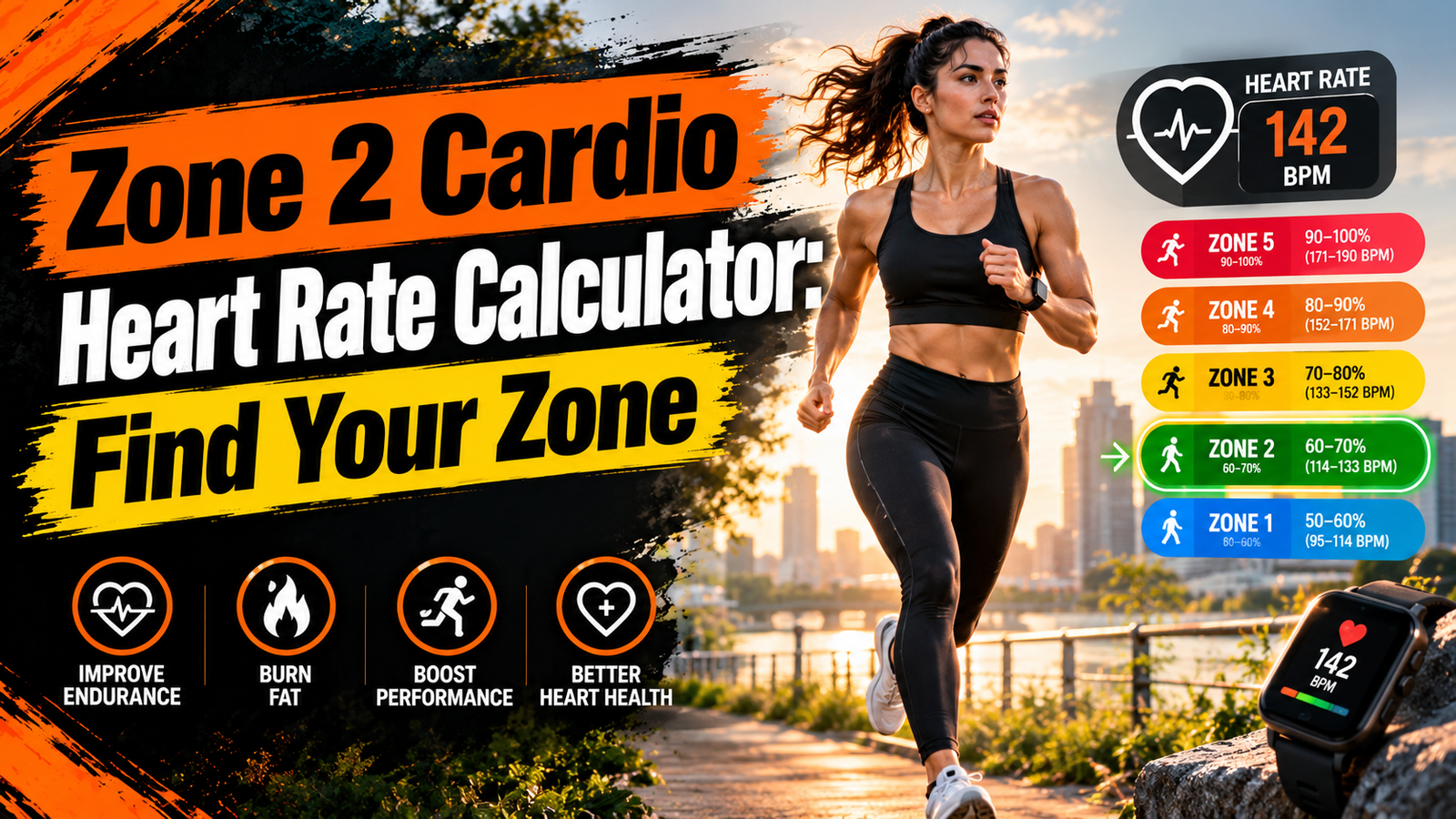
Zone 2 cardio is a form of steady aerobic exercise performed at a relatively comfortable intensity. In a commonly used five-zone model, it is often described as approximately 60–70% of your estimated maximum heart rate.
At this effort, your breathing is elevated, but you should generally be able to speak in complete sentences. The workout should feel sustainable rather than exhausting.
Examples of Zone 2 activities include:
- BMI calculator
- Calorie calculator
- One rep max calculator
- Upper Body Starter
- Brisk walking on relatively flat ground.
- Easy cycling at a steady pace.
- Comfortable jogging, if your fitness level allows it.
- Swimming at a controlled pace.
- Using an elliptical trainer at a manageable resistance.
The activity itself does not determine the zone. A brisk walk may place one person in Zone 2 while another person needs to jog slowly to reach a similar relative intensity.
The purpose is to match the effort to your own fitness level.
Zone 2 Cardio Heart Rate Calculator
You can estimate your Zone 2 target using your age and an age-predicted maximum heart rate. The calculator below uses the commonly used formula of 220 minus age and estimates Zone 2 as 60–70% of that result.
This is a general fitness estimate, not a clinical measurement. Different training systems use different zone boundaries.
Calculate your estimated Zone 2 heart rate
Enter your age to see your estimated heart rate range.
{@body const [age,setAge] = DIL.useState("30")} {@body const validAge = age.trim() !== "" && Number.isFinite(Number(age)) && Number(age) >= 18 && Number(age) <= 100} {@body const maxHr = validAge ? 220 - Number(age) : 0} {@body const zoneLow = Math.round(maxHr 0.6)} {@body const zoneHigh = Math.round(maxHr 0.7)} <box border radius="xl" padding={4} gap={3}> <text weight="medium">Your age (years)</text> <input value={age} onChange={setAge} inputType="number" placeholder="Enter your age" /> {#if validAge} <divider color="subtle" /> <text color="secondary" size="sm">Estimated maximum heart rate</text> <title size="xl" color="default">{maxHr} bpm</title> <text color="secondary" size="sm">Estimated Zone 2 target</text> <title size="2xl" color="success">{zoneLow}–{zoneHigh} bpm</title> <box background="surface-secondary" radius="lg" padding={3} gap={1}> <text weight="medium">How to use this result</text> Aim for a steady effort around this range as a starting point. You should generally be able to speak in sentences without gasping for breath. </box> <text color="secondary" size="xs">Formula: estimated maximum heart rate = 220 − age. Zone 2 estimate = 60–70% of maximum. Individual heart rates can differ substantially.</text> {:else} <text color="danger" size="sm">Enter an age from 18 to 100 to calculate an estimate.</text> {/if} </box>
If your healthcare professional or exercise physiologist has established your training zones using testing, use that individualised guidance rather than relying solely on this age-based estimate.
How to Calculate Zone 2 Heart Rate Manually
You do not need a smartwatch or a special fitness app to understand the basic calculation.
Step 1: Estimate your maximum heart rate
A traditional formula is:
Estimated maximum heart rate = 220 − your age
For example, if you are 30 years old:
220 − 30 = 190 bpm.
This means your age-predicted maximum heart rate is approximately 190 beats per minute. It does not mean your actual maximum is guaranteed to be 190.
Step 2: Calculate 60% of your estimated maximum
Multiply your estimated maximum heart rate by 0.60.
For a 30-year-old:
190 × 0.60 = 114 bpm.
This gives the lower end of the example Zone 2 range.
Step 3: Calculate 70% of your estimated maximum
Multiply the same number by 0.70.
190 × 0.70 = 133 bpm.
Your estimated Zone 2 range is therefore approximately 114–133 bpm.
Use this as a starting estimate and check it against how you feel during exercise.
Example Zone 2 heart rates by age
The following table uses the same formula and a 60–70% maximum-heart-rate range.
| Age | Estimated maximum HR | Estimated Zone 2 range |
|---|---|---|
| 20 | 200 bpm | 120–140 bpm |
| 25 | 195 bpm | 117–137 bpm |
| 30 | 190 bpm | 114–133 bpm |
| 35 | 185 bpm | 111–130 bpm |
| 40 | 180 bpm | 108–126 bpm |
| 45 | 175 bpm | 105–123 bpm |
| 50 | 170 bpm | 102–119 bpm |
| 55 | 165 bpm | 99–116 bpm |
| 60 | 160 bpm | 96–112 bpm |
| 65 | 155 bpm | 93–109 bpm |
| 70 | 150 bpm | 90–105 bpm |
These are rounded estimates, not personalised medical targets. The 220-minus-age formula can be inaccurate for an individual, and other training systems may define Zone 2 differently.
How Do You Know If You Are Really in Zone 2?
Heart rate is useful, but it is not the only way to judge exercise intensity. A simple method is the talk test, which checks how comfortably you can speak while moving.
1. Use the talk test
During a steady Zone 2 workout, you should generally be able to speak in complete sentences. Your breathing will be quicker than at rest, but you should not feel as though you are fighting for every breath.
If you can sing comfortably, your effort may be quite easy. If you can only say a few words before pausing for breath, you may be exercising at a higher intensity.
The talk test is a practical guide, not an exact measurement of your physiological training zone. The US Centers for Disease Control and Prevention also recommends using speaking ability to help assess relative exercise intensity.
2. Check your perceived effort
You can also rate how hard the workout feels on a scale from 0 to 10, where 0 means resting and 10 means maximal effort.
For many people, Zone 2 feels easy to moderate rather than hard. You should feel that you could continue for longer without needing frequent breaks.
3. Use a heart rate monitor
A smartwatch, chest strap, or fitness tracker can help you monitor your heart rate during exercise.
Wearables are useful for observing trends, but readings can be affected by device fit, movement, and measurement limitations. If a number does not match how you feel, slow down, check the device, and reassess rather than blindly chasing the target.
Why Is Zone 2 Cardio Useful?
Zone 2 training is popular because it provides a way to build aerobic exercise into your routine without making every session intense.
Potential benefits of consistent aerobic training include improved cardiovascular fitness, greater endurance, and better ability to sustain physical activity.
Supports aerobic endurance
Steady aerobic exercise challenges your heart, lungs, and working muscles at a sustainable intensity. Over time, regular training can improve your ability to perform activities such as walking, cycling, and running.
Helps you build a consistent routine
An easier workout can be more manageable than a session that leaves you exhausted. This can make it easier to establish a regular cardio habit.
Complements harder training sessions
If your programme includes strength training, intervals, or faster running, lower-intensity cardio can provide another way to develop aerobic fitness without making every workout demanding.
However, Zone 2 is not the only useful intensity. A balanced programme can include a mixture of aerobic activity, strength training, and other movement suited to your goals.
Can support weight management
Zone 2 cardio uses energy and contributes to your overall physical activity. It can support weight management when combined with a sustainable eating pattern and other healthy habits.
However, exercising in Zone 2 does not automatically guarantee fat loss. Changes in body fat depend on several factors, including total energy intake, activity, recovery, and consistency.
Is Zone 2 the Same as the Fat-Burning Zone?
Not exactly. The terms are often used interchangeably online, but they are not identical concepts.
At lower and moderate exercise intensities, the body may use a relatively larger proportion of energy from fat. As exercise intensity rises, carbohydrate use generally becomes more prominent. The exact mix depends on the individual, duration, fitness, and other factors.
That does not mean Zone 2 is automatically the best intensity for losing body fat.
For weight management, the total amount of activity you can sustain, your nutrition, and your long-term habits matter more than trying to remain in a particular heart rate range at all times.
If your goal is fat loss, choose cardio you enjoy and can perform consistently. Walking, cycling, swimming, and other aerobic activities can all contribute.
How to Calculate and Stay in Zone 2 Cardio
Finding your estimated Zone 2 heart rate is only the first step. The next challenge is keeping your effort in the right range during a real workout.
Your heart rate can change with age, fitness level, sleep, stress, temperature, and the type of exercise you do. That is why a Zone 2 cardio heart rate calculator is best used as a starting point rather than a perfect measurement of your training zone.
In this part, you will learn another way to calculate your target heart rate, how to stay in Zone 2 while walking or cycling, and how to build a practical weekly routine.
1. Calculate Zone 2 Using the Heart Rate Reserve Method
The simple age-based method estimates your maximum heart rate and calculates a percentage of it. However, it does not account for differences in resting heart rate.
The heart rate reserve (HRR) method, also known as the Karvonen method, includes your resting heart rate. It can provide a more individualised estimate of exercise intensity.
The heart rate reserve formula
Step 1: Estimate your maximum heart rate
A commonly used formula is:
Estimated maximum heart rate = 220 − your age
Step 2: Calculate your heart rate reserve
Heart rate reserve = estimated maximum heart rate − resting heart rate
Step 3: Calculate your target range
Target heart rate = resting heart rate + (heart rate reserve × intensity percentage)
For a rough Zone 2 estimate, you can calculate 60% and 70% of your heart rate reserve, then add your resting heart rate to both results. This is an illustrative approach; Zone 2 boundaries vary between training systems and individual assessments.
Example: A 40-year-old with a resting heart rate of 60 bpm
Suppose you are 40 years old and your resting heart rate is 60 beats per minute (bpm).
| Calculation | Result |
|---|---|
| Estimated maximum heart rate | 220 − 40 = 180 bpm |
| Resting heart rate | 60 bpm |
| Heart rate reserve | 180 − 60 = 120 bpm |
| Lower estimate | 60 + (120 × 0.60) = 132 bpm |
| Upper estimate | 60 + (120 × 0.70) = 144 bpm |
Using this particular method, the estimated range is 132–144 bpm.
Notice that this differs from the simple percentage-of-maximum method, which would estimate a lower range for the same person. Neither calculation should be treated as a precise diagnosis of your physiological training zones.
Which calculation method should you use?
| Method | Best use | Main limitation |
|---|---|---|
| Percentage of maximum heart rate | Quick, simple estimate | Does not account for resting heart rate |
| Heart rate reserve | More individualised estimate using resting heart rate | Still depends on estimated maximum heart rate and selected percentages |
| Exercise testing | More individualised training-zone assessment | May require a qualified professional and appropriate testing |
For most beginners, the simple calculator is a reasonable place to start. If you train regularly or want more precise zones, consider a qualified exercise professional or clinician who can help assess your individual needs.
2. How to Stay in Zone 2 While Walking
Walking is one of the easiest ways to begin Zone 2 training. You do not need to run, buy expensive equipment, or exercise at an uncomfortable pace.
The key is finding a walking speed that raises your heart rate while allowing you to maintain a controlled effort.
Follow these steps
- Warm up for five minutes. Start with a comfortable pace and gradually increase your speed.
- Walk briskly. Swing your arms naturally and use a pace that feels purposeful but sustainable.
- Check your heart rate. Use your watch, fitness tracker, or a manual pulse check.
- Use the talk test. You should generally be able to speak in complete sentences without gasping for breath.
- Adjust your pace gradually. If your heart rate stays below your estimated range, try walking slightly faster or choosing a gentle incline.
- Cool down. Slow your pace for the final few minutes rather than stopping abruptly after a hard effort.
What if your heart rate is too low while walking?
If you are walking comfortably but your heart rate remains below your estimated Zone 2 range, try one change at a time:
- Increase your walking speed slightly.
- Choose a route with a gentle incline.
- Add short periods of faster walking.
- Use a treadmill with a small incline if available.
Do not force your pace just to reach a number on your watch. If you are new to exercise, have a lower fitness level, or are returning after a break, a comfortable pace may be the right starting point.
What if your heart rate is too high?
Slow down if your heart rate rises above your target range and the effort starts to feel harder than intended.
Remember that heat, humidity, hills, dehydration, and fatigue can increase heart rate. In hot and humid Indian weather, the same walking route may feel noticeably harder than it does in cooler conditions.
3. How to Stay in Zone 2 While Cycling or Jogging
Your Zone 2 heart rate estimate does not automatically change when you switch from walking to cycling or jogging. However, your heart rate response and perceived effort may differ between activities.
Cycling
Cycling can make it easier to maintain a steady aerobic effort, especially on a stationary bike.
- Begin with light resistance.
- Pedal at a comfortable, consistent cadence.
- Increase resistance gradually if the effort feels too easy.
- Avoid repeatedly accelerating if your goal is steady-state cardio.
- Check your heart rate periodically, particularly when changing resistance or terrain.
If you cycle outdoors, choose a route where you can ride safely without needing to make frequent stops.
Jogging
Some beginners find it difficult to jog slowly enough to stay in their estimated Zone 2 range. That is normal.
Try a walk-jog approach:
- Jog gently until your heart rate approaches the upper end of your target range.
- Walk until your breathing becomes more comfortable and your heart rate begins to settle.
- Repeat the pattern as needed.
Over time, your ability to maintain a steady effort may improve. You do not need to run continuously to get started with aerobic training.
Walking vs cycling vs jogging for Zone 2
| Activity | Suitable for | Practical tip |
|---|---|---|
| Brisk walking | Beginners and low-impact routines | Adjust pace or use gentle inclines |
| Stationary cycling | Controlled, steady workouts | Use consistent resistance |
| Outdoor cycling | People who enjoy longer rides | Choose a safe route with manageable terrain |
| Easy jogging | People comfortable with running | Use walk-jog intervals when needed |
Choose an activity you can perform consistently. The best option is one that fits your current ability, schedule, and preferences.
4. Why Your Resting Heart Rate Matters
Your resting heart rate is the number of times your heart beats per minute when you are resting. It can provide useful context when estimating exercise intensity.
The heart rate reserve method uses this measurement to account for part of the difference between individuals.
How to measure your resting heart rate
For a reasonably consistent reading:
- Measure your pulse in the morning, shortly after waking.
- Remain relaxed and still before taking the measurement.
- Use a smartwatch or count your pulse manually for 60 seconds.
- Repeat on several mornings and calculate an approximate average.
- Recheck periodically rather than reacting to one unusual reading.
Your resting heart rate can change because of sleep, stress, illness, medication, hydration, and other factors. A single measurement does not tell you everything about your cardiovascular fitness.
A lower resting heart rate can be associated with aerobic fitness, but it is not a stand-alone fitness score. Some healthy people naturally have higher or lower readings.
Important: If you take medication that affects heart rate, such as a beta blocker, age-based calculations may not be suitable for guiding your exercise intensity. Ask your healthcare professional how to monitor effort safely.
5. Can a Smartwatch Track Zone 2 Accurately?
A smartwatch or fitness tracker can help you monitor heart rate during exercise. Many devices also let you set custom heart rate zones and receive alerts when your reading moves outside a selected range.
However, wrist-based optical sensors can sometimes produce inaccurate readings, especially during movement, in cold conditions, or when the device does not fit securely.
Tips for better heart rate readings
- Wear your watch snugly, following the manufacturer's instructions.
- Position it correctly on your wrist.
- Give the sensor time to establish a stable reading before relying on it.
- Compare the reading with your breathing and perceived effort.
- If accuracy matters for structured training, consider whether a compatible chest-strap monitor is appropriate for your needs.
Do not keep checking your watch every few seconds. A stable trend over time is usually more useful than reacting to every brief fluctuation.
If your watch says you are slightly above your estimated range but you can speak comfortably and feel in control, ease your pace a little and reassess. Treat both the device and the calculator as guides, not absolute authorities.
6. How Long Should a Zone 2 Cardio Session Last?
There is no single duration that suits everyone. Your ideal session length depends on your current fitness, health, available time, and training goals.
If you are new to exercise, start with a manageable duration and increase it gradually as you become more comfortable.
Example progression for beginners
| Stage | Example session | Main goal |
|---|---|---|
| Getting started | 15–20 minutes | Build a regular habit |
| Building consistency | 20–30 minutes | Maintain a comfortable, steady effort |
| Developing endurance | 30–45 minutes | Gradually increase time if recovery is good |
| Established routine | Longer sessions if appropriate | Support individual endurance goals |
These are examples, not mandatory milestones. You can remain at a stage longer if you need to, and shorter sessions still count toward your overall physical activity.
For general adult health, public health guidance commonly recommends working toward at least 150 minutes of moderate-intensity aerobic activity per week, alongside muscle-strengthening activity on two or more days. Your personal plan may need to be adjusted for your health and current ability.
You do not need to complete all your weekly cardio in one or two long sessions. Several shorter workouts can help you build consistency.
7. A Simple Weekly Zone 2 Cardio Plan
Here is an example for someone who is generally healthy and wants to establish a regular aerobic routine. Adjust the schedule to your fitness level and recovery needs.
| Day | Example activity | Duration |
|---|---|---|
| Monday | Brisk walking | 20–30 minutes |
| Tuesday | Strength training or comfortable daily movement | Based on your routine |
| Wednesday | Walking or easy cycling | 20–30 minutes |
| Thursday | Rest or gentle mobility work | As needed |
| Friday | Brisk walking or stationary cycling | 20–30 minutes |
| Saturday | Optional relaxed walk or another enjoyable activity | 15–30 minutes |
| Sunday | Rest or light movement | As needed |
Start with three sessions per week if that feels manageable. You can add time or another session as your routine becomes easier to recover from.
If you already exercise regularly, this schedule may be too light for your needs. More experienced exercisers can adjust session length and weekly volume according to their training plan.
The goal is not to maximise your heart rate or burn the most calories in each session. It is to build an aerobic routine that you can maintain consistently.
8. Common Zone 2 Cardio Mistakes to Avoid
Even with a reliable-looking calculator, it is easy to misunderstand how Zone 2 training should feel.
Mistake 1: Treating your calculated range as exact
Age-based formulas estimate maximum heart rate. They cannot identify your personal physiological thresholds with certainty.
Better approach: Use your calculated range as a starting point and combine it with the talk test and perceived effort.
Mistake 2: Going too fast
If you push the pace whenever your heart rate dips, your workout may become harder than intended.
Better approach: Aim for a steady, controlled effort. Make small adjustments instead of chasing every change in bpm.
Mistake 3: Ignoring the weather
Heat and humidity can make your heart rate rise even when you maintain the same pace.
Better approach: Exercise during cooler hours when possible, drink fluids according to your needs, and reduce intensity when conditions are challenging.
Mistake 4: Assuming Zone 2 guarantees fat loss
Low-intensity cardio can contribute to energy expenditure and support a sustainable exercise routine. However, fat loss depends on several factors, including overall energy balance, nutrition, sleep, and consistency.
Better approach: Combine regular activity with balanced eating, adequate recovery, and a realistic long-term plan.
Mistake 5: Increasing duration too quickly
Longer workouts are not always better, especially when you are new to exercise.
Better approach: Increase duration gradually and pay attention to persistent fatigue, discomfort, and recovery.
Mistake 6: Comparing your heart rate with someone else's
Two people can perform the same activity at different heart rates because of differences in age, fitness, genetics, health, medication, and environmental conditions.
Better approach: Focus on your own trends and how you feel rather than copying another person's target bpm.
9. When Should You Be Careful With Heart Rate-Based Training?
Heart rate calculators are designed to provide estimates, not medical clearance.
If you have a known heart condition, take medication that affects heart rate, are pregnant, or have another health concern that may affect exercise, seek individualised advice from a qualified healthcare professional before relying on a standard target range.
Stop exercising and seek prompt medical assessment if you experience concerning symptoms such as chest pain, faintness, or unusual shortness of breath. Severe or sudden symptoms may require emergency medical attention.
You can still work toward better fitness with the right plan. The important thing is choosing an approach that fits your circumstances rather than forcing yourself into a generic heart rate zone.
Zone 2 Cardio Heart Rate Calculator: Final Guide
How to Get the Most From Your Zone 2 Cardio Heart Rate Calculator
A Zone 2 cardio heart rate calculator gives you a practical starting point for planning aerobic workouts. By estimating your target heart rate, you can better understand how hard to walk, cycle, or jog during steady-state cardio.
However, remember that heart rate zones are estimates. The percentage-based method, heart rate reserve method, and zones used by different fitness devices may produce different results.
For everyday training, combine three useful signals:
- Heart rate: Use your estimated range as a guide.
- Talk test: You should generally be able to speak in complete sentences without gasping for breath.
- Perceived effort: Your workout should feel controlled and sustainable rather than exhausting.
If your calculated range does not match how you feel, do not automatically force your body to reach the number. Consider the weather, your current fitness, medication, fatigue, and other factors that may affect your heart rate.
Conclusion
Finding your estimated training zone does not need to be complicated. A Zone 2 cardio heart rate calculator helps you understand a possible target range based on your age, while the heart rate reserve method offers another estimate using your resting heart rate.
Start with an activity you enjoy. Walk briskly, cycle at a steady pace, or alternate walking and jogging if continuous running feels too difficult. Monitor your heart rate, use the talk test, and adjust your effort to suit the conditions.
Most importantly, build a routine you can maintain. You do not need to complete long workouts or stay within an exact range every second to make progress toward a more active lifestyle.
Ready to start? Calculate your estimated Zone 2 heart rate, choose a comfortable 20-minute cardio session, and make consistency your first goal. If you have a medical condition or take medication that affects heart rate, get personalised guidance before relying on standard heart rate formulas.
Frequently Asked Questions About Zone 2 Cardio Heart Rate
1. What is a Zone 2 cardio heart rate?
Zone 2 is commonly described as a sustainable aerobic training intensity. One frequently used estimate places it at approximately 60–70% of maximum heart rate. Exact boundaries differ across training systems, and this estimate may not match an individual's physiological thresholds.
2. How do I calculate my Zone 2 heart rate?
A simple method estimates maximum heart rate as 220 minus your age, then calculates 60% and 70% of that result. For example, a 30-year-old has an estimated maximum heart rate of 190 bpm, giving a rough range of 114–133 bpm using this method.
3. Is a Zone 2 heart rate calculator accurate?
It provides an estimate, not an exact measurement of your personal training zone. Age-based formulas can differ from your actual maximum heart rate, and the definition of Zone 2 varies. Use the result alongside your breathing, perceived effort, and individual circumstances.
4. Is Zone 2 always 60–70% of maximum heart rate?
No. This is a commonly used approximation, but some training systems define Zone 2 differently. The heart rate reserve method and exercise-testing methods may produce different ranges. Always check which method your calculator or fitness device uses.
5. What is the heart rate reserve method for Zone 2?
The heart rate reserve method subtracts your resting heart rate from your estimated maximum heart rate. You then calculate the selected intensity percentages of that reserve and add your resting heart rate back. It accounts for resting heart rate but still depends on estimates and chosen zone boundaries.
6. Can walking get me into Zone 2?
Yes. Brisk walking may bring many people into their estimated Zone 2 range. You can adjust your speed or choose a gentle incline if needed. If your heart rate remains lower, do not force an uncomfortable pace just to reach a calculated number.
7. How long should I do Zone 2 cardio?
There is no universal session length. Beginners may start with 15–20 minutes and gradually increase as they become more comfortable. Your ideal duration depends on fitness, health, goals, and recovery. Several shorter sessions can contribute to your weekly activity.
8. Is Zone 2 cardio good for weight loss?
Zone 2 cardio can help increase physical activity and energy expenditure, which may support weight management. However, weight loss depends on overall energy balance and other factors, including nutrition, sleep, and consistency. Zone 2 exercise does not guarantee fat loss by itself.
9. Can I trust my smartwatch's Zone 2 reading?
A smartwatch can be useful for tracking heart rate trends, but wrist-based sensors can sometimes give inaccurate readings. Wear the device correctly, consider your breathing and perceived effort, and avoid reacting to every brief fluctuation. A compatible chest-strap monitor may be useful for some training needs.
10. Is Zone 2 cardio safe for everyone?
Not every standard heart rate target is appropriate for every person. If you have a heart condition, take medication that affects heart rate, are pregnant, or have other relevant health concerns, seek individualised medical advice. Stop exercising if you develop concerning symptoms such as chest pain, faintness, or unusual shortness of breath, and seek appropriate medical care.
Stop reading, start moving
Reading about training is the easy part. Fifteen minutes today beats a fortnight of research - and all of it is free.
Start Free