Push Pull Legs Workout Split: Beginner-to-Advanced Guide
Learn how the push pull legs workout split works, how to schedule training days, and how to choose exercises and training volume for your experience level.
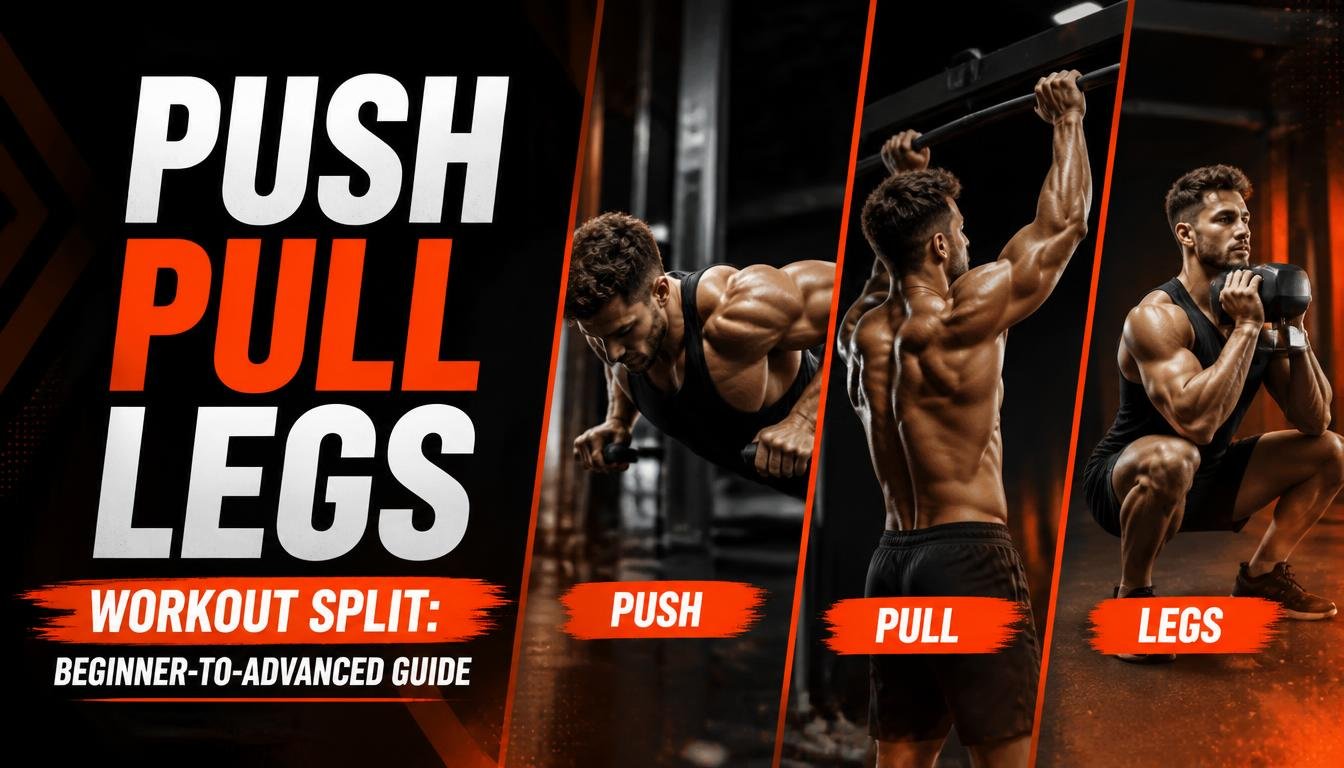
Push Pull Legs Workout Split: Complete Beginner-to-Advanced Guide
Introduction
The push pull legs workout split is a popular way to organise strength training by grouping exercises according to the muscles and movements they use. Push days focus on pressing movements, pull days focus on pulling movements, and leg days train the lower body.
This structure can make workouts easier to plan and helps you distribute training across the week. But there is no single “best” schedule for everyone. Your ideal version depends on your experience, available training days, recovery, goals, and the equipment you can use.
In this guide, you’ll learn how the push pull legs split works, how to schedule it, which exercises commonly belong in each session, and how to adapt the structure from beginner to advanced training.
What Is a Push Pull Legs Workout Split?
A push pull legs (PPL) split divides strength training into three types of sessions:
- Push: Exercises that primarily involve pushing, such as chest presses, shoulder presses, and triceps work.
- Pull: Exercises that primarily involve pulling, such as rows, pulldowns, and biceps work.
- Legs: Exercises for the quadriceps, hamstrings, glutes, and calves, often including core work.
The main idea is to group movements that share muscle involvement. For example, chest presses also use the triceps and front shoulders, while rows involve the back and biceps. Organising these exercises together can help you plan training without working the same muscles hard on consecutive days.
PPL is a way to organise training—not a special muscle-building shortcut. Results still depend on appropriate exercise selection, effort, progressive training, nutrition, and recovery.
Push, Pull, and Legs: What Goes Into Each Day?
Push day
Push workouts usually train the chest, shoulders, and triceps. Common movement patterns include:
- Free Tools
- BMI calculator
- Calorie calculator
- Macro calculator
- Calorie burn calculator
- Horizontal pressing, such as a bench press or machine chest press
- Incline pressing, which changes the angle of the press
- Overhead pressing
- Lateral raises for the side shoulders
- Triceps extensions or pressdowns
You do not need to include every exercise in one session. Choose a manageable selection that fits your experience and weekly schedule.
Pull day
Pull workouts generally focus on the back and biceps. They may include:
- Vertical pulling, such as a lat pulldown or assisted pull-up
- Horizontal pulling, such as a cable or chest-supported row
- Rear-delt work, such as reverse flyes
- Biceps curls
A balanced pull day includes movements that train the back from more than one direction, provided your training level and available time allow it.
Leg day
Leg workouts train the lower body, commonly including:
- A squat or knee-dominant movement
- A hip hinge, such as a Romanian deadlift
- A single-leg movement, such as a split squat or step-up
- Hamstring work, such as a leg curl
- Calf raises
- Optional core exercises
Choose variations you can perform comfortably and with control. Machines, dumbbells, barbells, and bodyweight exercises can all be useful depending on your situation.
Is Push Pull Legs Good for Beginners?
It can be, but beginners often do best with a schedule that leaves enough time to learn exercises and recover. A six-day PPL routine may be too demanding for someone who is new to structured strength training, especially if every session includes a large amount of work.
A beginner-friendly approach is to start with three training days per week, completing one push, one pull, and one legs session. This lets you practise the main movement patterns while keeping the weekly schedule simple.
If you can only train two days a week, a full-body routine may be easier to organise than a traditional PPL split. If you can train four days, you can use a flexible rotation or a different split that suits your recovery and priorities.
The most useful routine is one you can follow consistently without feeling that you must train through pain or exhaustion.
How Many Days a Week Should You Train?
PPL can be arranged across different schedules. The right choice depends on your experience, recovery, and how much time you have.
Three days per week: beginner-friendly
| Day | Workout |
|---|---|
| Monday | Push |
| Wednesday | Pull |
| Friday | Legs |
| Other days | Rest or easy activity |
This simple schedule gives you a rest day between sessions. Each muscle group has one dedicated workout in the weekly rotation.
Four days per week: flexible rotation
With four training days, continue the sequence rather than restarting it every Monday. For example:
| Day | Workout |
|---|---|
| Monday | Push |
| Tuesday | Pull |
| Wednesday | Rest |
| Thursday | Legs |
| Friday | Push |
| Weekend | Rest |
The next training day would be Pull, followed by Legs, and so on. This means the training week may not always match the calendar week. Keep track of your sequence and adjust rest days when needed.
Six days per week: traditional PPL
| Day | Workout |
|---|---|
| Monday | Push |
| Tuesday | Pull |
| Wednesday | Legs |
| Thursday | Push |
| Friday | Pull |
| Saturday | Legs |
| Sunday | Rest |
This schedule trains each category twice per week. It may suit experienced lifters who can manage the workload and recover between sessions, but it is not automatically better than training fewer days.
If you are new, do not jump straight into six sessions just because the schedule is popular online. Build up gradually and choose a plan that fits your life.
How to Choose the Right PPL Schedule
Ask yourself these questions before choosing a routine:
- How many days can I reliably train? Plan around your real schedule, not an ideal week.
- Am I familiar with the exercises? If not, start with fewer movements and prioritise learning.
- Can I recover between sessions? Persistent fatigue or declining performance may mean you need less volume or more rest.
- Do I have enough time per workout? A shorter, repeatable session is often more practical than an overpacked one.
- What is my main goal? Strength, muscle growth, general fitness, and returning to exercise may call for different exercise choices and workloads.
You can adjust the schedule over time. A three-day plan is not a lesser version of training; it may simply be the best fit for your current circumstances.
Basic Training Principles Before You Start
Start with manageable weights
Choose loads that allow you to perform the planned repetitions with controlled technique. The final repetitions can feel challenging, but you should not need to swing, bounce, or change your form to finish.
Use a practical range of repetitions
Many general strength-training plans use moderate repetition ranges, but no single range is mandatory for every exercise or person. The appropriate load and repetitions depend on your goals, experience, and ability to maintain technique.
Leave room for recovery
Rest between sets long enough to perform the next set safely and effectively. Take additional rest if you are breathing heavily or your technique is not ready.
Progress gradually
Progress may mean adding a repetition, improving control, learning a more challenging variation, or increasing weight slightly. Do not increase everything at once.
Keep a training log
Record the exercise, weight, sets, repetitions, and any notes about technique or difficulty. This makes it easier to notice patterns and choose sensible next steps.
Safety and Exercise Selection
No workout split is worth pushing through sharp or unusual pain. Stop an exercise if you experience concerning symptoms, and seek qualified guidance if discomfort persists or you are unsure how to modify a movement.
If you have a medical condition, a recent injury, or specific exercise restrictions, consult an appropriate healthcare professional before beginning a new training plan. A qualified trainer can also help you learn equipment setup and exercise technique.
What Comes Next
The next part will provide practical push, pull, and legs workout templates, with exercise options and beginner-to-advanced adjustments. It will also explain how to manage sets, repetitions, rest, and progression without making the routine unnecessarily complicated.
Push Pull Legs Workout Split: Practical Templates
How to use these workouts
Warm up with 5–10 minutes of easy movement, then do a few light practice repetitions of your first exercise. Warm-up sets do not need to be tiring.
For each workout:
- Start with the larger, more demanding movements.
- Use controlled repetitions and a comfortable range of motion.
- Rest long enough to perform the next set with good technique.
- Stop a set when you can no longer maintain control.
- Record your sets, repetitions, and weights.
The set and rep ranges below are general examples. They are not mandatory targets, and beginners can start with fewer sets.
Push day: chest, shoulders, and triceps
| Exercise | Main focus | Example sets × reps |
|---|---|---|
| Machine chest press or bench press | Chest, triceps | 2–3 × 6–12 |
| Incline dumbbell press | Chest, front shoulders | 2–3 × 8–12 |
| Seated shoulder press | Shoulders, triceps | 1–3 × 8–12 |
| Lateral raise | Side shoulders | 2–3 × 10–15 |
| Cable triceps pressdown | Triceps | 1–3 × 10–15 |
Beginner option: Choose three or four exercises, usually one or two presses plus a shoulder or triceps movement. Begin with 1–2 work sets per exercise.
More experienced option: Add sets gradually where they help you progress and recover well. You do not need multiple variations of every pressing movement in the same workout.
Pull day: back, rear shoulders, and biceps
| Exercise | Main focus | Example sets × reps |
|---|---|---|
| Lat pulldown or assisted pull-up | Lats and upper back | 2–3 × 6–12 |
| Chest-supported row or cable row | Back | 2–3 × 8–12 |
| Reverse fly or rear-delt machine | Rear shoulders, upper back | 1–3 × 10–15 |
| Dumbbell or cable curl | Biceps | 1–3 × 8–15 |
Beginner option: Start with a pulldown, a row, and one optional curl. Focus on smooth pulling rather than using momentum.
More experienced option: Use different row or pulldown variations across the week if you train pull twice weekly. Add work only if you can recover and maintain performance.
Leg day: quads, hamstrings, glutes, and calves
| Exercise | Main focus | Example sets × reps |
|---|---|---|
| Leg press, goblet squat, or squat | Quads and glutes | 2–3 × 6–12 |
| Romanian deadlift or another hip hinge | Hamstrings and glutes | 2–3 × 6–12 |
| Split squat or step-up | Legs and balance | 1–2 × 8–12 per side |
| Leg curl | Hamstrings | 1–3 × 10–15 |
| Calf raise | Calves | 1–3 × 10–15 |
Beginner option: Start with a squat or leg press, a comfortable hip-hinge variation, and one or two optional accessories. You can add exercises later.
More experienced option: Distribute leg exercises across two weekly sessions if a single leg day becomes too long or difficult to recover from.
Beginner, intermediate, and advanced: what changes?
Experience is not just how long you have had a gym membership. It also includes how confidently you perform the movements, how well you manage training, and whether you can recover from the workload.
Beginner
- Train three days per week: Push, Pull, Legs.
- Start with 1–2 work sets per exercise.
- Use familiar, stable movements such as machines and supported variations.
- Keep a few good repetitions in reserve.
- Practise consistently before adding more exercises.
Intermediate
- Consider a four- or six-day rotation if your schedule and recovery support it.
- Use more exercise variations where they serve a purpose.
- Track performance and increase repetitions or load gradually.
- Adjust weekly sets based on progress and recovery rather than copying someone else’s volume.
Advanced
- Choose training frequency and volume around specific goals and individual recovery.
- Use more targeted exercise selection and planned progression.
- Consider varying the emphasis between sessions—for example, a heavier press and a moderate-repetition press—without making every workout maximal.
- Review performance over several weeks and reduce workload when needed.
There is no universal set count that defines beginner, intermediate, or advanced training. Your plan should match your current capacity.
Sets, repetitions, and effort
A “set” is one bout of repetitions. “Reps” are the individual repetitions within that set.
For general training, moderate repetition ranges are a useful starting point. Heavier loads may suit some strength-focused work, while lighter loads can be practical for accessories. Whichever range you choose, use a load that allows controlled technique.
A helpful effort guide is to finish most sets feeling you could still perform a few good repetitions. Beginners should avoid routinely training to failure while learning movements. As experience grows, effort can be adjusted to the exercise and goal.
Rest between sets
Rest until you can perform the next set with control. Larger compound exercises often need more recovery time than smaller isolation exercises. A fixed rest timer is optional; readiness and technique matter more than rushing.
If your breathing is still very heavy or your repetitions become noticeably worse, rest longer or reduce the load.
Progressive overload without rushing
Progressive overload means gradually increasing the challenge over time. It does not mean adding weight every workout.
Try this simple method:
- Choose a weight you can lift with steady technique.
- Work within a repetition range, such as 8–12.
- Add repetitions over subsequent sessions when you can.
- When you can reach the top of the range for all planned sets with good form, consider a small weight increase.
- Return to the lower end of the rep range and build again.
You can also progress by improving control, range of motion, or consistency. If performance drops and recovery feels poor, hold steady or reduce the workload rather than forcing an increase.
How to arrange PPL across the week
Three days
| Day | Session |
|---|---|
| Monday | Push |
| Wednesday | Pull |
| Friday | Legs |
This is a simple starting schedule. The following week, you can continue the sequence or repeat the same weekly arrangement.
Six days
| Day | Session |
|---|---|
| Monday | Push |
| Tuesday | Pull |
| Wednesday | Legs |
| Thursday | Push |
| Friday | Pull |
| Saturday | Legs |
| Sunday | Rest |
If you use this schedule, consider how much work each muscle group receives across both sessions. You may need fewer sets per workout than someone training each category once weekly.
Common PPL planning mistakes
Doing too much too soon: Start with fewer sets and add work only when you are adapting well.
Choosing exercises only because they are popular: Pick movements you can perform comfortably and consistently.
Ignoring overlap: Presses also involve triceps and shoulders; rows and pulldowns also involve biceps. Account for that when choosing accessory work.
Changing the plan constantly: Keep exercises stable long enough to practise and track them.
Taking every set to failure: Harder is not always more productive. Leave room to maintain technique and recover.
Copying an advanced routine as a beginner: More days and more exercises are not automatically better.
When to modify the plan
Reduce the workload, take additional rest, or choose an easier variation if you are struggling to recover or maintain technique. Stop an exercise if you experience sharp or unusual pain. For persistent symptoms, an injury, a medical condition, or specific exercise restrictions, seek guidance from an appropriate professional.
The best PPL plan is one that fits your schedule, lets you train with control, and can be adjusted as your ability changes.
Push Pull Legs Workout Split: Complete Beginner-to-Advanced Guide — Part 3
Sample Weekly Schedules
A push pull legs (PPL) split can fit different schedules. Choose the version you can follow consistently while recovering well between sessions.
3-Day PPL Schedule
| Day | Workout |
|---|---|
| Monday | Push |
| Tuesday | Rest |
| Wednesday | Pull |
| Thursday | Rest |
| Friday | Legs |
| Saturday | Rest |
| Sunday | Rest |
This is a practical starting point for beginners. Each muscle group gets one focused workout per week, so use controlled technique and gradually increase training demands.
4-Day Schedule
| Day | Workout |
|---|---|
| Monday | Push |
| Tuesday | Pull |
| Wednesday | Rest |
| Thursday | Legs |
| Friday | Push or Pull, alternating weekly |
| Saturday | Rest |
| Sunday | Rest |
For the fourth session, alternate between push and pull from week to week. This gives one upper-body area an extra session without requiring six gym days.
6-Day PPL Schedule
| Day | Workout |
|---|---|
| Monday | Push A |
| Tuesday | Pull A |
| Wednesday | Legs A |
| Thursday | Push B |
| Friday | Pull B |
| Saturday | Legs B |
| Sunday | Rest |
Use this schedule only if you can recover from it and maintain good form. Six sessions are not automatically better than three or four. If performance, sleep, motivation, or joint comfort declines, reduce training days or sets.
How to Progress Without Overcomplicating It
Progressive overload means gradually increasing the challenge placed on your muscles. It does not mean adding weight every workout at any cost.
A simple method is double progression:
- Pick a rep range, such as 8–12 reps.
- Use a weight that lets you complete the reps with controlled technique.
- Keep the weight the same while gradually adding reps.
- Once you can complete the top of the range for all planned sets with good form, increase the weight slightly.
- Build reps again with the new weight.
For example, if your target is 3 sets of 8–12 reps, you might progress from 10, 9, 8 reps to 12, 12, 12 reps over several sessions. Then make a small weight increase and work back up.
Do not sacrifice technique to chase a number. If you cannot complete a rep smoothly, stop the set rather than forcing it.
How Much Rest Should You Take?
Rest long enough to perform the next set with good technique.
- Large compound lifts: often around 2–3 minutes, or longer if needed.
- Smaller isolation exercises: often around 1–2 minutes.
- Between workouts for the same muscle group: allow enough recovery to return feeling ready and perform well.
These are starting ranges, not strict rules. Heavy sets, conditioning, experience, and individual recovery can change how much rest you need.
Nutrition and Recovery for a PPL Routine
Training provides a stimulus; recovery helps you adapt to it. You do not need a complicated diet to support a PPL program.
Eat consistently
Include a source of protein in regular meals, along with carbohydrates, fats, fruits, vegetables, and enough total food to support your goal. Your needs depend on body size, activity, preferences, and whether you want to gain muscle, lose fat, or maintain weight.
Sleep and manage fatigue
Aim for a regular sleep routine and pay attention to how you feel across the week. Persistent soreness, worsening performance, poor sleep, or a noticeable drop in motivation may mean you need more recovery.
Adjust your plan when needed
If a workout feels unusually difficult, reduce the load or number of sets. If you repeatedly feel run down, consider a lighter week, fewer training days, or fewer hard sets. A sustainable plan is more useful than a demanding plan you cannot recover from.
Common PPL Questions
Is push pull legs good for beginners?
It can be, especially as a three-day routine. Beginners should prioritize learning exercise technique, starting with manageable volume, and progressing gradually. A full-body routine may also be a good option, particularly for people who can train only two or three days per week.
Is a 6-day PPL split necessary?
No. Six days can work for some experienced lifters, but it is not required for progress. Choose the fewest training days that let you train consistently, recover, and meet your goals.
Can I do cardio with PPL?
Yes. Add cardio in a way that does not routinely interfere with your lifting or recovery. You might do it on rest days, after lifting, or in separate sessions. Adjust the amount and intensity to your fitness level and goals.
Should I train to failure?
You do not need to take every set to failure. Most sets can finish with a small number of good-form reps still possible. If you use failure training, reserve it mainly for suitable exercises and avoid letting technique break down.
What if I miss a workout?
Do not try to cram every missed session into the next day. Continue with the next workout in your sequence, or adjust the week to preserve rest and recovery. Consistency over time matters more than a perfect calendar.
Conclusion
The push pull legs workout split organizes training into pushing, pulling, and leg-focused sessions. It can be adapted to three, four, or six days per week, making it useful for a range of schedules and experience levels.
Start with a manageable routine, learn the movements, track your workouts, and increase reps or weight gradually when your technique is solid. Keep nutrition and recovery practical, and adjust the plan when your body or schedule calls for it.
Build a routine you can repeat. Use MyWorkoutAI.in’s workout and calorie tools to help organize your training and estimate your nutrition needs. Treat estimates as starting points, then adjust based on your progress and how you feel.
Key Takeaways
- PPL divides workouts into push, pull, and legs.
- Three days per week is a reasonable starting point for many beginners.
- Six days per week is optional, not a requirement.
- Use controlled technique and gradual progression.
- Rest, nutrition, and consistency matter alongside exercise selection.
- Modify exercises or seek qualified guidance if you have an injury, medical condition, or persistent pain.
FAQs
1. What does PPL stand for in fitness?
PPL stands for push, pull, legs. It groups exercises by movement pattern and the main muscle groups involved.
2. How many days a week should I do PPL?
Many beginners can start with three days per week. More experienced lifters may choose four or six days if they recover well.
3. Can beginners follow a push pull legs split?
Yes. Begin with manageable volume, learn proper technique, and increase training demands gradually. A full-body plan is another good beginner option.
4. Is PPL better than a full-body workout?
Neither is universally better. The best split depends on your schedule, experience, goals, preferences, and ability to recover.
5. How many exercises should a PPL workout include?
There is no fixed number. Choose enough exercises to train the intended muscles effectively without making the session unnecessarily long or difficult to recover from.
6. How many sets and reps should I do?
Use a manageable number of working sets and a rep range suited to the exercise and goal. Technique and consistency matter more than following one exact formula.
7. Can I build muscle with a 3-day PPL split?
You can make progress with three well-planned sessions. Results depend on training quality, progressive overload, nutrition, recovery, and consistency.
8. Can I add abs and cardio to PPL?
Yes. Add them where they fit your recovery and schedule. Avoid adding so much extra work that it reduces the quality of your main workouts.
9. What should I do if I miss a PPL workout?
Resume with the next workout in your sequence or adjust the week. Avoid stacking sessions in a way that leaves you unable to recover.
10. When should I change my PPL routine?
Consider changing it when your goals, schedule, recovery, or available equipment changes—or when progress has stalled despite consistent training and sensible adjustments.
Stop reading, start moving
Reading about training is the easy part. Fifteen minutes today beats a fortnight of research - and all of it is free.
Start Free