How to Build Muscle: A Beginner’s Guide to Strength Training
Learn how to build muscle as a beginner with simple strength-training principles, a practical workout plan, nutrition basics, recovery tips, and safe ways to progress.
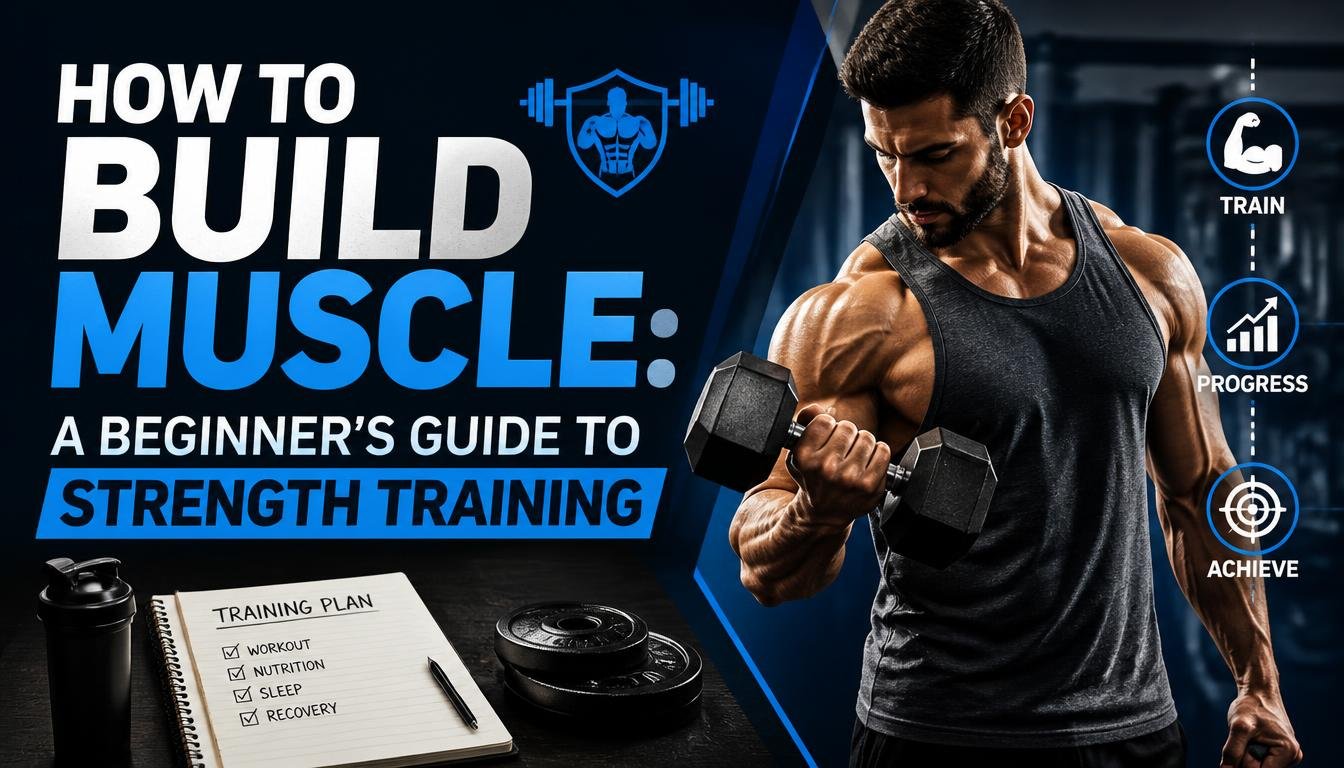
How to Build Muscle: A Beginner's Guide to Strength Training
Building muscle can feel confusing when you are just starting out. There are countless workout routines, exercise variations, supplements, and fitness opinions competing for your attention. The good news is that you do not need a complicated plan to begin.
If you want to learn how to build muscle, focus on a few fundamentals: train consistently, practice exercises with good technique, gradually challenge your muscles, eat enough to support your goal, and give your body time to recover.
This beginner’s guide explains how strength training works, how to choose a routine, what to eat, and how to track progress. You’ll also find a simple workout framework you can adapt to your schedule and equipment.
What Does It Mean to Build Muscle?
Muscle building, also called muscle growth or hypertrophy, is the process of increasing the size of your muscles over time. Strength training challenges your muscles, and your body adapts to that repeated challenge when training, nutrition, and recovery are appropriate.
Muscle growth does not happen overnight. Beginners may notice improvements in coordination and strength before visible changes become obvious. Progress varies with factors such as training history, genetics, age, nutrition, sleep, and consistency.
The goal is not to make every workout exhausting. It is to create a manageable training routine that you can repeat and gradually improve.
How Strength Training Helps Build Muscle
Strength training uses resistance to challenge your muscles. Resistance can come from dumbbells, barbells, machines, resistance bands, or your own body weight.
When you perform a challenging set, your muscles work against that resistance. Over time, a well-planned program can help your body adapt by improving strength and supporting muscle growth.
The role of progressive overload
Progressive overload means gradually increasing the training challenge as your ability improves. You can do this by:
- Adding a small amount of weight.
- Completing more repetitions with the same weight.
- Performing more quality sets when appropriate.
- Improving control and range of motion.
- Using a more challenging variation when you are ready.
- BMI calculator
- Macro calculator
- Calorie burn calculator
- Body fat calculator
- Upper Body Starter
Progress should be gradual. Do not add weight if doing so causes you to lose control, shorten the movement, or experience pain.
Why consistency matters
One hard workout is not enough to build a lasting habit or produce major changes. Repeating a sensible routine over weeks and months gives you opportunities to practice technique, build strength, and adjust your training.
Choose a schedule you can maintain. Three well-planned sessions each week can be more practical than aiming for six days and repeatedly missing workouts.
Beginner Muscle-Building Principles
Before choosing exercises, understand the principles that make a routine useful.
1. Train the major muscle groups
A balanced program should include movements that train your:
- Chest and shoulders
- Back
- Arms
- Quadriceps and hamstrings
- Glutes and calves
- Core
You do not need a separate exercise for every small muscle in every workout. Many compound exercises train several muscle groups at once.
2. Learn technique before chasing heavy weights
Start with a load that lets you move in a controlled way. Learn the setup, movement path, and safe range of motion for each exercise. Ask a qualified trainer for help if you are unsure how to perform a movement.
3. Start with a manageable amount of training
More exercises and more sets are not automatically better. Beginners often benefit from a simple routine that leaves room to learn and recover.
4. Keep a workout log
Record the exercise, weight, repetitions, and sets you complete. This makes it easier to see whether you are gradually improving and helps you avoid guessing from session to session.
Choose a Beginner-Friendly Workout Schedule
Your workout split is the way you organize training across the week. There are several workable options, and the best choice depends on your available time and preferences.
Option 1: Full-body training three days per week
A full-body routine trains major muscle groups during each session. It is often convenient for beginners who can visit the gym two or three days per week.
Example schedule:
| Day | Workout |
|---|---|
| Monday | Full body |
| Tuesday | Rest or light activity |
| Wednesday | Full body |
| Thursday | Rest |
| Friday | Full body |
| Saturday | Rest or light activity |
| Sunday | Rest |
Option 2: Upper lower training four days per week
An upper lower split separates upper-body and lower-body sessions.
| Day | Workout |
|---|---|
| Monday | Upper body |
| Tuesday | Lower body |
| Wednesday | Rest |
| Thursday | Upper body |
| Friday | Lower body |
| Saturday | Rest |
| Sunday | Rest |
You do not have to begin with four days. Start with the schedule that fits your life and build from there if needed.
A Simple Beginner Strength-Training Workout
The following is an illustrative full-body template. It is not a personalized exercise prescription. Choose variations that suit your experience, equipment, mobility, and comfort.
| Movement pattern | Example exercise |
|---|---|
| Squat | Goblet squat or leg press |
| Hip hinge | Dumbbell Romanian deadlift |
| Horizontal push | Machine chest press or push-up variation |
| Horizontal pull | Seated cable row or dumbbell row |
| Vertical pull | Lat pulldown |
| Core | Dead bug or plank variation |
For a beginner, one or two controlled working sets per exercise may be a reasonable starting point, depending on the exercise and your fitness level. You can build up gradually as you become more familiar with the movements and recover well.
How to choose your starting weight
Choose a weight that allows you to complete your planned repetitions with steady technique. The final repetitions should feel challenging, but you should not need to twist, bounce, or use momentum to finish.
If you cannot complete the movement with control, reduce the weight or choose an easier variation. If every repetition feels very easy, you may be able to increase the challenge slightly next time.
How Many Reps and Sets Should Beginners Do?
There is no single perfect repetition range for everyone. Many beginner routines use moderate rep ranges because they allow practice with manageable loads.
A practical starting framework is:
- Use a comfortable rep range appropriate for the exercise.
- Perform a manageable number of working sets.
- Rest long enough to perform the next set with good technique.
- Stop a set when your form begins to break down.
- Increase the challenge gradually as the exercise becomes more familiar.
For some exercises, you may use fewer repetitions; for others, more. The important thing is to choose a repeatable approach and avoid treating every set as a test of your maximum effort.
How to Warm Up Before Strength Training
A warm-up prepares you for the session and gives you a chance to practice the movements before working sets.
A simple warm-up can include:
- A few minutes of easy movement, such as walking or cycling.
- Gentle, dynamic movements relevant to the exercises you plan to do.
- One or more lighter practice sets of your first major exercise.
A warm-up should not exhaust you. If you are new to an exercise, use the practice sets to check your setup and range of motion.
Part 1 Summary
To start building muscle, keep your approach simple:
- All Free Tools
- Learn the main strength-training movements.
- Choose a realistic weekly schedule.
- Train major muscle groups with a balanced routine.
- Use manageable loads and controlled technique.
- Track your workouts.
- Progress gradually rather than rushing to lift heavier.
In Part 2, we’ll cover how to progress your workouts, how to eat to support muscle growth, how to recover, and how to avoid common beginner mistakes.
How to Build Muscle: A Beginner's Guide to Strength Training — Part 2
How to Progress Your Strength Training
Once you have learned the basic movements, focus on improving gradually. You do not need to add weight every workout. Progress can also mean completing more repetitions with the same load, improving control, or performing the same workout with more confidence.
Use a simple progression method
Try this approach:
- Choose a rep range that suits the exercise, such as 8–12 repetitions.
- Select a weight that lets you complete the reps with controlled technique.
- Keep the weight steady while you gradually add repetitions.
- When you can complete the top of the range for all planned sets with good form, increase the weight by a small amount.
- Build your repetitions back up with the new weight.
For example, if your plan calls for 3 sets of 8–12 reps, you might complete 10, 9, and 8 reps in one session. Over several workouts, you may reach 12 reps on all three sets. At that point, a small weight increase may be appropriate.
Good technique comes before heavier weights. If the next load makes you swing, twist, shorten the movement, or lose control, stay with the current weight or choose an easier variation.
Keep a workout log
Record the following after each session:
- Exercise name or variation
- Weight or resistance used
- Repetitions completed
- Number of working sets
- Notes about technique, effort, or discomfort
A simple log helps you spot gradual progress and makes your next workout easier to plan.
How Much Training Is Enough?
Beginners often assume that a longer workout or more exercises will produce faster results. In practice, too much training can make it harder to recover and stay consistent.
Start with a manageable amount of work. You can increase it as you become more experienced and learn how your body responds.
A practical starting point
For many beginners, a few well-chosen exercises performed for a modest number of working sets is enough to learn the routine and build a training habit. You do not need to train every muscle from every possible angle.
A balanced workout should include movements that cover major patterns, such as:
- Squatting or another knee-dominant movement
- A hip hinge
- A pushing movement
- A pulling movement
- Optional core or accessory work
Adjust the exercise choices and amount of work to your fitness level, equipment, and recovery.
Should you train to failure?
You do not need to take every set to the point where you cannot complete another repetition. For most beginner training, it is sensible to stop when you feel you have only a few good-form repetitions left, especially while learning unfamiliar exercises.
If your technique starts to break down, end the set. Do not force repetitions through pain or use momentum to finish.
What Should You Eat to Build Muscle?
Strength training gives your muscles a reason to adapt. Food provides energy and nutrients that support training and recovery.
You do not need a perfect diet or a cupboard full of supplements. Start by eating regular, balanced meals and including protein-rich foods throughout the day.
Include protein-rich foods
Protein provides amino acids that the body uses to build and repair tissues. Useful options include:
- Eggs
- Milk, yogurt, and paneer
- Fish, chicken, and other meats
- Lentils, beans, and chickpeas
- Soy foods such as tofu
- Nuts and seeds as part of a balanced diet
Choose foods that fit your preferences, budget, culture, and dietary needs. Vegetarian and vegan diets can support training too; planning a variety of protein sources can help.
Eat enough to support your goal
Building muscle requires adequate energy, but the amount you need depends on your body size, activity, training, and goals.
If your goal is to gain muscle, a modest increase in food intake may help if you are currently eating too little. If you also want to reduce body fat, avoid assuming that an aggressive diet is necessary. Your best approach depends on your starting point and priorities.
Pay attention to trends over time rather than reacting to one day’s scale reading. Weight naturally fluctuates with hydration, food, and other factors.
Keep carbohydrates and fats in your diet
Carbohydrates can help provide energy for training and daily activity. Dietary fats also play important roles in the body. Instead of cutting out entire food groups without a clear reason, aim for a balanced eating pattern that includes a variety of foods.
Do You Need Protein Powder or Other Supplements?
No supplement is required to begin strength training or build a consistent workout habit.
Protein powder can be a convenient food option for people who find it difficult to get enough protein from meals. It is not inherently better than protein-rich foods, and it does not replace a balanced diet.
Be cautious with products that promise rapid muscle gain or dramatic results. Supplements vary in quality, and some may not be suitable for everyone. If you have a medical condition, take medication, or are unsure whether a supplement is appropriate, ask a qualified healthcare professional.
For beginners, the highest-value priorities are usually a sensible training plan, regular meals, sleep, and consistency.
Recovery: Give Your Body Time to Adapt
Muscle-building progress does not happen only during the workout. Recovery helps you return to training ready to perform well.
Get enough sleep
Try to keep a regular sleep schedule and make sleep a priority. Your sleep needs may differ from someone else’s, but consistently poor sleep can make training and everyday life feel harder.
Allow recovery between demanding sessions
You do not need to train the same muscles hard every day. A full-body beginner plan often includes rest or lighter days between strength sessions.
If a muscle group is still very sore or your performance is unusually poor, consider reducing the workload or allowing more recovery before training it hard again.
Use rest days well
A rest day does not have to mean lying still all day. Easy walking, gentle movement, or other comfortable activities may fit well, provided they do not leave you more fatigued.
Rest days are also a good time to prepare meals, review your workout log, and plan your next session.
Common Beginner Mistakes
Mistake 1: Increasing weight too quickly
Lifting heavier can be useful, but only when you can control the movement. Build your technique and repetitions first, then increase resistance gradually.
Mistake 2: Changing exercises every workout
Trying new exercises can be enjoyable, but changing everything constantly makes progress harder to measure. Keep a core set of movements long enough to learn them and track improvements.
Mistake 3: Doing too much too soon
A sudden jump in training days, exercises, or sets can make recovery difficult. Start with a manageable routine and increase the workload gradually.
Mistake 4: Ignoring pain
Muscle effort and ordinary exertion are not the same as sharp or persistent pain. Stop or modify a movement that hurts, and seek qualified guidance if pain continues or you are unsure how to proceed.
Mistake 5: Expecting visible changes immediately
Strength, coordination, and confidence may improve before visible muscle changes become obvious. Progress varies, so focus on the habits and training records you can control.
Mistake 6: Comparing your progress with someone else’s
People start with different training histories, schedules, bodies, and resources. Compare your current performance with your own earlier training, not with someone else’s highlight reel.
Part 2 Summary
- Progress gradually through more repetitions, better control, or small weight increases.
- Keep a workout log so you can track what you actually do.
- Begin with manageable training volume and add work only when appropriate.
- Eat balanced meals and include protein-rich foods.
- Supplements are optional, not a requirement.
- Prioritize sleep, recovery, and consistency.
- Stop or modify exercises that cause pain.
In Part 3, we’ll bring the principles together with a sample beginner week, answer common questions, and provide the FAQ schema and publishing checklist.
How to Build Muscle: A Beginner's Guide to Strength Training — Part 3
A Sample Beginner Training Week
This sample uses three full-body workouts with rest days between sessions. It is a general template, not a personalized prescription. Adjust exercises to your experience, available equipment, and comfort.
| Day | Plan |
|---|---|
| Monday | Full-body strength workout |
| Tuesday | Rest or comfortable light activity |
| Wednesday | Full-body strength workout |
| Thursday | Rest |
| Friday | Full-body strength workout |
| Saturday | Rest or comfortable light activity |
| Sunday | Rest |
Example workout
Choose one exercise from each movement pattern:
- Squat: goblet squat or leg press
- Hip hinge: dumbbell Romanian deadlift
- Push: machine chest press or push-up variation
- Pull: seated row or dumbbell row
- Vertical pull: lat pulldown
- Core: dead bug or plank variation
Begin with a manageable number of working sets. Focus on learning the movements rather than exhausting yourself. If a movement is unfamiliar, ask a qualified trainer to check your technique.
What if you cannot train three days?
Two consistent sessions are a reasonable starting point for many people. You can use the same full-body template on two non-consecutive days, then adjust the amount of work to suit your schedule and recovery.
If you can train four days, an upper lower split may be convenient. The best schedule is the one you can follow consistently.
How to Know Your Plan Is Working
Use more than one measure of progress. The scale alone cannot tell you whether your strength or training performance is improving.
Track:
- Exercises, sets, repetitions, and weights
- Whether your technique is becoming more controlled
- Whether you are completing workouts consistently
- How well you recover between sessions
- Changes in strength and, if useful to you, body measurements or progress photos
Progress may be gradual and uneven. A single workout or weigh-in is not enough to judge your plan. Look for patterns over time.
If you stop progressing, review your consistency, exercise technique, workload, nutrition, and recovery before changing everything at once.
Beginner Muscle-Building FAQs
1. How do beginners build muscle?
Start with a balanced strength-training routine, learn exercises with controlled technique, and gradually increase the challenge. Eat regular balanced meals, include protein-rich foods, and allow time for recovery.
2. How many days a week should a beginner lift weights?
Many beginners can start with two or three strength-training days per week. The right amount depends on your schedule, experience, goals, and ability to recover.
3. Can I build muscle at home?
Yes. Body-weight exercises, resistance bands, and adjustable dumbbells can provide resistance for a home routine. Choose movements you can perform safely and make them gradually more challenging.
4. Do I need to lift heavy to build muscle?
You do not need to begin with heavy weights. Start with a resistance you can control and use good technique. As you become stronger, gradually increase the challenge.
5. How many sets and reps should beginners do?
There is no single perfect number. Begin with a manageable amount of work and a rep range that suits the exercise. Add training volume or resistance gradually as you gain experience and recover well.
6. Do I need protein powder to build muscle?
No. Protein powder is optional and can be convenient, but protein-rich foods can also help meet your needs. Supplements do not replace a balanced diet or consistent training.
7. Can I build muscle and lose fat at the same time?
It may be possible for some people, particularly those new to strength training, but results vary. Your starting point, nutrition, training, and recovery all matter. Avoid assuming that an extreme diet is necessary.
8. How long does it take to see muscle growth?
There is no guaranteed timeline. Strength and coordination may improve before visible muscle changes are obvious. Results vary, so focus on consistent training and gradual progress rather than a deadline.
9. Should my muscles be sore after every workout?
No. Soreness is not a reliable measure of workout quality or muscle growth. You can have a productive session without being very sore. Persistent or sharp pain is a reason to stop or modify an exercise.
10. What should I do if I miss a workout?
Resume your routine at the next practical opportunity. You do not need to double the next session to make up for a missed day. Keep the plan manageable and return to consistency.
FAQ Schema JSON-LD
Add this structured data only if your website supports it. Keep the schema answers consistent with the visible FAQs and validate it before publishing.
Conclusion
Learning how to build muscle does not require a complicated routine. Start with a realistic strength-training schedule, practice the main movements, and gradually increase the challenge while maintaining good technique.
Support your training with balanced meals, protein-rich foods, and adequate recovery. Track your workouts so you can make informed adjustments instead of guessing.
Start small, stay consistent, and build from there. MyWorkoutAI.in’s workout and calorie tools can help you organize training and estimate nutrition needs. Treat estimates as starting points and adjust them to your goals and progress.
If you have an injury, medical condition, or persistent pain, seek guidance from a qualified professional before making major training changes.
Stop reading, start moving
Reading about training is the easy part. Fifteen minutes today beats a fortnight of research - and all of it is free.
Start Free