Full Body Workout at Home Without Equipment: Beginner Plan
Build a simple home fitness routine with this beginner-friendly full body workout—no gym or equipment needed. Learn the exercises, sets, reps, and ways to progress.
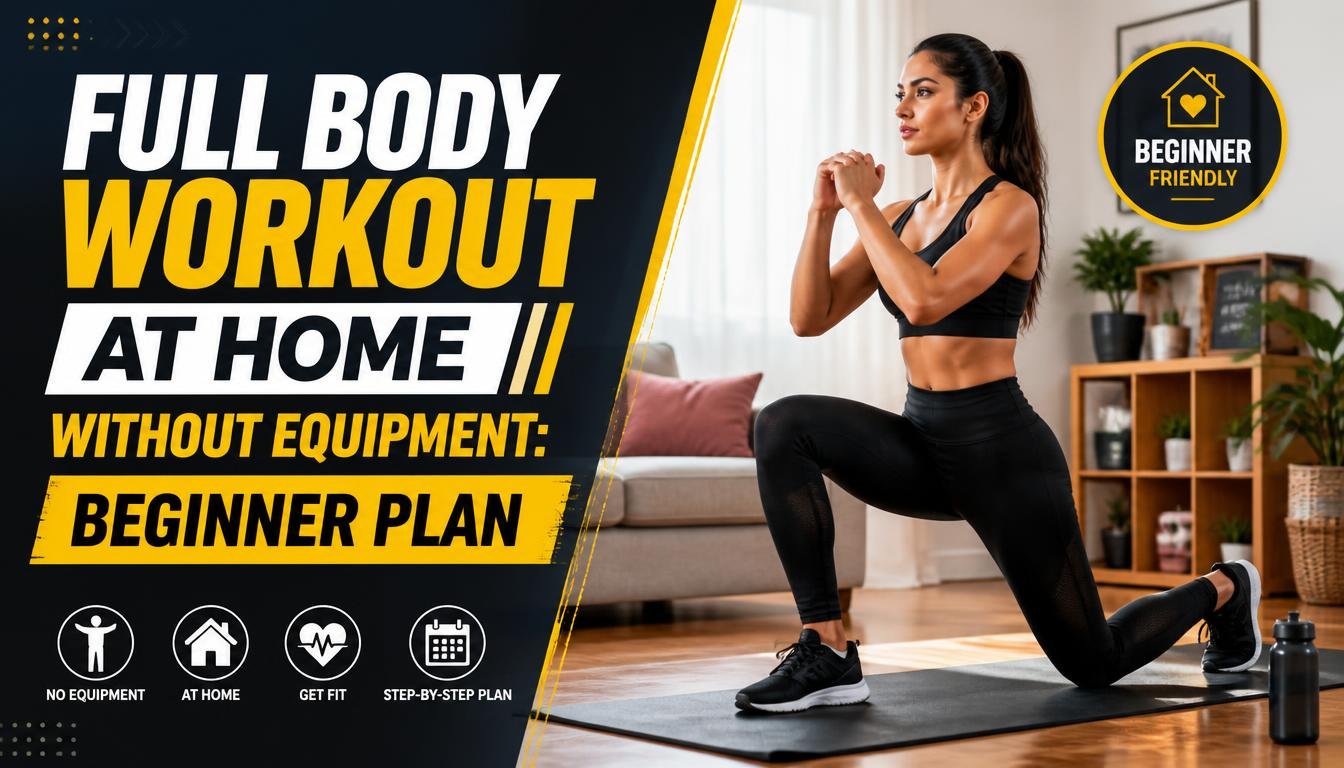
Full Body Workout at Home Without Equipment: Beginner Plan
You don’t need a gym membership, weights, or complicated machines to start getting stronger. A full body workout at home without equipment can help you build a consistent exercise habit, improve muscular endurance, and develop strength using movements that rely on your own body weight.
The key is choosing exercises that train your major muscle groups, learning how to perform them with control, and gradually making your workouts more challenging. You can start with a small space, comfortable clothing, and a stable floor.
This guide explains how to structure a beginner-friendly full body routine, which exercises to include, how many sets and repetitions to do, and how to progress over time. The plan is designed for generally healthy beginners; adjust it to your ability and stop if an exercise causes pain.
What Is a Full Body Workout?
A full body workout is a session that trains several major muscle groups in one routine. Rather than focusing only on your arms or legs, it combines movements for the lower body, upper body, and core.
A balanced bodyweight workout may include:
- All Free Tools
- Squat or lunge movements for the thighs and glutes
- Push movements for the chest, shoulders, and triceps
- Hip-focused movements for the glutes and back of the legs
- Core exercises to train the muscles that help stabilize your trunk
- Low-impact conditioning, if appropriate for your fitness level
Calorie calculator Macro calculator Protein calculator Body fat calculator Water calculator Ideal weight calculator One rep max calculator
You do not need to perform dozens of exercises. A handful of well-chosen movements, repeated consistently, can be a more manageable starting point than a long routine that is difficult to finish.
Benefits of Working Out at Home Without Equipment
1. It is convenient
Home workouts remove the need to travel to a gym or wait for equipment. You can schedule a short session before work, during a break, or at another time that suits your routine.
2. It can help you build a habit
When your workout is easy to access, it may be easier to repeat. Start with a realistic schedule instead of trying to exercise every day from the beginning.
3. It develops bodyweight strength and control
Exercises such as squats, wall push-ups, and glute bridges teach you to control your body through different movements. As you improve, you can adjust the exercise variation, repetitions, or tempo to increase the challenge.
4. It can be adapted to different fitness levels
Many bodyweight exercises have easier and harder versions. For example, a beginner can start with wall push-ups, then progress to a lower support, and eventually try floor push-ups if they are comfortable and appropriate.
5. It requires little space
You generally need enough room to lie down, stand, and move your arms and legs safely. Clear the area of slippery rugs, furniture edges, and other obstacles before beginning.
Before You Start: Warm Up for 5 Minutes
A warm-up helps you transition from rest to exercise. Keep it comfortable and use movements that prepare you for the exercises in your routine.
Try this simple sequence:
- March in place for 60 seconds.
- Make gentle arm circles for 30 seconds.
- Perform 8–10 slow, comfortable hip hinges.
- Do 8–10 easy bodyweight squats, using a chair for support if needed.
- Step side to side for 60 seconds.
Move within a comfortable range. The warm-up should not leave you exhausted. If you have an injury, a health condition, or concerns about whether exercise is suitable for you, ask a qualified healthcare professional for guidance.
The Full Body Workout at Home Without Equipment
This beginner routine includes movements for your legs, chest, shoulders, glutes, and core. Complete the exercises in order, resting between sets as needed.
Beginner full body routine
| Exercise | Sets | Repetitions or time |
|---|---|---|
| Bodyweight squat | 2 | 8–12 reps |
| Wall or incline push-up | 2 | 6–10 reps |
| Glute bridge | 2 | 10–15 reps |
| Reverse lunge or supported split squat | 2 | 6–8 reps per side |
| Bird dog | 2 | 6–8 reps per side |
| Standing calf raise | 2 | 10–15 reps |
| Plank from knees or hands | 2 | 15–30 seconds |
Rest: Take about 45–90 seconds between sets, or longer if you need it to regain steady breathing and good control. The repetition ranges are starting points, not targets you must force yourself to reach.
If you are completely new to exercise, begin with one set of each movement. Focus on learning the exercises before increasing the amount of work.
How to Perform Each Exercise
1. Bodyweight squat
The squat trains the muscles of your thighs and glutes. It also helps you practice a movement pattern used in everyday activities such as sitting down and standing up.
How to do it:
- Stand with your feet around hip- to shoulder-width apart.
- Keep your chest comfortable and your feet planted.
- Bend your knees and hips, lowering as far as you can while maintaining control.
- Press through your feet to stand back up.
Beginner modification: Squat toward a sturdy chair, lightly touching it before standing. Use a comfortable depth and avoid dropping quickly into the movement.
2. Wall or incline push-up
Push-ups train the chest, shoulders, and triceps. Starting against a wall or sturdy counter reduces the amount of body weight you need to move.
How to do it:
- Place your hands on a wall or stable, non-slippery elevated surface.
- Step your feet back until your body forms a comfortable straight line.
- Bend your elbows and bring your chest toward your hands.
- Press back to the starting position without letting your hips sag.
Make it easier: Stand closer to the wall. If using a counter, make sure it cannot move or tip.
3. Glute bridge
The glute bridge targets the glute muscles and practices hip extension.
How to do it:
- Lie on your back with your knees bent and feet flat on the floor.
- Keep your arms relaxed beside you.
- Press through your feet and lift your hips until your body forms a comfortable line from shoulders toward knees.
- Pause briefly, then lower slowly.
Avoid arching your lower back to lift higher. A smaller, controlled range is fine.
4. Reverse lunge or supported split squat
This movement trains the legs one side at a time and can help you practice balance and coordination.
How to do it:
- Stand tall, with your feet about hip-width apart.
- Step one foot back and bend both knees as far as is comfortable.
- Keep your front foot planted and your torso steady.
- Push through the front foot to return to standing.
- Repeat on the other side.
Beginner modification: Hold a wall or sturdy support for balance, or use a stationary split squat with a shorter range of motion. If lunges feel uncomfortable, replace them with another set of chair squats.
5. Bird dog
The bird dog trains core stability and coordination without requiring fast movement.
How to do it:
- Start on your hands and knees, with hands under shoulders and knees under hips.
- Gently brace your midsection.
- Extend one arm and the opposite leg only as far as you can without twisting.
- Return to the start and switch sides.
Move slowly. If extending both limbs is difficult, lift only one arm or one leg at a time.
6. Standing calf raise
Calf raises train the muscles at the back of your lower legs.
How to do it:
- Stand with your feet about hip-width apart.
- Hold a wall or sturdy support if needed.
- Rise onto the balls of your feet.
- Pause briefly, then lower with control.
Avoid bouncing. Use a smaller range if your balance is uncertain.
7. Plank from knees or hands
A plank is an isometric exercise that asks your core muscles to maintain a steady position.
How to do it:
- Start on your hands and knees.
- Place your hands under your shoulders.
- Step your knees back if you are doing a full plank, or keep them on the floor for the modified version.
- Keep your body steady and breathe normally.
- Stop the set when you can no longer maintain a comfortable position.
Do not hold your breath or push through pain. A shorter, well-controlled hold is more useful than a longer hold with poor form.
How Long Should a Home Full Body Workout Take?
For many beginners, this routine may take around 20–35 minutes, including a short warm-up and rest periods. Your actual session length will depend on how many sets you perform, how much rest you need, and whether you are learning new movements.
If you have limited time, start with one set of the first five exercises. You can add the remaining movements as your fitness and confidence improve.
The goal is not to finish as quickly as possible. Prioritize controlled repetitions, comfortable breathing, and a routine you can repeat consistently.
How Often Should You Do a Full Body Workout at Home?
For most beginners, two or three full body workouts per week is a practical starting point. This gives you regular practice while leaving time between sessions to recover.
Try one of these schedules:
| Frequency | Example schedule | Best for |
|---|---|---|
| 2 days per week | Monday, Thursday | Beginners building a routine |
| 3 days per week | Monday, Wednesday, Friday | People who recover well and want more practice |
Avoid turning every day into a hard workout when you are just starting. Rest days can include easy walking, gentle mobility, or other comfortable activities.
If you feel unusually sore, tired, or less coordinated, take more recovery time or reduce the next session. Consistency matters more than forcing yourself to follow a rigid calendar.
A Simple 4-Week Beginner Plan
Use the routine from Part 1 as your foundation. The aim is to gradually build confidence and control—not to increase everything at once.
Week 1: Learn the movements
- Complete 1 set of each exercise.
- Use easier versions when needed, such as wall push-ups or chair squats.
- Move slowly enough to maintain control.
- Finish each set feeling that you could do a few more comfortable repetitions.
Week 2: Add a little volume
- If Week 1 felt manageable, try 2 sets of each exercise.
- Keep the same exercise variations.
- Rest as long as needed to maintain good form.
Week 3: Build consistency
- Continue with 2 sets.
- Add a repetition or two to an exercise only if your current range feels controlled.
- Keep the movement smooth rather than rushing to finish.
Week 4: Review and adjust
- Continue the routine if it feels appropriate.
- If an exercise is becoming easy, consider a slightly harder variation.
- If you are struggling to recover, repeat Week 2 or reduce the number of sets.
Progress is not a race. Repeat a week whenever you need more practice.
How to Make Bodyweight Exercises More Challenging
When an exercise becomes easy, you can increase the challenge without buying equipment. Change only one factor at a time so you can tell how your body responds.
1. Add repetitions
If you can perform the top end of the suggested repetition range with steady form, add one or two repetitions next time.
For example, if you comfortably complete 8 wall push-ups, try 9 or 10 before changing the exercise.
2. Add a set
Moving from one set to two sets increases the amount of work. Add a set only when you can recover comfortably from your current routine.
3. Use a harder variation
Choose a variation that is challenging but still controllable.
| Easier option | Possible next step |
|---|---|
| Chair squat | Bodyweight squat |
| Wall push-up | Push-up against a sturdy counter |
| Glute bridge | Glute bridge with a brief pause |
| Supported split squat | Split squat with less hand support |
| Knee plank | Full plank, if comfortable |
Progressions are options, not requirements. A harder version is not automatically better if it causes discomfort or makes your technique fall apart.
4. Slow down the movement
Try lowering for about two or three seconds, then return to the starting position smoothly. Slower repetitions can make a familiar exercise feel more demanding without adding equipment.
Do not make every repetition excessively slow. Use a pace that lets you stay balanced and maintain control.
5. Improve your range of motion gradually
If a movement feels comfortable and stable, you may be able to move through a slightly larger range over time. Never force depth or range to match someone else’s form.
What If You Cannot Do a Standard Push-Up?
That is common for beginners. A standard floor push-up requires you to control a substantial portion of your body weight. Start with a version that lets you practice the same general movement.
Push-up progression
- Wall push-up: Stand close to the wall and bend your elbows.
- Higher incline push-up: Use a sturdy, stable surface that will not slide or tip.
- Lower incline push-up: Choose a lower support only when the higher version feels controlled.
- Floor push-up: Try it when you can maintain a steady body position through the movement.
There is no need to rush through these stages. You can continue using wall or incline push-ups as part of a useful workout.
What If Squats or Lunges Feel Difficult?
Start with a comfortable range and use support when needed.
For squats, practice sitting down and standing up from a sturdy chair. Keep your feet planted and use your hands for assistance if necessary.
For lunges, try a supported split squat with a small range of motion. If balance is the main challenge, hold a wall or sturdy support. If the movement causes pain, stop and choose a comfortable alternative.
The goal is to train safely and build capacity—not to prove you can complete a particular exercise.
A Shorter 15-Minute Version
On busy days, a shorter routine can help you keep the habit going. After a brief warm-up, perform one set of each movement:
- Bodyweight squat — 8–12 reps
- Wall push-up — 6–10 reps
- Glute bridge — 10–15 reps
- Bird dog — 6–8 reps per side
- Plank from knees — 15–30 seconds
Rest between exercises as needed. If you are short on time, it is better to complete a few controlled movements than to rush through the entire routine.
Common Mistakes to Avoid
Doing too much too soon
Starting with long workouts every day can make it harder to recover and maintain the habit. Begin with a manageable amount and increase gradually.
Rushing through repetitions
Fast, uncontrolled repetitions can make it difficult to maintain balance and technique. Use a steady pace and stop a set when you cannot perform the movement comfortably.
Ignoring discomfort
Muscle effort is expected during exercise, but sharp, worsening, or unusual pain is a reason to stop. Do not push through pain to finish a set.
Comparing your progress with others
People start with different strength, mobility, experience, and recovery needs. Compare your current ability with your own previous sessions instead.
Changing too many things at once
If you add more sets, harder variations, and extra workout days simultaneously, it may be difficult to know what is working. Adjust one factor at a time.
Forgetting to rest
Recovery is part of training. If you feel run down or your form is noticeably worse, take a rest day or reduce the session.
Can You Build Muscle With a No-Equipment Workout?
Bodyweight training can help beginners improve strength and may support muscle development when exercises are challenging enough and progressed over time. However, results vary with training experience, exercise selection, effort, recovery, and nutrition.
As you become stronger, some bodyweight movements may stop providing enough challenge for particular muscles. You can make them harder with variations, but eventually you may choose to add resistance or seek a more individualized program.
For now, focus on learning the movements, training consistently, and gradually increasing the challenge while maintaining control.
Conclusion: Start Simple and Stay Consistent
A full body workout at home without equipment can be a practical way to begin exercising. With a few bodyweight movements, a clear schedule, and gradual progression, you can build a routine that fits your space and current fitness level.
Start with the easier exercise variations and a manageable number of sets. Focus on controlled movement, rest when you need it, and make small changes as your strength and confidence improve. You do not need to make every workout exhausting for it to be worthwhile.
If you want help planning your next steps, explore the workout and calorie tools on MyWorkoutAI.in to support your fitness routine.
Key Takeaways
- Train your major muscle groups with a mix of squats, push-ups, hip exercises, and core work.
- Beginners can start with one set per exercise and build gradually.
- Two or three sessions per week is a reasonable starting schedule for many people.
- Use easier variations, such as wall push-ups and chair squats, when needed.
- Progress by adding a few repetitions, an extra set, or a more challenging variation—one change at a time.
- Stop if an exercise causes sharp, worsening, or unusual pain.
Frequently Asked Questions
1. Can I get a full body workout at home without equipment?
Yes. Bodyweight exercises such as squats, push-ups, glute bridges, lunges, and planks can train several major muscle groups. Choose variations that match your current ability and progress gradually.
2. How many days a week should a beginner do a full body workout?
Two or three days per week is a practical starting point for many beginners. Leave time between challenging sessions for recovery and adjust based on how you feel.
3. How long should a no-equipment full body workout take?
A beginner session may take around 20–35 minutes, including warm-up and rest. A shorter session can also be useful if it helps you stay consistent.
4. Is a 15-minute full body workout enough?
A 15-minute workout can be a useful starting point, especially when you are new to exercise or short on time. Begin with a few controlled exercises and increase the workload gradually as appropriate.
5. Can I build muscle with bodyweight exercises?
Bodyweight training can help beginners build strength and may support muscle development when the exercises are sufficiently challenging and progressed over time. Results vary, and some people may eventually need added resistance for continued progress.
6. What is the easiest full body exercise for beginners?
There is no single easiest exercise for everyone. Chair squats, wall push-ups, and glute bridges are often useful starting options because they can be adjusted to a comfortable level.
7. Do I need to warm up before a home workout?
A brief, comfortable warm-up can help you transition into exercise. Try marching in place, gentle arm circles, easy squats, and side steps before beginning your main routine.
8. Should I work out every day to see results?
Not necessarily. Rest and recovery are important parts of a routine. Many beginners can start with two or three full body sessions per week and use other days for comfortable activities such as walking.
9. What should I do if I cannot do a push-up?
Start with wall push-ups. As they become manageable, you can try a push-up against a sturdy elevated surface, then consider a lower incline or floor variation when you can maintain control.
10. What if an exercise causes pain?
Stop that exercise rather than pushing through pain. Choose a comfortable alternative if appropriate, and consult a qualified healthcare professional if pain persists or you are unsure which movements are suitable for you.
Stop reading, start moving
Reading about training is the easy part. Fifteen minutes today beats a fortnight of research - and all of it is free.
Start Free