Beginner Gym Workout Plan: A Simple 4-Week Guide
Start strength training with this beginner-friendly 4-week gym workout plan. Learn how to structure sessions, choose exercises, progress safely, and build consistency.
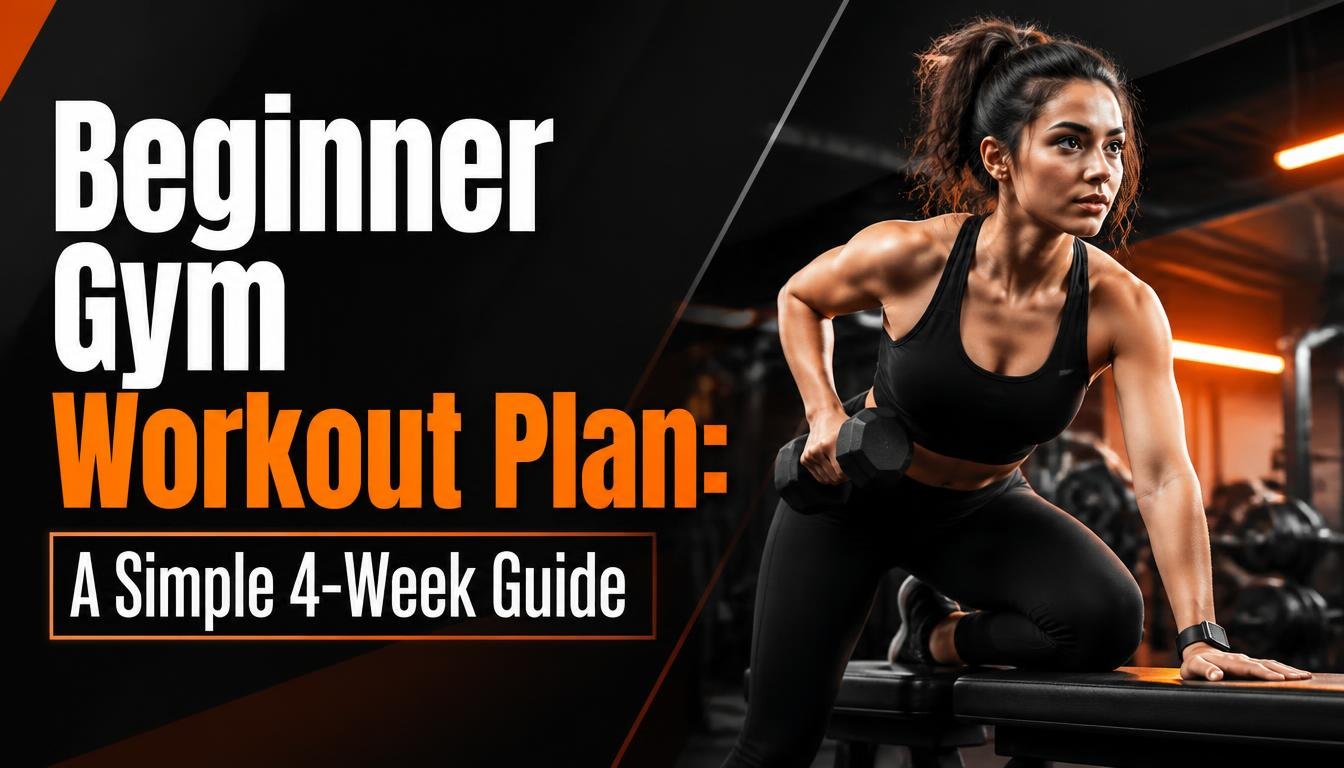
Beginner Gym Workout Plan: A Simple 4-Week Guide
Starting at the gym can feel intimidating. There are machines you have never used, exercises you are unsure how to perform, and plenty of workout plans that seem designed for experienced lifters.
A good beginner gym workout plan should make things simpler. You need a manageable schedule, a few basic movements, enough recovery, and a way to make gradual progress—not a complicated routine that leaves you exhausted.
This four-week guide introduces a straightforward approach to building gym confidence and establishing a strength-training habit. It is a general example for healthy adults who are new to gym training, not an individualized exercise prescription.
What to Know Before You Start
The first goal is to learn how to train consistently and comfortably. You do not need to lift heavy weights, work out every day, or feel sore after every session to make progress.
For the first month, focus on:
- [Free Tools
](/tools)- Learning a few basic movement patterns.
- Using equipment safely and adjusting it to fit you.
- Choosing resistance you can control.
- Taking rest days seriously.
- Building a routine that fits your schedule.
If you have a health condition, an injury, are pregnant or recently gave birth, or are unsure whether exercise is appropriate for you, seek advice from a qualified healthcare professional before starting. Ask gym staff or a qualified trainer to demonstrate unfamiliar equipment.
How the 4-Week Plan Works
This plan uses three full-body gym sessions per week, with rest or light activity between sessions. Full-body workouts are a practical way for beginners to practise the major movement patterns without needing to visit the gym every day.
Suggested weekly schedule:
| Day | Activity |
|---|---|
| Monday | Full-body workout |
| Tuesday | Rest or easy activity |
| Wednesday | Full-body workout |
| Thursday | Rest or easy activity |
| Friday | Full-body workout |
| Saturday | Optional walk or enjoyable activity |
| Sunday | Rest |
You can move the days around to fit your life. If three sessions are too much at first, begin with two non-consecutive days and add a third when you feel ready.
How hard should a beginner workout feel?
Choose a weight that allows you to perform each repetition with control and maintain good technique. At the end of a set, you should generally feel that you could still do a few more repetitions—not that you had to struggle through poor form.
Rest between sets until you can perform the next set with control. Beginners often benefit from taking more rest rather than rushing.
Warm Up Before Each Workout
A warm-up prepares you for the movements ahead. It does not need to be complicated or exhausting.
Try this simple sequence:
- Spend a few minutes walking, cycling, or using another comfortable cardio machine.
- Move your joints gently through ranges of motion relevant to the workout.
- Before a strength exercise, do a lighter practice set if needed.
The warm-up should leave you feeling ready, not tired. Adjust it based on the workout and how your body feels that day.
The Main Exercises in This Beginner Plan
The plan uses familiar movements that cover the major muscle groups. Machines can be especially useful when you are learning because they guide the movement, though they still need to be adjusted and used correctly.
1. Leg press or chair squat
Main focus: Legs and hips.
Use a leg-press machine if you have been shown how to set it up. Alternatively, practise sitting back toward a sturdy chair and standing again, using body weight or light assistance as needed.
Keep the movement controlled and use a comfortable range of motion. Do not force your knees or hips into a position that causes pain.
2. Seated chest press or wall push-up
Main focus: Chest, shoulders, and triceps.
A chest-press machine can provide a guided option. A wall push-up is another beginner-friendly choice: place your hands on a wall, keep your body aligned, and bend and straighten your elbows with control.
Choose a variation that feels manageable and does not cause discomfort.
3. Seated row
Main focus: Back and arms.
Set the machine according to its instructions. Pull the handles toward your torso while keeping your shoulders controlled, then return slowly.
Avoid jerking the weight or leaning far backward to finish the repetition.
4. Lat pulldown
Main focus: Back and arms.
Use a comfortable grip and pull the bar toward the upper chest while keeping your torso steady. Return the bar slowly.
Do not pull behind your neck. If you are unsure about setup or technique, ask a qualified trainer to demonstrate.
5. Hip hinge or glute bridge
Main focus: Hips and glutes.
A glute bridge can be practised on a mat with body weight. Lie on your back with knees bent, press through your feet, and raise your hips comfortably before lowering with control.
A hip hinge can also be practised with no weight, learning to move at the hips while keeping the back in a comfortable, stable position.
6. Core exercise
Main focus: Trunk stability.
A beginner option is a short, controlled plank against a wall or sturdy elevated surface. Keep breathing and stop when you can no longer maintain a comfortable position.
You do not need to hold a plank for a long time. Quality and control matter more than duration.
Your First Workout: Learn the Movements
For your first gym visit, keep the session simple. Ask staff to show you how to adjust each machine, and start with a light resistance.
A beginner session can look like this:
| Exercise | Sets | Repetitions |
|---|---|---|
| Leg press or chair squat | 1–2 | 8–12 |
| Chest press or wall push-up | 1–2 | 8–12 |
| Seated row | 1–2 | 8–12 |
| Lat pulldown | 1–2 | 8–12 |
| Glute bridge | 1–2 | 8–12 |
| Wall or elevated plank | 1–2 | Short, controlled holds |
These are starting ranges, not targets you must hit immediately. If an exercise feels unfamiliar, practise with no weight or ask for instruction before adding resistance.
Rest between sets as needed. If the session feels too long, use fewer exercises and build up gradually.
How to Choose the Right Weight
The right starting weight is one you can control throughout the set. Your last repetitions may feel challenging, but your movement should remain steady and pain-free.
Use this simple process:
- Begin with a very light resistance or no added weight.
- Practise the movement and check your setup.
- If the set feels easy and your technique remains solid, increase the resistance slightly next time.
- If you need to swing, jerk, or shorten the movement to complete repetitions, reduce the resistance.
Do not compare your starting weights with someone else’s. Your goal is to learn the movement and progress from your own baseline.
What to Expect in Your First Month
The first four weeks are about building a foundation. You may notice that exercises feel more familiar, your coordination improves, or you become more comfortable in the gym.
You may not see dramatic changes in muscle size or body weight in one month. Results vary, and early progress can include learning, confidence, and improved exercise control.
Avoid judging your entire routine by one workout or one scale reading. Give yourself time to practise consistently.
A Few Important Safety Rules
- Stop an exercise if you experience sharp pain, dizziness, chest discomfort, or unusual shortness of breath.
- Do not hold your breath during repetitions; breathe steadily.
- Use safety features and machine settings as instructed.
- Keep weights and equipment in their designated places.
- Ask for help if you are uncertain about technique or setup.
- Leave recovery time between demanding sessions.
Next (Part 2) will include the week-by-week workout schedule, how to progress from Week 1 to Week 4, cardio options, rest and recovery guidance, and common beginner mistakes to avoid.
Beginner Gym Workout Plan: Weeks 1–4
Your weekly schedule
Train three non-consecutive days each week—for example, Monday, Wednesday, and Friday. On the other days, rest or choose easy activities such as walking, cycling, or gentle mobility work.
| Day | Plan |
|---|---|
| Monday | Full-body Workout A |
| Tuesday | Rest or easy activity |
| Wednesday | Full-body Workout B |
| Thursday | Rest or easy activity |
| Friday | Full-body Workout A |
| Saturday | Optional easy cardio |
| Sunday | Rest |
The following week, alternate the workouts: B, A, B. Continue alternating so both workouts receive balanced attention.
Week 1: Learn the movements
Goal: Practise technique and finish each set feeling that you could do a few more repetitions.
Complete 1–2 sets of each exercise. Aim for 8–12 controlled repetitions, unless a different range is listed. Rest about 1–2 minutes between sets, or longer if you need it to recover.
Workout A
- Leg press or box squat: 8–12 reps
- Machine chest press: 8–12 reps
- Seated cable row: 8–12 reps
- Dumbbell Romanian deadlift with light weights, or a hip-hinge drill: 8–10 reps
- Dead bug: 6–8 reps per side
Workout B
- Goblet squat to a box, or leg press: 8–12 reps
- Lat pulldown: 8–12 reps
- Dumbbell incline press or machine chest press: 8–12 reps
- Glute bridge: 10–12 reps
- Bird dog: 6–8 reps per side
Use the first session to learn how to set up each machine and adjust it to your body. Ask gym staff for help if you are unsure.
Week 2: Repeat and build confidence
Goal: Make the routine familiar before making it harder.
Complete 2 sets of each exercise if Week 1 felt manageable. Keep the same exercises and weight while you practise smooth, controlled repetitions.
At the end of each set, ask yourself:
- Did I maintain control throughout the movement?
- Could I have completed another 2–3 good repetitions?
- Did I feel discomfort that seemed sharp, unusual, or joint-related?
If your technique breaks down, reduce the weight or use an easier variation. Do not increase weight simply because a new week has started.
Week 3: Add a little challenge
Goal: Progress gradually while keeping good form.
If you can complete the top of the repetition range for every set with steady technique, increase the weight by the smallest practical amount at your next session. Otherwise, keep the weight and try to add one repetition to some sets.
For example, if your chest press is 2 sets of 8–12 reps:
- Session 1: 10 reps, then 9 reps
- Session 2: 10 reps, then 10 reps
- Session 3: 11 reps, then 10 reps
That is progress—even if the weight stays the same.
Week 4: Consolidate your progress
Goal: Finish the month with a routine you can continue.
Keep the same three-day schedule. Use the weight and repetition range that allow you to maintain control. You may increase the load slightly on exercises where you consistently reach the top of the range with good technique.
At the end of the week, note:
- Which exercises feel more comfortable?
- Which weights or repetitions have increased?
- Which movements need more practice?
- How well are you recovering between sessions?
You do not need to test your maximum lift or train to exhaustion to measure progress.
How to choose your starting weight
Choose a weight that lets you complete the planned repetitions with controlled movement. The final few repetitions should feel challenging, but you should still be able to maintain good technique.
If you cannot reach the minimum repetitions without straining or losing control, lower the weight. If every repetition feels very easy across all sets, try a small increase next time.
For free-weight exercises, start lighter than you think you need while learning the movement. A trainer or qualified gym professional can help check your form.
A simple session structure
- Warm up: 5–10 minutes of easy movement, followed by a few gentle practice repetitions of your first exercise.
- Strength training: Complete the workout in the order listed. Rest enough to perform the next set safely.
- Optional cardio: Add 10–20 minutes at an easy-to-moderate pace if you have time and energy.
- Cool down: Slow down gradually and do comfortable mobility work if it feels useful.
A session may take around 35–60 minutes, depending on your pace, rest periods, and how busy the gym is. It is fine to take longer when you are learning.
Cardio: Keep it manageable
Cardio is optional after your strength workout, especially while you are getting used to the gym. Choose an activity you enjoy, such as brisk walking, cycling, or an elliptical machine.
Start with a duration that feels comfortable. You should be able to speak in short sentences during moderate activity. Add time gradually rather than suddenly increasing both cardio and strength-training volume.
If your main goal is general fitness, building toward regular weekly activity is more useful than trying to do a punishing cardio session after every workout. Follow public-health guidance appropriate to your age and circumstances, and adapt it to your current fitness level.
Rest and recovery
Recovery is part of the plan. Leave a day between full-body strength sessions when possible, get adequate sleep, eat regular balanced meals, and drink water throughout the day.
Some muscle soreness can happen when you begin a new routine, but sharp pain, worsening pain, dizziness, or feeling unwell are reasons to stop and reassess. Seek medical advice for concerning or persistent symptoms.
If you miss a workout, do not try to make up for it by doubling the next session. Simply continue with the next planned workout.
Common beginner mistakes to avoid
Starting too heavy: Choose a load you can control. The first month is for learning and consistency.
Changing exercises every session: Repeating a manageable routine helps you practise and track progress.
Rushing repetitions: Use a controlled pace and a comfortable range of motion. Avoid bouncing or swinging to move the weight.
Skipping warm-ups: A few minutes of easy movement and practice repetitions can help you prepare for the session.
Training hard every day: More is not always better. Recovery days help you return ready for the next workout.
Comparing yourself with experienced lifters: Your starting point is personal. Track your own technique, consistency, and gradual improvements.
Treating soreness as proof of success: A productive workout does not have to leave you exhausted or very sore.
How to adapt the plan
- If you are short on time: Do the first three exercises and one core exercise, then finish. Resume the full routine next time.
- If an exercise feels uncomfortable: Stop and try a pain-free variation, reduce the range or load, or ask a qualified professional for guidance.
- If the gym is crowded: Use a similar movement pattern—for example, a machine chest press instead of dumbbell pressing, or a leg press instead of a squat variation.
- If you are very sore or unusually tired: Take an extra rest day or reduce the number of sets. Resume gradually when you feel ready.
If you have a medical condition, a recent injury, or specific exercise restrictions, ask a healthcare professional about an appropriate plan before starting.
Keep a simple workout log
Record the date, exercise, weight, sets, and repetitions. Add a short note about how the movement felt. This makes it easier to see gradual progress without relying on memory.
The best beginner gym workout plan is one you can repeat safely and consistently. Focus on learning the movements, showing up regularly, and making small adjustments when you are ready.
Beginner Gym Workout Plan: Conclusion
Starting at the gym can feel intimidating, but you do not need a complicated routine to make progress. A simple full-body plan performed three days a week gives you time to practise basic movements, recover between sessions, and build a consistent habit.
For your first four weeks, focus on learning the exercises, choosing manageable weights, and recording your sets and repetitions. Increase the challenge gradually only when you can maintain good technique. If you miss a session, return to your schedule rather than trying to make up for it all at once.
There is no single perfect workout for everyone. Adjust exercises to your comfort, equipment access, and current fitness level. If you have an injury, medical condition, or exercise restrictions, seek guidance from a qualified professional.
Key takeaways
- Train three non-consecutive days each week.
- Alternate between Full-body Workout A and Workout B.
- Begin with manageable weights and controlled repetitions.
- Add repetitions or a small amount of weight gradually, when ready.
- Treat rest, recovery, and consistency as part of the plan.
- Track your workouts to notice progress over time.
Try MyWorkoutAI
Want help organising your fitness routine? Explore the AI workout and calorie tools at MyWorkoutAI.in to support your planning. Remember that generated workouts and calorie estimates are starting points—not medical advice or guarantees. Adjust them to your needs and seek professional guidance when appropriate.
Frequently asked questions
1. How many days a week should a beginner go to the gym?
Three non-consecutive strength-training days per week is a practical starting point for many beginners. Rest or do easy activity between sessions.
2. Is a 4-week gym plan enough to see results?
Four weeks is enough to practise the routine and begin building consistency. Strength, fitness, and body-composition changes vary by person and depend on many factors.
3. Should beginners do cardio or weights first?
If strength training is your priority, do it before optional cardio so you have more energy for learning the lifts. You can also do cardio on separate days.
4. How long should a beginner gym workout take?
Many beginner sessions take roughly 35–60 minutes, depending on the number of sets, rest periods, and how busy the gym is. Take the time you need to exercise safely.
5. What weight should I start with?
Choose a weight that allows controlled repetitions while leaving a few good repetitions in reserve. Reduce the weight if you struggle to maintain technique.
6. Should I work out every day as a beginner?
You do not need to lift weights every day. Rest days between full-body sessions can help you recover and prepare for the next workout.
7. What should I do if I miss a gym day?
Continue with your next planned workout. Avoid doubling the next session to compensate for a missed day.
8. Is muscle soreness necessary for progress?
No. Soreness is not a reliable measure of workout quality. Stop and reassess if you experience sharp, worsening, or unusual pain.
9. Can I follow this plan at home?
Yes, with suitable substitutions such as bodyweight squats, incline push-ups, resistance-band rows, and glute bridges. Choose options you can perform with control.
10. When should I increase the weights?
Consider a small increase when you can complete the top of your planned repetition range across your sets with steady technique. If not, keep practising at the current weight.
FAQ Schema (JSON-LD)
Use this structured data only if the same questions and answers are visible on the published page. Validate it before publishing, and follow current search-engine structured-data guidelines.
Stop reading, start moving
Reading about training is the easy part. Fifteen minutes today beats a fortnight of research - and all of it is free.
Start Free