
Progressive Overload Explained: How to Get Stronger Over Time
Learn what progressive overload is, why it helps you build strength and muscle, and how to apply it safely with a simple training plan.
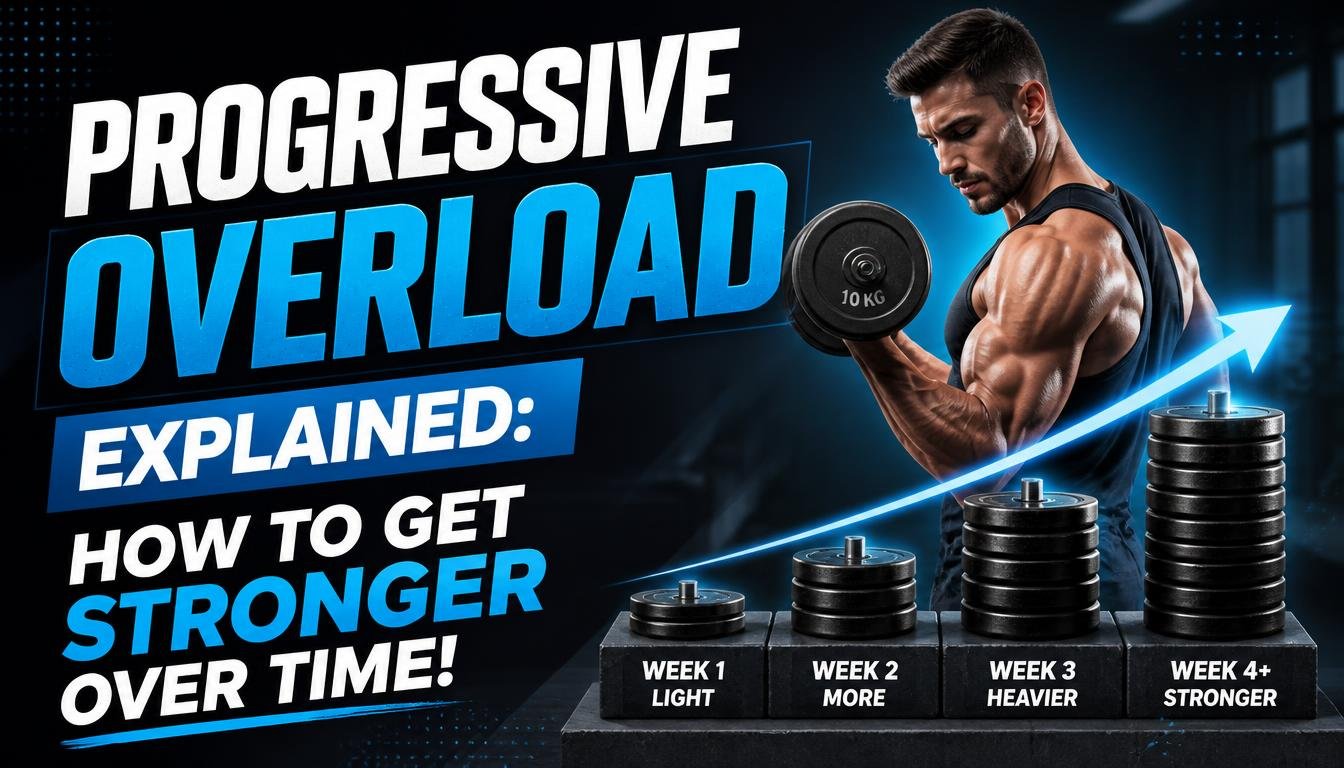
Progressive Overload Explained: How to Get Stronger Over Time
Getting stronger is not just about working hard during a workout. It is about giving your body a reason to adapt—and gradually increasing that challenge as your fitness improves. That is the idea behind progressive overload, one of the most important principles in strength training.
Whether you train at home, lift weights at the gym, or are just starting a workout routine, progressive overload can help you make steady progress. You do not need to add weight to every exercise every week. You need a sensible way to make your training a little more challenging over time while maintaining good technique and allowing your body to recover.
This guide explains what progressive overload means, why it works, and how to use it in a practical training routine.
What Is Progressive Overload?
Progressive overload is the gradual increase of training demands over time. You might lift a slightly heavier weight, perform more repetitions, complete more challenging variations, or improve how well you control an exercise.
Your body responds to the demands placed on it. When you consistently train with an appropriate challenge and recover well, your muscles and nervous system can adapt. As your capacity improves, the workout that once felt difficult may become more manageable. Progressively increasing the challenge helps keep your training productive.
Progressive overload is not the same as making every workout exhausting. It is a planned process of doing a little more when you are ready.
A simple example
Imagine you perform dumbbell rows with 10 kg for 8 repetitions per set. After practicing the movement, you can complete 10 repetitions with the same weight while keeping your form controlled.
That improvement is progress. You could continue building repetitions within your target range before increasing the dumbbell weight. Once you increase the weight, you may return to fewer repetitions and build up again.
The goal is not to make every session harder than the last. The goal is to create a clear path from your current ability to a slightly higher level of performance.
Why Progressive Overload Matters
Progressive overload gives your workouts direction. Without some form of progression, you may repeat the same training demands for months—even after your body has adapted to them.
1. It helps you build strength
Strength improves through practice and adaptation. Repeating exercises with good technique helps you become more skilled at the movements, while gradually increasing the challenge can support further strength gains.
Progress may show up as lifting more weight, completing more repetitions, or performing the same workload with better control.
2. It can support muscle growth
Muscles need an appropriate training stimulus to grow. Over time, increasing the challenge of your resistance training can help you continue providing that stimulus.
More weight is one option, but it is not the only one. Additional repetitions, more challenging exercise variations, or improved range of motion may also make a workout more demanding.
3. It makes progress easier to measure
Progressive overload turns “I think I’m getting stronger” into something you can track. Recording your exercises, weights, repetitions, and sets gives you a record of what you have actually done.
That record can help you decide when to progress, when to repeat a workout, and when to reduce the challenge because recovery is falling behind.
4. It helps you train with purpose
A progression plan gives each workout a clear objective. Instead of adding weight at random, you can work toward a specific target—such as completing the top of a repetition range with solid technique.
That makes training more consistent and can help you avoid changing your routine every time you see a new exercise online.
The Main Ways to Apply Progressive Overload
There are several ways to make training more challenging. Choose the method that fits your exercise, experience, equipment, and goals. You do not need to increase every training variable at once.
1. Increase the weight
Adding a small amount of weight is a straightforward way to increase the demand of an exercise.
For example, if you can perform your planned sets of goblet squats with a 12 kg dumbbell and still maintain good form, you might try a slightly heavier dumbbell next time. The heavier load will usually mean you complete fewer repetitions at first.
Use manageable increases. A small jump that allows you to keep control is generally more useful than a large jump that forces you to shorten the movement or change your technique.
2. Perform more repetitions
You can progress by completing more repetitions with the same weight.
For example:
- Free all Tools
- Workout 1: 8, 8, 7 repetitions
- Workout 2: 8, 8, 8 repetitions
- Workout 3: 9, 8, 8 repetitions
This is especially useful when your available weights increase in large jumps, or when you are training with bodyweight exercises.
More repetitions count as progress when they are performed with consistent technique and within a sensible effort level.
3. Add a set
Adding a set increases the total amount of work you perform for an exercise. This can be useful when your current sets are well-managed and you have room for more training volume.
However, more sets also mean more fatigue and time. Do not keep adding sets indefinitely. Start with a manageable amount of work and increase it only when you can recover and maintain performance.
4. Improve range of motion and control
A repetition is not automatically better because it is faster or heavier. Performing an exercise through a consistent, appropriate range of motion—and controlling the movement—can improve the quality of your training.
For example, you might progress a bodyweight squat by gradually improving depth while keeping your balance and control. For push-ups, you might work toward a consistent chest-to-floor range before moving to a harder variation.
Use a range of motion that is comfortable for your body. Do not force a position that causes pain.
5. Choose a more challenging variation
When you cannot easily add weight, changing the exercise variation can increase the challenge.
Examples include:
- Wall push-ups → incline push-ups → floor push-ups
- Assisted split squats → bodyweight split squats → loaded split squats
- Standard plank → longer controlled hold → a more demanding plank variation
Move to a harder version when you can perform the current one with stable technique. A more advanced variation is not useful if it prevents you from completing controlled repetitions.
6. Improve consistency and technique
Not every improvement needs to be a heavier lift or an extra repetition. You may be progressing when you perform the same workout with better balance, steadier control, or more consistent technique.
These improvements matter because they help you build a reliable foundation for future increases. They also make your training log more meaningful: you are comparing similar repetitions rather than counting reps that vary greatly in quality.
Progressive Overload in Practice
Use the double-progression method
One beginner-friendly way to apply progressive overload is double progression: increase repetitions within a target range first, then increase the weight and build repetitions again.
For example, choose a range of 8–12 reps for an exercise:
- Pick a weight you can lift with controlled technique.
- Keep the weight the same while gradually adding reps.
- Once you can complete 12 reps for every planned set with good form, increase the weight slightly.
- Expect your reps to drop after the increase. Build them back up over time.
You do not have to progress every workout. Repeating the same weight and reps while you practice the movement is still useful training.
Example: dumbbell bench press
Suppose your plan is 3 sets of 8–12 reps:
| Session | Set 1 | Set 2 | Set 3 |
|---|---|---|---|
| 1 | 10 | 9 | 8 |
| 2 | 10 | 10 | 9 |
| 3 | 11 | 10 | 10 |
| 4 | 12 | 12 | 12 |
| 5 | Increase weight | 9 | 8 |
The numbers are an illustration, not a required schedule. Your progress may be faster, slower, or uneven. Increase the load only if the last repetitions remain controlled and you are not relying on momentum or shortening the movement.
How much weight should you add?
There is no single increase that works for every exercise or person. The right jump is the smallest practical increase that still lets you perform the exercise well.
- Upper-body exercises often need smaller increases because the muscles involved may be working with lighter loads.
- Lower-body exercises may allow somewhat larger increases, depending on the exercise and equipment.
- Bodyweight exercises: use a harder variation, a larger comfortable range of motion, or additional repetitions before adding external load.
If your gym’s dumbbells jump from 10 kg to 12.5 kg and that feels too large, keep using the lighter pair while building repetitions, or choose another progression method. You do not need to force a jump just because heavier equipment is available.
How hard should a set feel?
A useful approach is to finish most working sets with a few good repetitions still possible. This is often described as reps in reserve (RIR).
- 3 RIR: You estimate you could complete about three more good reps.
- 2 RIR: You estimate you could complete about two more.
- 1 RIR: You estimate you could complete one more.
- 0 RIR: You cannot complete another repetition with the required technique.
These are estimates, not exact measurements. Beginners may find it difficult to judge RIR at first, so prioritize consistent form and gradual progress over trying to calculate effort perfectly.
You generally do not need to take every set to failure to make progress. Very hard sets can create more fatigue, which may affect the quality of later sets or your next workout.
A simple progressive overload workout plan
This example uses a full-body routine performed three days per week. It is a template, not a personalized prescription. Adjust exercise choices, loads, and volume to your experience, available equipment, and recovery.
Train on non-consecutive days where possible—for example, Monday, Wednesday, and Friday. Begin each session with a few minutes of easy movement and lighter practice sets for the exercises you will perform.
Workout A
| Exercise | Working sets | Rep target |
|---|---|---|
| Goblet squat | 3 | 8–12 |
| Dumbbell bench press or push-up | 3 | 8–12 |
| One-arm dumbbell row | 3 | 8–12 per side |
| Romanian deadlift | 2 | 8–12 |
| Plank | 2 | 20–45 seconds |
Workout B
| Exercise | Working sets | Rep target |
|---|---|---|
| Split squat | 3 | 8–12 per side |
| Overhead press | 3 | 8–12 |
| Lat pulldown or band row | 3 | 8–12 |
| Glute bridge | 2 | 10–15 |
| Dead bug | 2 | 8–12 per side |
Alternate the workouts across the week:
- Week 1: A / B / A
- Week 2: B / A / B
- Continue alternating.
Choose a load that lets you complete the lower end of the rep range with good technique. When you can complete the top of the range for all sets at a controlled effort, consider a small increase in load.
For exercises measured by time, such as planks, build up the hold within a planned range. Once the top end feels controlled, progress to a more challenging variation rather than extending the hold indefinitely.
What to record in your workout log
A training log makes progressive overload easier to apply. Record enough information to compare one session with the next.
For each exercise, track:
- Exercise name and variation
- Weight or equipment used
- Repetitions for each set
- Number of sets
- Optional effort rating or estimated reps in reserve
- Notes about technique, discomfort, or unusual fatigue
Copyable workout log
| Date | Exercise | Weight | Set 1 | Set 2 | Set 3 | Notes |
|---|
Try to compare like with like. If you change the exercise, range of motion, equipment, or technique substantially, note that change. Otherwise, it may be difficult to tell whether your performance has genuinely improved.
When should you progress—and when should you hold steady?
Progress when the current workout feels manageable and you can complete the planned work with consistent technique.
Consider holding steady when:
- You are still learning the exercise.
- Your repetitions vary widely from set to set.
- You are struggling to maintain your usual range of motion.
- You have had poor sleep, unusually high stress, or limited recovery.
- You feel uncertain about how to perform the movement safely.
Consider reducing the challenge if you repeatedly lose technique, cannot complete the planned repetitions, or feel unusually fatigued. That may mean using a lighter load, doing fewer sets, or taking more recovery time.
Progress is rarely a perfectly straight line. A session where you repeat the same numbers can still be part of a productive training plan.
Common progressive overload mistakes
Adding weight before you are ready
Lifting heavier is not automatically better. If a weight increase causes you to swing, bounce, shorten the movement, or lose control, it may be too large for now.
Try instead: Build repetitions within a target range, then make a small increase.
Changing too many things at once
Adding weight, sets, reps, and training days simultaneously makes it harder to know what helped—and can increase fatigue quickly.
Try instead: Change one main variable at a time. For example, build reps first, then increase the load.
Treating every workout like a test
Trying to beat your previous performance every session can turn normal fluctuations into frustration and may encourage poor decisions when you are tired.
Try instead: Follow your progression criteria. Repeat a session when needed, and treat good technique as part of the goal.
Ignoring recovery
Muscles and strength do not improve only during the workout. Recovery—including sleep, adequate food, and time between demanding sessions—helps you handle training consistently.
Try instead: Keep a sustainable schedule and adjust training if performance or recovery is repeatedly declining.
Counting poor-quality repetitions
A rep performed with a shorter range of motion or uncontrolled momentum may not be comparable to the reps you logged before.
Try instead: Use a consistent technique standard. Count the repetitions you can perform with the movement quality you intended.
Expecting the same rate of progress forever
New lifters may improve quickly at first, while progress often becomes slower and less predictable with experience. That does not mean the program has stopped working.
Try instead: Look at trends across several sessions rather than judging your progress from one workout.
What if you stop making progress?
A short plateau does not automatically mean you need a new program. First, check the basics:
- Is your log accurate? Make sure you are comparing the same exercise and similar technique.
- Are you training consistently? Missed sessions make progress harder to assess.
- Is the exercise appropriately challenging? If every set is very easy, you may need to increase the challenge gradually.
- Are you recovering? Persistent fatigue can make it harder to perform well.
- Is the progression step too large? Smaller increases or a repetition-based approach may work better.
If you have repeated difficulty progressing, consider adjusting the plan’s volume, exercise selection, or recovery demands. A qualified coach can help assess technique and programming, especially if you are unsure how to make changes.
Stop an exercise if you experience sharp or worsening pain. For injuries, medical conditions, or persistent symptoms, seek guidance from a qualified healthcare professional before continuing or changing your training.
The key principle
Progressive overload is a gradual process—not a demand to do more every time you train. Build a repeatable workout, track what you do, and increase the challenge when your performance shows you are ready.
The best progression is one you can sustain while training with good technique and recovering well.
Conclusion: Get stronger one step at a time
Progressive overload is a simple idea: gradually increase the challenge of your workouts as your body becomes capable of handling more. That might mean lifting a little more weight, completing another repetition, improving your technique, or moving to a more challenging exercise variation.
You do not need to set a personal record every session. Choose a manageable routine, track your performance, and use consistent technique to decide when to progress. If your performance stalls or recovery suffers, repeating a workout—or temporarily reducing the challenge—can be a sensible part of training.
Start with one or two exercises in your next workout. Record your sets and repetitions, then look for a small, achievable improvement over time.
Make your next workout easier to track
Use the workout and calorie tools on MyWorkoutAI.in to help organize your training and support your fitness routine. Keep your plan realistic, focus on consistency, and let your progress build gradually.
Key takeaways
- Progressive overload means gradually increasing training demands over time.
- You can progress by adding weight, repetitions, sets, or choosing a more challenging variation.
- Double progression is a practical method: build reps within a range, then increase the load slightly.
- Keep technique consistent so your workout log reflects meaningful progress.
- You do not need to make every workout harder.
- Recovery and consistency matter; adjust the plan when fatigue or performance problems persist.
- Stop an exercise if you experience sharp or worsening pain. Seek qualified guidance for injuries, medical conditions, or persistent symptoms.
Frequently Asked Questions
1. What is progressive overload in simple terms?
Progressive overload means gradually making your workouts more challenging as you get stronger or fitter. You can do this by increasing weight, repetitions, sets, or exercise difficulty while maintaining good technique.
2. Do I need to increase weight every week?
No. Weekly increases are not required. You can repeat the same weight while building repetitions or improving technique. Increase the load when you can complete your planned work with consistent form and appropriate effort.
3. Is progressive overload necessary to build muscle?
Progressive overload is a useful way to keep resistance training challenging as your ability improves. Muscle growth also depends on factors such as training consistency, sufficient effort, nutrition, and recovery.
4. Can I use progressive overload with bodyweight exercises?
Yes. Add repetitions, improve controlled range of motion, use a more challenging variation, or add external resistance when appropriate. For example, you might progress from incline push-ups to floor push-ups.
5. What is double progression?
Double progression is a method where you first increase repetitions within a chosen range. Once you can complete the top of that range for all planned sets with good technique, you increase the weight slightly and build the repetitions again.
6. How much weight should I add?
Use the smallest practical increase that allows you to maintain controlled technique. The right amount depends on the exercise, equipment, and your current strength. If the next available weight feels too heavy, continue progressing with repetitions or another method.
7. Should I train to failure for progressive overload?
Not necessarily. You can make progress without taking every set to failure. Many people benefit from finishing most sets with a few good repetitions still possible, especially when learning exercises or managing fatigue.
8. How do I know if I am progressing?
Track your exercises, loads, repetitions, and sets. Progress may mean lifting more weight, completing more reps with the same weight, performing a harder variation, or using more consistent technique.
9. What should I do if my progress stalls?
Check that you are training consistently, comparing similar exercises and technique, and recovering adequately. If needed, use smaller progression steps or adjust your training plan. A short plateau does not automatically mean you need to change everything.
10. Can progressive overload cause injury?
Progression that is too rapid, poorly controlled, or beyond your current capacity may increase risk. Make gradual changes, prioritize technique, and avoid pushing through sharp or worsening pain. Seek professional guidance if you have an injury, medical condition, or persistent symptoms.
Stop reading, start moving
Reading about training is the easy part. Fifteen minutes today beats a fortnight of research - and all of it is free.
Start Free

